
In-store marketing with EYE Beacon beacons
Teltonika EYE Beacon Bluetooth beacons are placed around the departments of a shop, and an app on the shopper's smartphone works out which shelf they are standing at and shows them a discount on that very product.
Teltonika EYE Beacon Bluetooth beacons are placed around the departments of a shop, and an app on the shopper's smartphone works out which shelf they are standing at and shows them a discount on that very product. The idea is simple. There are plenty of people on the shop floor, but by various estimates only 20 to 40% of them buy anything. The rest looked, turned the product over in their hands and left. If even some of them get the right offer at the right minute, the shop's takings grow noticeably with no growth in footfall. This use case describes how Teltonika proposes to solve the problem with inexpensive beacons and a third-party app, and where such an arrangement might be useful in Azerbaijan.
What this scenario solves
A shopper leaves without buying because nothing nudged them at the moment of doubt.
There is no personal discount, no assistant nearby, and a printed price label has no idea who is standing in front of it.
The shop does not even find out that the person was interested in the product.
Advertising on billboards and in social feeds is shown to everybody indiscriminately and costs a great deal.
A shopper leaves without buying because nothing nudged them at the moment of doubt. There is no personal discount, no assistant nearby, and a printed price label has no idea who is standing in front of it. The shop does not even find out that the person was interested in the product. Advertising on billboards and in social feeds is shown to everybody indiscriminately and costs a great deal.
The result is a gap. The most valuable signal of all — that the person is already in the department, looking at a particular shelf — is lost. Whether they will come back for that product tomorrow is anybody's guess, and probably not.
Meanwhile shoppers themselves expect a personal approach. Surveys show that more than half of consumers (about 56%) believe brands should understand their needs better. A blanket mailing offering up to 50% off everything does not meet that expectation.
Retail needs a cheap way to know which shopper is in which department and to react to it straight away. Cameras with analytics and visitor counting systems give statistics, but they give no channel to a particular person. What is needed is a technology that ties physical presence to the shopper's smartphone.
What Teltonika offers
The solution is built on Teltonika EYE Beacon beacons and a shop or brand mobile app written by a third-party developer.
Installation and setup
Fitting the device and configuring it for the fleet scenario at hand.
Data transfer
The device collects data and sends it to the monitoring platform; how often depends on the model and its settings.
Analysis and control
The person in charge gets reports and alerts and looks into what stands out.

EYE Beacon is a small device with Bluetooth Low Energy. It needs no wiring, fixes on with adhesive tape or a screw, and the built-in battery lasts up to 10 years depending on the transmission settings. That matters in retail: nobody wants to walk round a hundred beacons with a screwdriver every six months.
How it is arranged. Beacons are placed in the areas of interest: at the entrance, in the electronics department, by the stand with the new collection, at the till. Each beacon continuously broadcasts its identifier in the standard iBeacon or Eddystone format. A shopper's smartphone with the app installed hears that signal and understands that the person is at the trainers stand right now.
After that the app's logic takes over. It can:
• show a notification with the offer of the day for that department;
• issue a personal voucher if the person has already looked at that product online;
• greet the shopper at the entrance and remind them of their loyalty card points;
• invite them in when they walk past the shop window in a shopping centre.
Measuring the effect is built into the scheme as well. For example, on detecting a beacon the app generates a QR voucher. When the cashier scans it, the system knows the time from first contact to purchase. That produces data nobody had before: how many people come into the department, how many linger there, and how many minutes after the notification they reach the till.
The marketing team builds decisions on that data. Which department draws attention but does not sell. Where to put a promotional stand. Which discount works and which does not. Game mechanics are possible too: a prize draw, say, among those who physically came into the shop on the day of the promotion.
One limitation has to be clear from the outset. A beacon sends nothing to anybody by itself — all it does is broadcast an identifier. Everything depends on the app: the shopper has to install it, switch Bluetooth on and allow notifications. That is why the scheme works best for chains that already have an app with a loyalty programme and an active audience.
The frequency of notifications is worth thinking about in advance too. If the phone buzzes at every shelf, the person will turn notifications off or delete the app. In practice one or two messages per visit is enough, and the beacons gather the rest of the data quietly, for analytics. Spam on the shop floor is more irritating than spam in an inbox, because at that moment the person is busy choosing. Consent to data processing is thought through separately: the shopper has to understand that the app is noting their movements around the floor, and be able to switch that off.
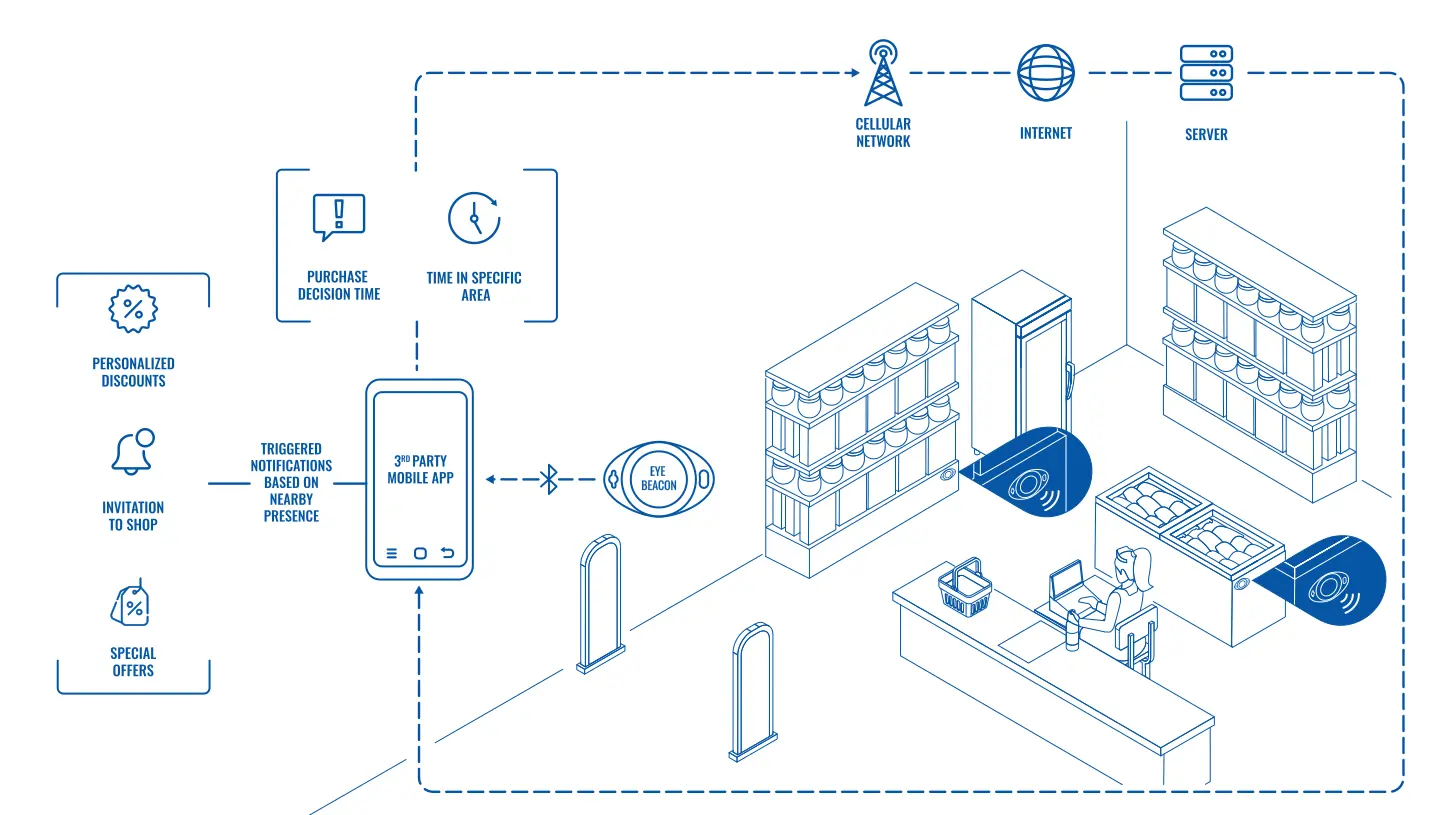
What you get
More purchases in the shop itself
The person gets the discount while standing at the shelf, not three days later in a mailing, by which time they have forgotten the product.
Advertising only to your own audience
The message is seen by someone already in the department, not by a passer-by at a billboard.
Data on behaviour on the shop floor
You can see how many people enter each department, how long they stay and how soon they reach the till.
Discounts for those in two minds
A personal offer goes to the shopper who was interested in a product but might have left without it.
Fitting in minutes and years without maintenance
The beacons need no wiring, fix to any surface, and the battery lasts up to 10 years.
A new line of business for integrators
A telematics company can take this solution into the retail market without changing equipment supplier.
Why this solution
A retail project needs beacons that are cheap, easy to install and undemanding for years. EYE Beacon is built for exactly that: a compact housing, several mounting options, the standard iBeacon and Eddystone protocols, which off-the-shelf SDKs for iOS and Android work with. The beacons can be ordered with your own branding so that they look like part of the shop's decor.
Teltonika has a broad range of devices — from vehicle trackers to sensors and beacons — and many years in IoT. For an integrator that means one supplier for vehicles, for the warehouse and for the shop floor alike.
What not to expect. A beacon does not pinpoint the shopper to the centimetre; it gives a zone, meaning close to this particular beacon. Metal shelving and a crowd of people damp the signal, so the power and the layout are chosen on site, walking the floor with a smartphone.
How this works in Azerbaijan. The scenario suits Baku shopping centres — Ganjlik Mall, 28 Mall, Park Bulvar, Deniz Mall — and large supermarket and electronics chains that have an app and a loyalty card of their own. A second option is car dealer and furniture showrooms, where the customer spends a long time walking round. EYE Beacon beacons are equally useful in telematics, by the way: GPS.az fits the same devices to containers, trailers and tools, and Teltonika trackers read them and pass the data to Wialon. For retail we supply the beacons and help with the layout and with setting up the identifiers, while the shop's own developer writes the mobile app. Before a bulk order we advise a pilot on a single department: 5–10 beacons, a month of operation and a comparison of sales against the neighbouring departments.
Related case studies
Related rollouts and equipment

Questions about the “In-store marketing with EYE Beacon beacons” scenario
Request a call
A specialist will call back and match a solution to your fleet and your task.