
Corporate car sharing without keys
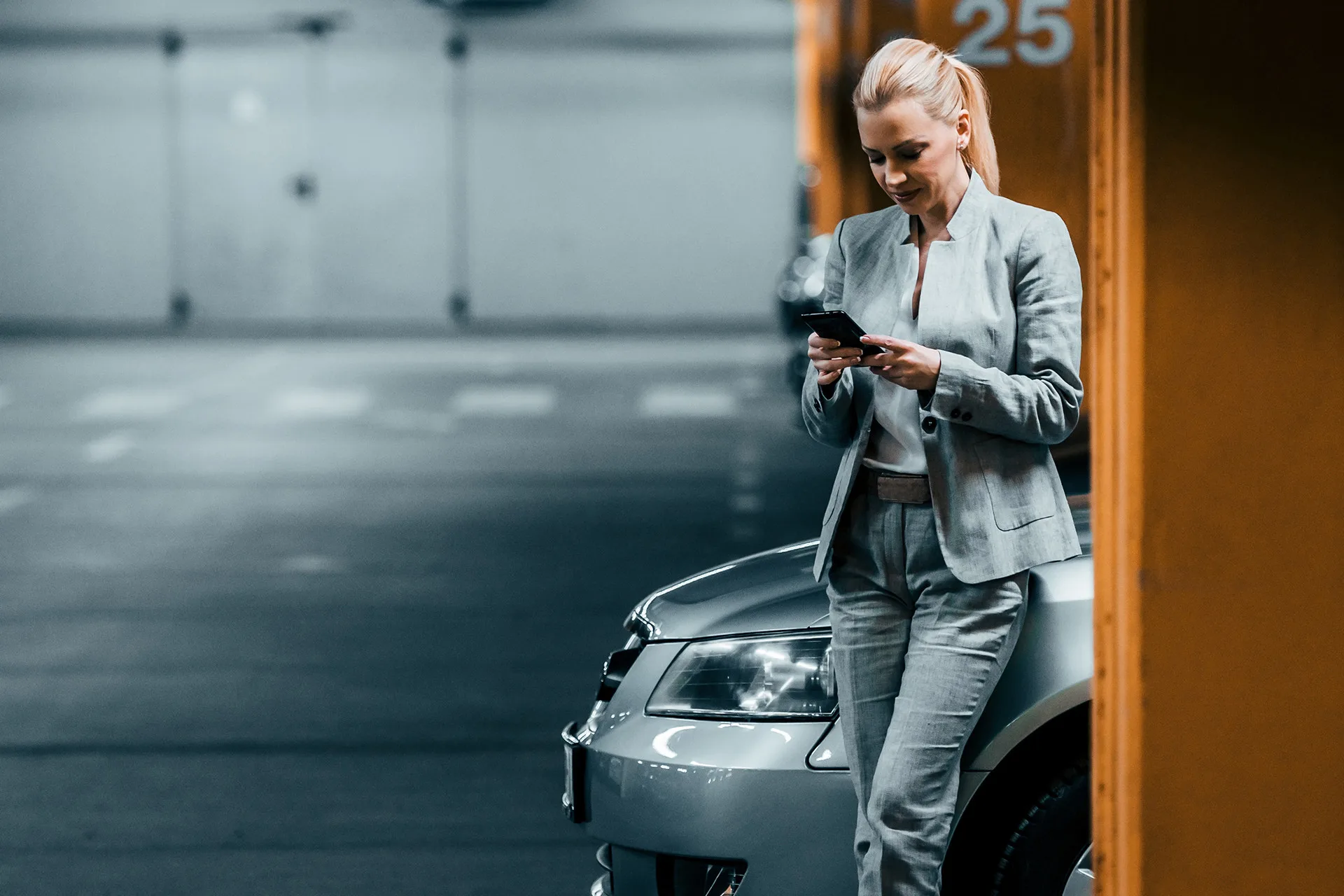
An employee unlocks a company car with a smartphone over Bluetooth: the Teltonika FMM130 tracker recognises the phone and, through a CAN-CONTROL adapter, releases the locks even in an underground car park with no mobile coverage.
An employee unlocks a company car with a smartphone over Bluetooth: the Teltonika FMM130 tracker recognises the phone and, through a CAN-CONTROL adapter, releases the locks even in an underground car park with no mobile coverage. Corporate car sharing means the company stops assigning vehicles to individuals and instead lets employees book from a shared pool through an app. The vehicles stand idle less, staff travel on business without paper requisitions, and sometimes use a car privately under the company's rules. The main technical snag is that office car parks are almost always in basements and enclosed courtyards where the mobile internet disappears. If the lock only opens through the cloud, the employee will stand beside the car with a phone waiting for a signal. In this case study Teltonika shows how to get round the problem with a Bluetooth key.
What this scenario solves
Car sharing is developing in many countries, and the corporate segment is growing along with it.
The advantages are clear: fewer vehicles for the same volume of journeys, less congestion and fewer emissions, and a fleet that is renewed more often.
For a company it is also a way of putting to work vehicles that used to stand outside the office for half the working day.
Most office car parks and vehicle collection points are in the basements of business centres or on enclosed sites.
Car sharing is developing in many countries, and the corporate segment is growing along with it.
The advantages are clear: fewer vehicles for the same volume of journeys, less congestion and fewer emissions, and a fleet that is renewed more often. For a company it is also a way of putting to work vehicles that used to stand outside the office for half the working day.
Car parks are the weak point. Most office car parks and vehicle collection points are in the basements of business centres or on enclosed sites. Concrete floors and walls deaden the cellular signal, and the tracker in the vehicle is often left without a connection.
For car sharing that is critical. If the unlock command goes from the app to the server and from there over the cellular network to the tracker, then with no coverage in the basement the car simply will not open. The employee has to go looking for a security guard or a dispatcher, and the whole point of keyless access is lost.
Outside town the problem is the same. In the mountains, at woodland holiday centres, at remote sites and warehouses, coverage can be weak or absent altogether. A vehicle that cannot be unlocked or locked means a journey that does not happen and a call to support.
Conventional keys are inconvenient too. They have to be handed over in person, kept in a safe with the facilities manager, signed out, and chased up when nobody has brought them back. Every handover takes time, and the record of who drove when is kept on paper or in a spreadsheet.
What Teltonika offers
The employee walks up to the vehicle, the app on the smartphone passes an encrypted command to the FMM130 tracker over Bluetooth, and the tracker opens the central locking through a CAN-CONTROL adapter. No internet is needed at that moment.
Installation and setup
Fitting the device and configuring it for the fleet scenario at hand.
Data transfer
The device collects data and sends it to the monitoring platform; how often depends on the model and its settings.
Analysis and control
The person in charge gets reports and alerts and looks into what stands out.
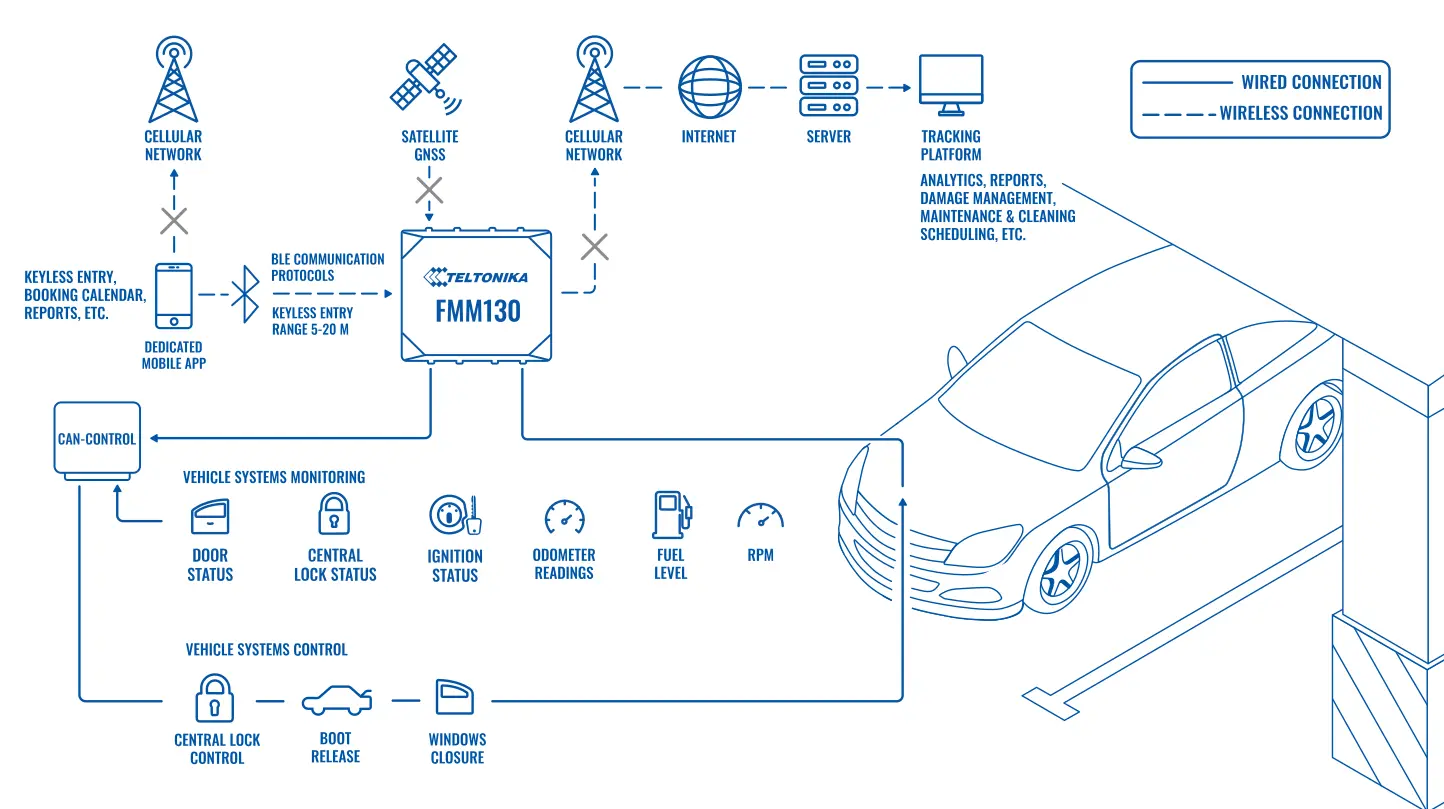
What is fitted in the vehicle. A Teltonika FMM130 tracker (or an FMC125 if additional interfaces are needed) is connected to the vehicle's electrical system. A CAN-CONTROL adapter is connected to the tracker, and it can issue commands to the vehicle over the CAN bus: unlock or lock the central locking, close the windows, flash the indicators, open the boot. The set of available commands depends on the model of vehicle and on what has been implemented in the app.
How the virtual key works. All Teltonika trackers support Bluetooth Low Energy 4.X and a dedicated data exchange protocol that is open to developers. The car sharing app uses it to talk to the tracker directly. The phone acts as a short-range transmitter: within roughly 5 to 20 metres of the vehicle it sends the tracker an encoded signal. The tracker checks that this is a phone with a valid booking and carries out the command. Someone else's smartphone will not open the vehicle.
What happens with no connectivity. Even if there is neither a cellular network nor Wi-Fi in the basement, the phone and the tracker come to an understanding between themselves over Bluetooth. The key and the access rights are loaded into the app in advance, at the time of booking, while the phone still had coverage. The tracker accumulates journey data in memory and sends it to the server as soon as the vehicle reaches the surface.
Booking. In the corporate app the employee sees the available vehicles on a map, their exact position and the route to the nearest one. A vehicle can be booked for the time required through a calendar, like a meeting room. The company sets the rules: who is entitled to which vehicles, whether a car may be taken at the weekend, whether there are limits.
Records and charging. Every unlocking and locking is recorded. An internal credit scheme can be built on that — one unlocking or locking action debits a credit, say, while private journeys are paid for separately. The tracker also reads data from the CAN bus: mileage, fuel level, instrument readings, fault codes. The fleet manager sees what condition the vehicle came back in and when it is due for servicing.
Key security. The digital key is issued for the duration of the booking and stops working once it ends. If an employee leaves or loses a phone, the administrator revokes access in the app, and there is no need to change locks or hunt for a missing set. Every action on the vehicle is recorded against a specific user, so the history can always be reconstructed.
What the fleet administrator sees. The utilisation of each vehicle by day and by hour, the most sought-after models, the vehicles that are hardly ever booked. This data helps decide how many vehicles the company really needs: it not infrequently turns out that the fleet can be cut by several units with no loss to staff.
One working episode. In the morning an employee books a saloon for two hours for a client meeting. He goes down to the second basement level of the business centre, where his phone has not a single bar of signal, holds the phone closer to the vehicle and unlocks it with one tap. He comes back, returns the vehicle to its place and locks it from the app. As soon as the vehicle sets off on its next journey, the server receives a full report: times, route, mileage and fuel consumption.
The conditions under which a command is carried out. Unlocking over Bluetooth goes through only if the phone has a valid booking and is close to the vehicle. It is sensible to permit commands for the locks and the immobiliser only with the ignition off or at zero speed: that is set in the app's logic and in the tracker's settings. Rights to send remote commands from the platform are granted to named administrators, and every command remains in the object's history.
What the system will not do. If a vehicle is stolen after all, the tracker will show where it is for as long as it has power and a connection. Getting the vehicle back is the job of the security service and the police; the tracker gives them the coordinates and the route.
What you get
The vehicle unlocks where there is no coverage
The Bluetooth key works directly between the phone and the tracker, so underground car parks and remote sites stop being a problem.
No keys passed from hand to hand
No need to keep keys in a safe, sign them out and work out who still has a set. Fewer contacts with other people's belongings is a plus too.
Vehicles work harder
A shared pool with online booking is utilised more densely than assigned vehicles that stand outside the office for half the day.
Vehicle condition without an inspection
CAN bus data shows mileage, fuel and fault codes, so the manager knows when a vehicle is due for servicing and what state it was returned in.
Every journey attached to its employee
Unlockings, lockings, route and times are tied to a specific person, and there are fewer disputes about who scratched the car.
A perk for staff
Being able to use a company car privately under the company's rules works as a benefit the employer could not otherwise offer.
Why this solution
Bluetooth Low Energy is present in every Teltonika tracker, and the exchange protocol over it is open to app developers. That means a company or a car sharing operator can build its own app and connect it to the tracker without closed intermediaries. For a corporate fleet with its own booking rules and its own internal systems, that matters.
The CAN-CONTROL adapter covers the other half of the job: controlling the factory locks and other vehicle functions over the CAN bus, without cutting into the lock wiring and without an extra relay for every function. The FMM130 is a compact tracker that hides away under the dashboard, while the FMC125 is chosen when something else has to be connected to the vehicle, a driver card reader for instance.
There are limitations. The list of commands available through CAN-CONTROL depends on the make and model of vehicle: on some cars, control of the windows or the boot over CAN is not supported. The app for staff is a separate development or an off-the-shelf product from one of the partners; the tracker does not replace it. And of course the Bluetooth key only works next to the vehicle — you cannot unlock it from a distance.
How this works in Azerbaijan. Most of the business centres in Baku — in the White City area, on Neftchilar Avenue and Heydar Aliyev Avenue, in the Nasimi and Yasamal districts — keep vehicles in underground car parks on two or three levels. There is not coverage everywhere down there, and that is exactly the scenario the Bluetooth key was invented for. Corporate car sharing makes sense for banks, for oilfield service companies on Absheron and for large retail chains, where a pool of company vehicles serves dozens of employees. For offices in Sumgait and Ganja the arrangement is the same. When fitting the system we first check which commands the CAN-CONTROL adapter supports on the specific models in the fleet, and only then do we promise features. SIM cards for the trackers are chosen from Azercell, Bakcell or Nar according to coverage in the places where the vehicles most often stand. GPS.az fits the FMM130 or FMC125 with CAN-CONTROL, configures them and brings the fleet data onto the Wialon platform, where journeys, mileage, fuel and the utilisation of each vehicle are visible, and the data can be handed to the car sharing app through an API.
Related case studies
Related rollouts and equipment

Questions about the “Corporate car sharing without keys” scenario
Request a call
A specialist will call back and match a solution to your fleet and your task.