
Guarding trailers in the yard: the FMB965
An owner of trailers out on hire or lease can see them in the yard even after they have been uncoupled from the tractor unit: the FMB965 tracker runs on its own battery for up to 30 days and raises an alert if a trailer is moved.
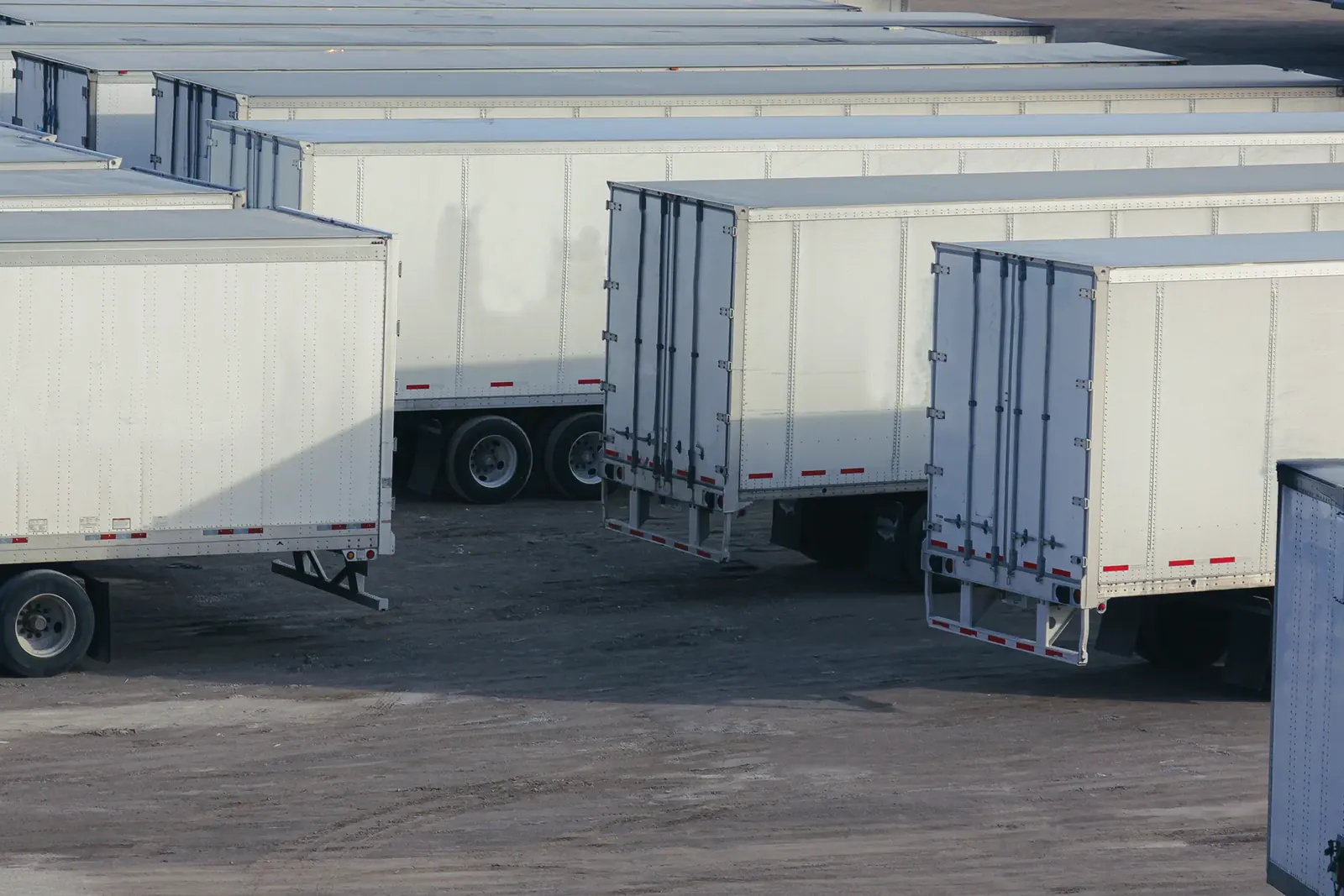
An owner of trailers out on hire or lease can see them in the yard even after they have been uncoupled from the tractor unit: the FMB965 tracker runs on its own battery for up to 30 days and raises an alert if a trailer is moved. A trailer spends most of its life without a tractor unit. It is left at a customer's warehouse, on a yard waiting for a run, in a port. At that moment an ordinary tracker loses power and falls silent, and the owner has no idea where their property is until the trailer is coupled up again. In the Teltonika scenario the FMB965 goes on the trailer, with a large internal battery and a special sleep mode. The trailer keeps reporting in while it stands, and if anyone tries to steal it the tracker wakes up and tells the owner.
What this scenario solves
A trailer is often left in an unguarded yard if it does not belong to the driver.
Once uncoupled, an ordinary tracker loses power and stops sending coordinates.
The trailer itself is frequently stolen along with the load, and the losses double.
The longer a trailer stands idle, the greater the chance it will be taken.
A trailer is often left in an unguarded yard if it does not belong to the driver. Once uncoupled, an ordinary tracker loses power and stops sending coordinates. The trailer itself is frequently stolen along with the load, and the losses double. The longer a trailer stands idle, the greater the chance it will be taken.
Meanwhile the hire market is growing. According to ReportLinker, hire and leasing of trailers is becoming an ever more attractive way of moving goods, and by 2027 this market should exceed 85 billion dollars. Demand is being fuelled by growth in logistics, e-commerce and retail.
The choice of hire over purchase is also influenced by emissions regulation, new vehicle safety requirements and disruption in the motor industry. Some companies opt for long-term hire or leasing of trailers: maintenance is the owner's responsibility, and renewing the fleet to meet new requirements is easier than it is with purchase. But trailer owners acquire a different headache: the security and accounting of property that is in other people's hands.
A hirer looks after somebody else's trailer less carefully than their own. A 2021 report on cargo theft notes that drivers more often leave a trailer in an unguarded yard if it does not belong to them. According to an assessment by Northbridge Insurance, in most cases thieves do not take only the load — the trailer goes with it. The most dangerous period is when a trailer stands unattended in a yard for a long stretch.
What Teltonika offers
The FMB965 goes straight onto the trailer: while it is coupled up the tracker draws power from the tractor unit, and once uncoupled it moves into a sleep mode drawing less than 1 mA, wakes every few hours, sends coordinates and rouses the owner immediately if it is moved.
Installation and setup
Fitting the device and configuring it for the fleet scenario at hand.
Data transfer
The device collects data and sends it to the monitoring platform; how often depends on the model and its settings.
Analysis and control
The person in charge gets reports and alerts and looks into what stands out.
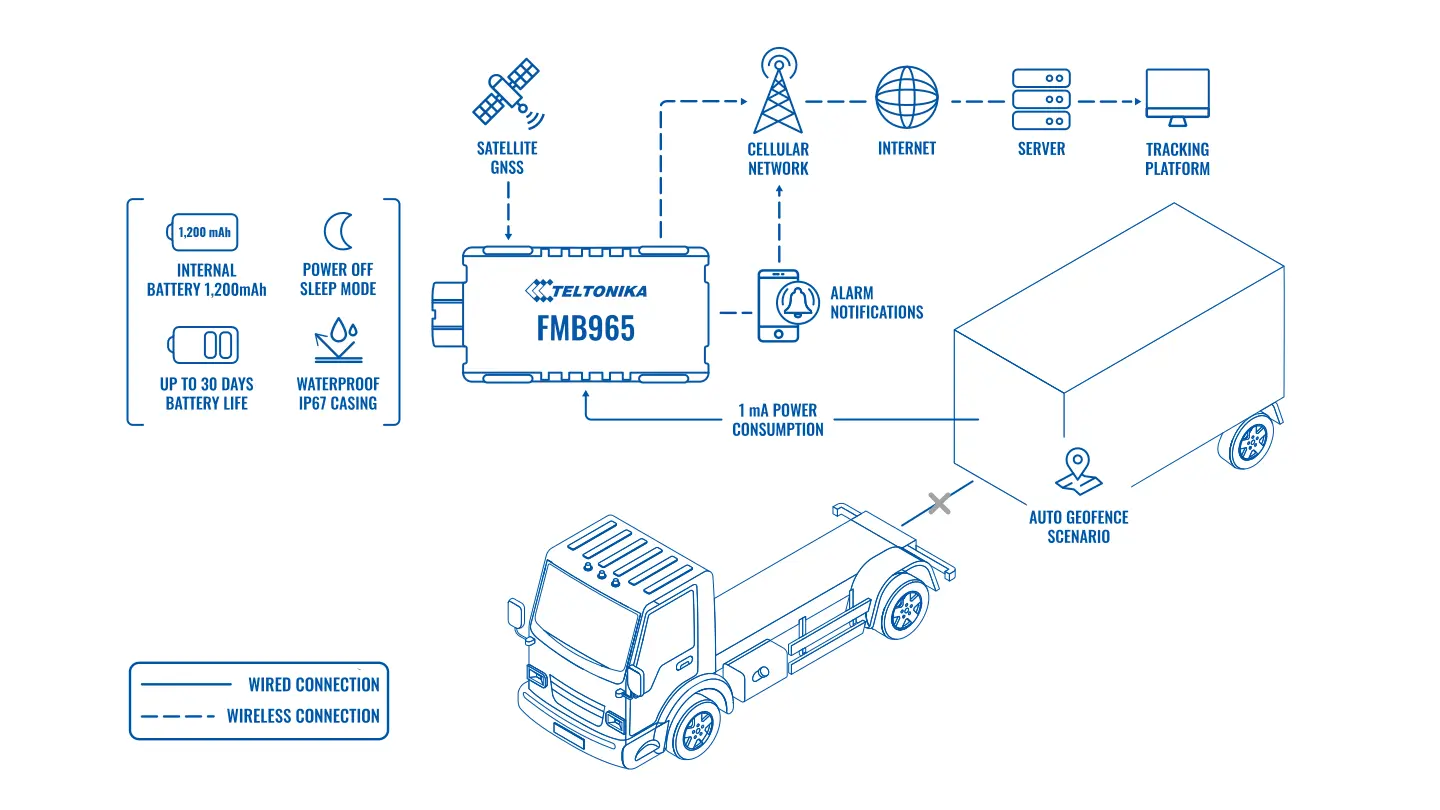
Why a special tracker is needed. A wired vehicle tracker is designed for constant external power; without it, it runs its backup battery down quickly and disappears. The FMB965 is built differently. It has a 1200 mAh internal battery and a Power Off sleep mode in which consumption falls below 1 mA. Together that gives up to 30 days of operation with no external power.
The housing. A trailer lives outdoors, so the tracker gets the rain, dust and road dirt too. The FMB965 housing is protected to IP67, and damp, corrosion and dust do not bother it.
Coupled up. While the trailer is hitched to a tractor unit the tracker draws power from its electrics and works as normal: it sends the track, the stops and events according to its settings. That data shows where the trailer has been and how long it stood.
In the yard. The tractor unit is uncoupled, external power is gone, and the FMB965 goes to sleep. By default it wakes every 4 hours — the interval is set in the configuration — and sends a record with its location. The owner knows at all times where the trailer is standing. If the tracker registers movement, ignition or the appearance of external power, it comes out of sleep and notifies the responsible person at once.
An automatic geofence. When the trailer stops, the tracker remembers the last point and builds a zone around it. While the trailer stays put, nothing happens. If it is taken outside the zone, the owner receives a notification instantly. This scenario works in the Power Off sleep mode as well.
After waking. All the other scenarios come into play. The tracker can recognise jamming of the GSM signal and reports it to the owner. Through a digital output you can connect a siren or an audible warning that will scare thieves off.
Keeping an eye on the hirer. The tracker shows where the driver has been leaving the trailer: on a guarded yard or on the verge. If a trailer regularly spends the night in a free unguarded yard, that is a raised risk, and the hire charge can be recalculated on the terms of the contract.
Doors and load. Door opening is monitored by EYE Sensor Bluetooth sensors. The dispatcher and the driver learn of every opening and can see if unloading is not going to plan. An important caveat: in ultra deep sleep and Power Off modes Bluetooth in the FMB965 does not work, so the doors are monitored only while the tracker is awake.
What this looks like in practice. A trailer is left at a customer's warehouse on Friday evening and the tractor unit goes off on another run. All weekend the tracker reports in at the same point every four hours. On Sunday night somebody else's tractor unit is hitched to the trailer: external power appears, movement begins, the tracker wakes and sends an alert. A minute later a second notification arrives: the trailer has left the automatic geofence. The owner sees the direction of travel, rings the police and passes on coordinates that update every few seconds.
Fitting. The tracker is fastened in a protected spot on the chassis or inside the trailer, connected to power from the tractor unit through the standard wiring, and the GPS and mobile reception are checked. It matters that the tracker cannot be seen from outside, otherwise a thief will start with it.
What you get
The trailer is visible without a tractor unit
A 1200 mAh battery and a sleep mode below 1 mA give up to 30 days of operation after uncoupling.
An alert at any attempt to steal it
Movement, ignition or power being connected wake the tracker, and the owner learns of it straight away.
The geofence sets itself
The tracker remembers where the trailer parked and reports if it is taken outside, even in sleep mode.
A jammer will not save the thief
Once awake the tracker detects GSM signal suppression and can switch on a siren through a digital output.
Hire priced on actual use
The history of stops shows how the hirer treats the trailer and helps calculate the charge fairly.
A housing for outdoors
The IP67 rating protects the tracker from rain, dirt and dust in an open yard.
Why this solution
The FMB965 brings together exactly what a trailer needs: weeks of independence, a protected housing, automatic geofences and security scenarios that work with no involvement from the driver. There is no need to fit a separate self-contained beacon alongside a wired tracker — one device covers both work on the road and security in the yard.
The FMB965 works in the same ecosystem as the rest of the Teltonika trackers: it is configured through the same configurator, and its data is accepted by the common monitoring platforms. Trailers can be followed in one window with the tractor units, showing at a glance which trailer is coupled to which vehicle.
What to bear in mind. The more often the tracker wakes in the yard, the faster the battery runs down. For a trailer that stands for several weeks the interval is best left infrequent, with movement alerts switched on. And the Bluetooth door sensors do not work during sleep; for guarding a load in the yard the geofence and the movement sensor are more dependable.
How this works in Azerbaijan. Trailers stand here for long stretches in a few typical places: in the port of Alat waiting for the ferry to Aktau and Turkmenbashi, at the border crossings at the Red Bridge and Yalama, and on the yards by the warehouses in Baku and Sumgait, where a trailer is left for loading. For Middle Corridor hauliers, whose trailer may wait a week for a load or a ferry, the independence of the FMB965 covers exactly that period. In summer on an open yard at +40 °C the housing heats up badly, so we choose a mounting place in the shade of the chassis, well away from the tractor unit's exhaust. Azercell, Bakcell and Nar coverage on the main yards and trunk roads is stable, and if a trailer stands somewhere with no network the tracker will send the stored data at the first opportunity. Trailers that go to Georgia, Turkey or Kazakhstan need a SIM card with roaming or a multi-operator SIM, which we settle at connection. GPS.az fits the FMB965 to trailers, connects the door sensors and sets up the parking geofences in Wialon along with movement notifications and a report on the places where the hirer left the trailer.
An agreed procedure for an alert. It is decided in advance who receives notifications of movement and of leaving a geofence at night and at weekends, who has the right to switch on the siren through the tracker output and who the coordinates are passed to. The siren is usually switched on for a confirmed alert rather than for any movement, so that a lawful change of tractor unit at a terminal does not turn into a panic. All the events stay in the unit's history and will come in useful in a discussion with the insurer. A tracker improves the chances of finding a trailer but does not guarantee its return; detention remains a matter for the police.
Related case studies
Related rollouts and equipment


Questions about the “Guarding trailers in the yard: the FMB965” scenario
Request a call
A specialist will call back and match a solution to your fleet and your task.