
A tracker for quad bike and motorcycle hire
A Teltonika solution for firms hiring out quad bikes, motorcycles, mopeds and jet skis: the waterproof FMB965 tracker with a battery that lasts up to 30 days, helmet monitoring and a panic button.
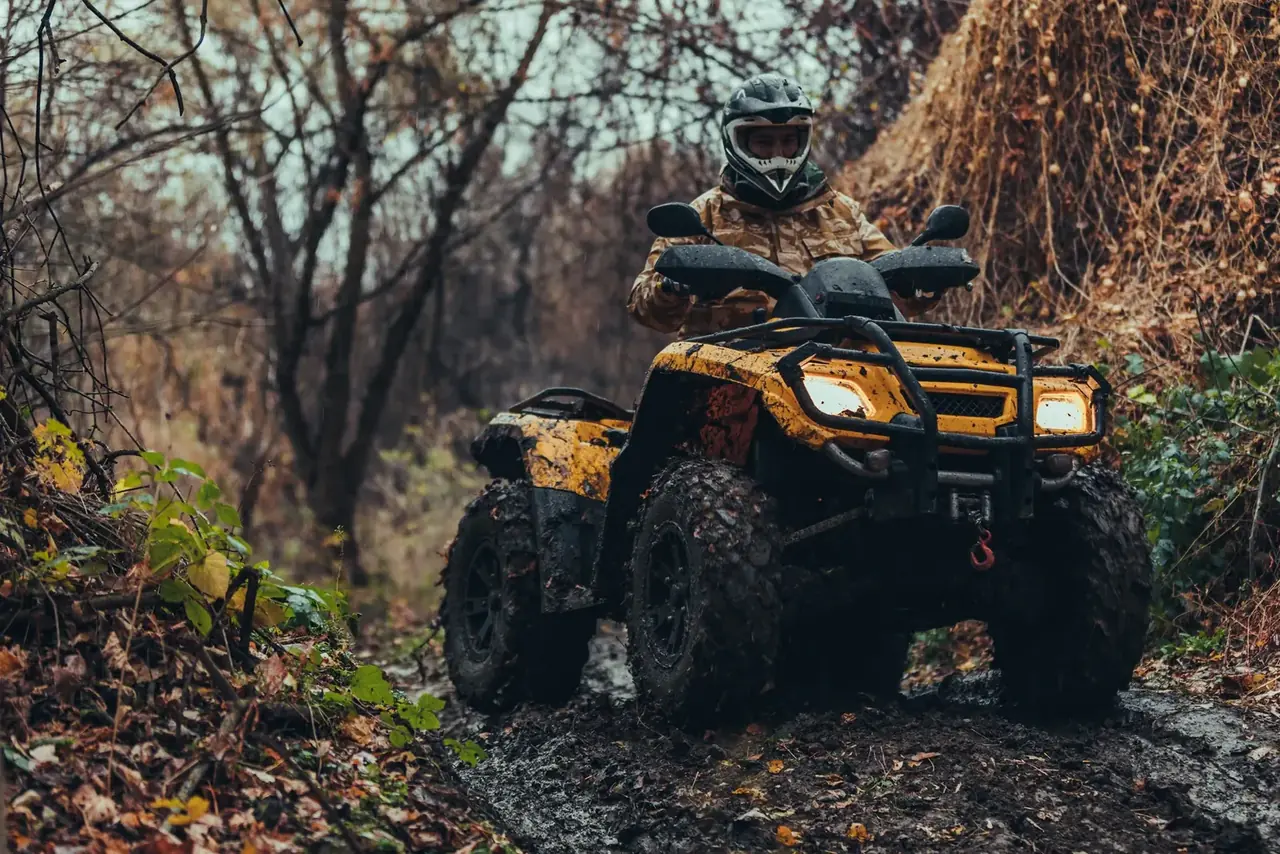
A Teltonika solution for firms hiring out quad bikes, motorcycles, mopeds and jet skis: the waterproof FMB965 tracker with a battery that lasts up to 30 days, helmet monitoring and a panic button. Leisure machines lead a life of their own. They stand for weeks, then go out at the weekend into mud, sand, water and rain, and behind the handlebars are people sitting on a quad bike for the first time in their lives. An ordinary vehicle tracker in those conditions either drowns, or flattens a small battery, or is simply not needed half the time. In this use case Teltonika shows how the FMB965, built on the popular FMB920, solves those problems, and what it gives the hire firm's owner in terms of customer safety.
What this scenario solves
Quad bikes, motorcycles and jet skis work in mud, sand and water, and an ordinary tracker does not last long there.
Hire machines stand still most of the time, and their small batteries are quickly flattened by any extra equipment.
Tourists' mopeds and motorcycles are constantly caught in the rain, and in the monsoon season in Asia and Latin America 75 to 90% of the annual rainfall comes down.
An inexperienced rider on a quad bike off-road has an accident easily, and has almost no protection.
Quad bikes, motorcycles and jet skis work in mud, sand and water, and an ordinary tracker does not last long there. Hire machines stand still most of the time, and their small batteries are quickly flattened by any extra equipment. Tourists' mopeds and motorcycles are constantly caught in the rain, and in the monsoon season in Asia and Latin America 75 to 90% of the annual rainfall comes down. An inexperienced rider on a quad bike off-road has an accident easily, and has almost no protection.
The fleet at firms like this is a mixed one: off-roaders, quad bikes, buggies, motorcycles, jet skis, snowmobiles. Exactly what is in use depends on the season and the region. Outings are mostly at weekends, and the weather cancels them readily. The upshot is that a machine goes out on a route once or twice a month and stands on the yard the rest of the time, and the tracker has to survive those weeks somehow without a charge.
There is also the cost of a mistake. A quad bike drowned in a river or smashed on rocks on a safari means a repair at the hire firm's expense and a machine off the road in season. And if the rider was a tourist without a helmet, the consequences can be far worse.
The figures for motorcycles are telling in this respect: on a 2019 estimate, the death rate among motorcyclists is almost 29 times higher than among car drivers. There is no cab, no belts and no airbags here, and the only real protection is a helmet and the rider's good sense.
What Teltonika offers
For hire machines Teltonika offers the FMB965 tracker: compact, in an IP67 housing, with a 1200 mAh battery, a deep sleep mode lasting up to 30 days and outputs for helmet monitoring and rider warnings.
Installation and setup
Fitting the device and configuring it for the fleet scenario at hand.
Data transfer
The device collects data and sends it to the monitoring platform; how often depends on the model and its settings.
Analysis and control
The person in charge gets reports and alerts and looks into what stands out.
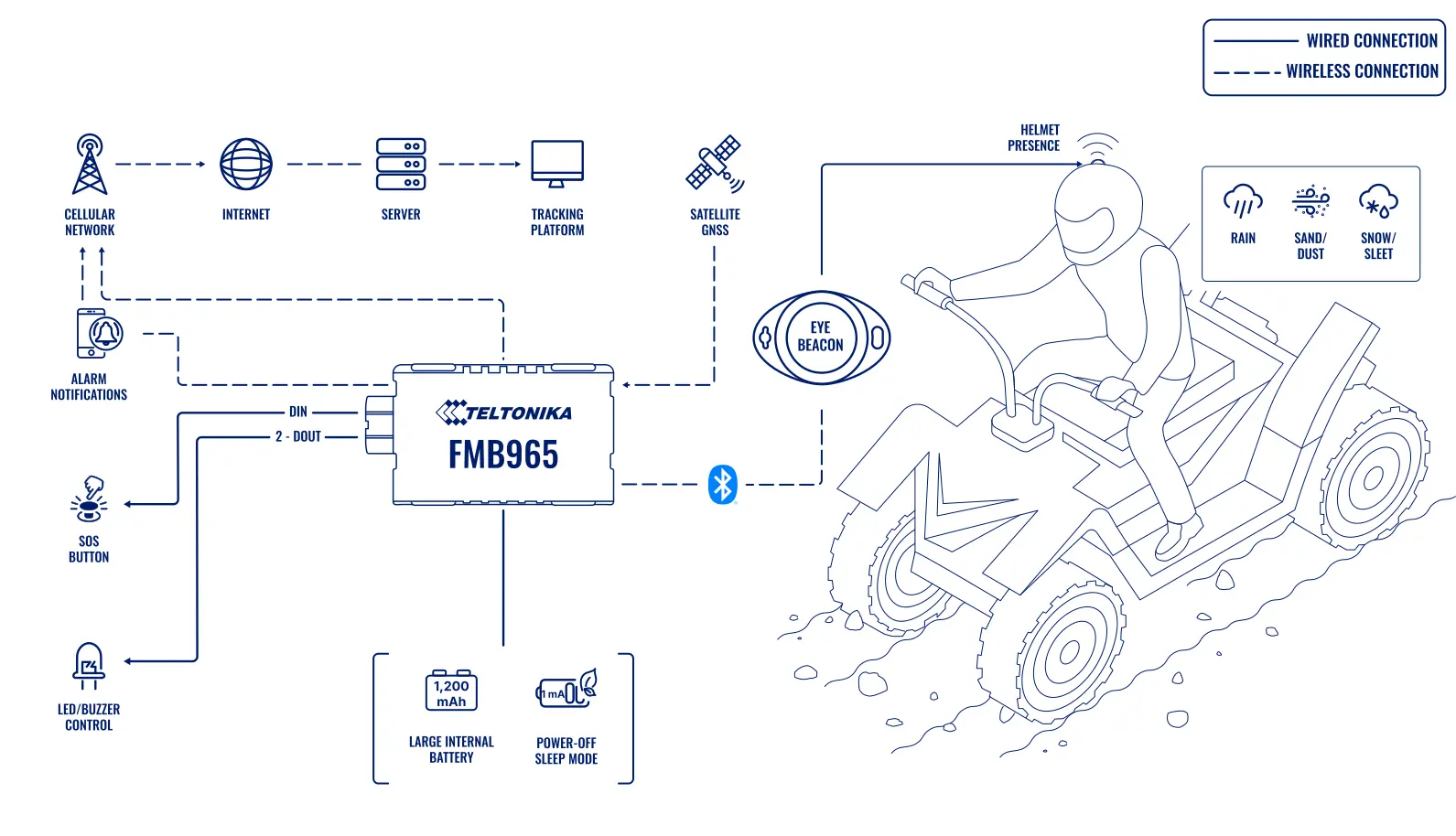
Housing and fitting. At 79 × 43 × 22 mm the FMB965 fits into almost any machine, and the recesses along its edges help to secure it firmly. The IP67 housing is untroubled by rain, spray, mud and dust, so the tracker goes onto jet skis as well as motorcycles, where it is exposed to everything. Instead of screws the housing closes on Clip-On catches. There are no metal parts, so there is nothing to rust, and fitting goes faster.
Battery and sleep. The main difference from the FMB920 is the 1200 mAh battery and the Power Off sleep mode. In that mode the tracker draws less than 1 mA and can last up to 30 days on one charge, coming online once every 4 hours. When the machine moves off, the tracker wakes and starts sending data in the normal way straight away.
For machines that stand for a long time and are not charged from an alternator, Teltonika advises connecting the tracker so that with the ignition off it disconnects from the on-board battery and runs from its own. The quad bike's small battery then does not go flat while it is idle.
The helmet. An EYE Beacon, fitted to the helmet, connects to the tracker. If the helmet is not nearby, the tracker can prevent the engine from starting, that is, it works as an immobiliser. For a hire firm that is direct protection against a tourist setting off with no helmet because it is only a short way.
Rider warnings. Two digital outputs are connected to an LED and a buzzer. The tracker flashes and beeps if the helmet needs to be put on, if a set speed has been exceeded or if the rider has left the permitted area. The rider learns of the breach at once rather than after returning to base.
The panic button. An SOS button can be fitted to the machine. When it is pressed the tracker sends an alert with coordinates, if there is a cellular connection; with no network the alert will go when the network appears, so in the mountains the instructor also needs a way of their own to reach the group. That is particularly valuable when a group has got lost on a route and the phones and satnavs are dead.
Maintenance. Firmware and settings on every tracker in the fleet are changed remotely through FOTA WEB. There is no need to gather the machines at base to change a speed threshold before a new season.
The FMB965 suits more than quad bikes and motorcycles. It goes onto snowmobiles, all-terrain vehicles, pleasure boats and jet skis, and trailers — anywhere that needs water protection and independence from the vehicle's power.
How it looks at a hire firm. A group of six quad bikes leaves base on a two-hour route. Every customer has a beacon on their helmet, and without it the machine will not start. Halfway round, one rider turns off the permitted trail towards the river — the tracker beeps, the LED flashes, and the instructor at base sees a notification that a geofence has been left. A week later, when the quad bikes are standing idle, the trackers sleep and report once every 4 hours that the machines are where they should be.
Another benefit is keeping account of the hire. The tracks show how far each machine actually travelled over the season, which quad bikes work harder than the rest and when they are due for servicing. If a customer brings a machine back with a wrecked suspension and insists they only rode on the road, the track shows where they really were. And if a moped leaves the yard at night without the engine being started, that is, it is being loaded into a van, the tracker wakes on movement and reports it. The owner gets a notification and sees where the machine is being taken.
The kit for one machine. An FMB965 wired into the on-board electrics through the ignition, an EYE Beacon on the helmet, a starter cut-off relay, an LED and a buzzer on the handlebars and, if wanted, an SOS button. On the platform: route geofences, speed rules, notifications to the instructor and a mileage report for the season.
Where the scenario applies and where it does not. It suits machines that have an on-board battery and room under the plastics for a tracker. Jet skis need a dry mounting position: IP67 protects against spray and brief immersion, not against working underwater all the time. The beacon-based starter cut-off is fitted only where the machine's starting circuit allows it, and is tested on every model.
An example of the result. After the season the hire firm's owner has a report on every machine: days in use, mileage, departures from the permitted areas, presses of the panic button and attempts to start without a beacon. From it you can see which machines are due for servicing and on which routes customers most often leave the trail.
The limits of what we do. GPS.az fits and configures the equipment, but the hire rules, briefing the customers and going out to help them remain the business owner's responsibility.
What you get
Untroubled by water and mud
An IP67 housing on catches, with no metal screws, stands up to rain, spray and the dust of the off-road.
Up to 30 days without a charge
A 1200 mAh battery and the Power Off mode let a machine stand for a month without flattening its own battery.
Starting only with the helmet nearby
An EYE Beacon on the helmet works as a key: the tracker sees the beacon near the machine, though it cannot check that the helmet is actually on the rider's head.
The rider hears the warning
An LED and a buzzer signal about the helmet, excess speed and leaving the area.
SOS with coordinates
The panic button sends the location of the incident at once, and help does not waste time searching.
One tracker for the whole mixed fleet
From mopeds to jet skis and snowmobiles, configured remotely through FOTA WEB.
Why this solution
The FMB965 is built on the FMB920, one of Teltonika's highest-volume trackers. That means the firmware and the operating logic have been proven on a huge fleet of devices, while the new housing and battery solve exactly the problems of hire machines.
Compactness settles a great deal. On a quad bike or a moped there is no room for a tracker the size of a cigarette packet with wires going in all directions. The FMB965 hides under the plastics and needs no complicated fitting.
Its independence from the vehicle's power has been thought through around the way such machines are really used: standing for weeks, then working hard. A sleep mode with waking on movement handles that with no manual intervention.
The safety features are built into the tracker itself: helmet monitoring, outputs for warnings, a panic button. The hire firm's owner does not have to assemble a system from different devices.
An honest limitation: 30 days of independent operation assumes coming online rarely, once every 4 hours. If you need frequent tracking while the machine is parked, or it stands for several months, the battery will have to be recharged, or permanent power from the vehicle battery left connected.
How this works in Azerbaijan. Quad bike and buggy hire operates in the mountain districts: Guba, Gusar, Gabala, Shahdag, Ismayilli — where tourists from Baku and from abroad come in summer. On Absheron and at Nabran jet skis and boats are hired out in summer, and in Baku hundreds of courier mopeds ride around the city. They all have the same concerns: not losing the machine, not letting anyone ride off without a helmet, finding a group if it gets lost in the forest. Points to bear in mind: in the mountains the connection drops, so the tracker's built-in buffer and the panic button matter; route geofences are best drawn generously, so that the tracker does not beep at every bend in the trail. In winter at Shahdag the tracker earns its place on snowmobiles, while on jet skis what matters most is secure mounting under the seat, well away from the water. GPS.az supplies the FMB965 and the FMB920, connects EYE Beacons, buzzers and panic buttons and sets up geofences, notifications and sleep modes on the Wialon platform.
Related case studies
Related rollouts and equipment
Questions about the “A tracker for quad bike and motorcycle hire” scenario
Request a call
A specialist will call back and match a solution to your fleet and your task.