
Basic GPS monitoring on the FMB920 tracker
The Teltonika FMB920 tracker is ready for basic vehicle monitoring out of the box: you only have to put in a SIM card and point it at a server, while geofences, towing detection, driving style and Bluetooth sensors are switched on in the settings as and when they are needed.
The Teltonika FMB920 tracker is ready for basic vehicle monitoring out of the box: you only have to put in a SIM card and point it at a server, while geofences, towing detection, driving style and Bluetooth sensors are switched on in the settings as and when they are needed. Coordinates on a map are no longer enough. A fleet owner wants to know where the vehicle stood, whether the tracker was disconnected, whether the driver was speeding, whether the vehicle was taken away on a recovery truck. And for the integrator who fits trackers for customers, what matters is how quickly a device can be brought into service and how it is managed afterwards. In this use case Teltonika sets out what basic monitoring on its trackers includes, and what tools the company rolling them out gets.
What this scenario solves
Choosing a tracker is not only about the hardware.
What matters is which features are built into the firmware, how the device is configured and updated, and whether there is documentation and support.
That determines what the integrator can offer the customer and how much effort maintenance will take.
Cheap trackers can often do nothing but transmit coordinates.
Choosing a tracker is not only about the hardware. What matters is which features are built into the firmware, how the device is configured and updated, and whether there is documentation and support. That determines what the integrator can offer the customer and how much effort maintenance will take.
Cheap trackers can often do nothing but transmit coordinates. There is no memory for when the connection drops, no remote firmware update, no events for loss of power. The moment the customer needs anything beyond a dot on the map, a tracker like that has to be replaced.
Time to commission matters too. If every tracker has to be configured by hand at length, rolling out across a fleet of a hundred vehicles stretches into weeks, and configuration mistakes only come to light once the vehicles are in service.
The fleet of trackers has to be managed somehow. Changing settings on fifty vehicles scattered across the regions, or updating firmware without gathering them in one place, is a task you cannot solve without remote tools.
And finally, the customer's needs change. Today all they want is the route; in six months it is temperature control in the load space or driver identification. It helps if the tracker can do that without being replaced.
What Teltonika offers
All Teltonika trackers are built on one firmware platform, so even the simple FMB920 has the same core of features as the professional models, and it is configured and updated remotely through the manufacturer's free tools.
Installation and setup
Fitting the device and configuring it for the fleet scenario at hand.
Data transfer
The device collects data and sends it to the monitoring platform; how often depends on the model and its settings.
Analysis and control
The person in charge gets reports and alerts and looks into what stands out.
Shared firmware. The core of features is the same for simple, advanced and professional trackers, and the platform keeps gaining new capabilities. For the integrator that means settings learned once work across the whole range, and new features arrive as an update.
Hardware. Teltonika trackers have a high-gain GNSS antenna for an accurate track and 128 MB of built-in memory. Out of coverage the tracker keeps writing points and sends them once the network comes back. The memory is also what makes firmware updates possible, something far from every simple tracker can do. A built-in backup battery lets it raise an alert if the tracker is cut off from power.
The FMB920 is the company's most popular model. Compact, inexpensive and capable. It leaves the factory with a configuration for ordinary tracking: the customer only has to put in a SIM card and enter the server address, and the tracker starts working.
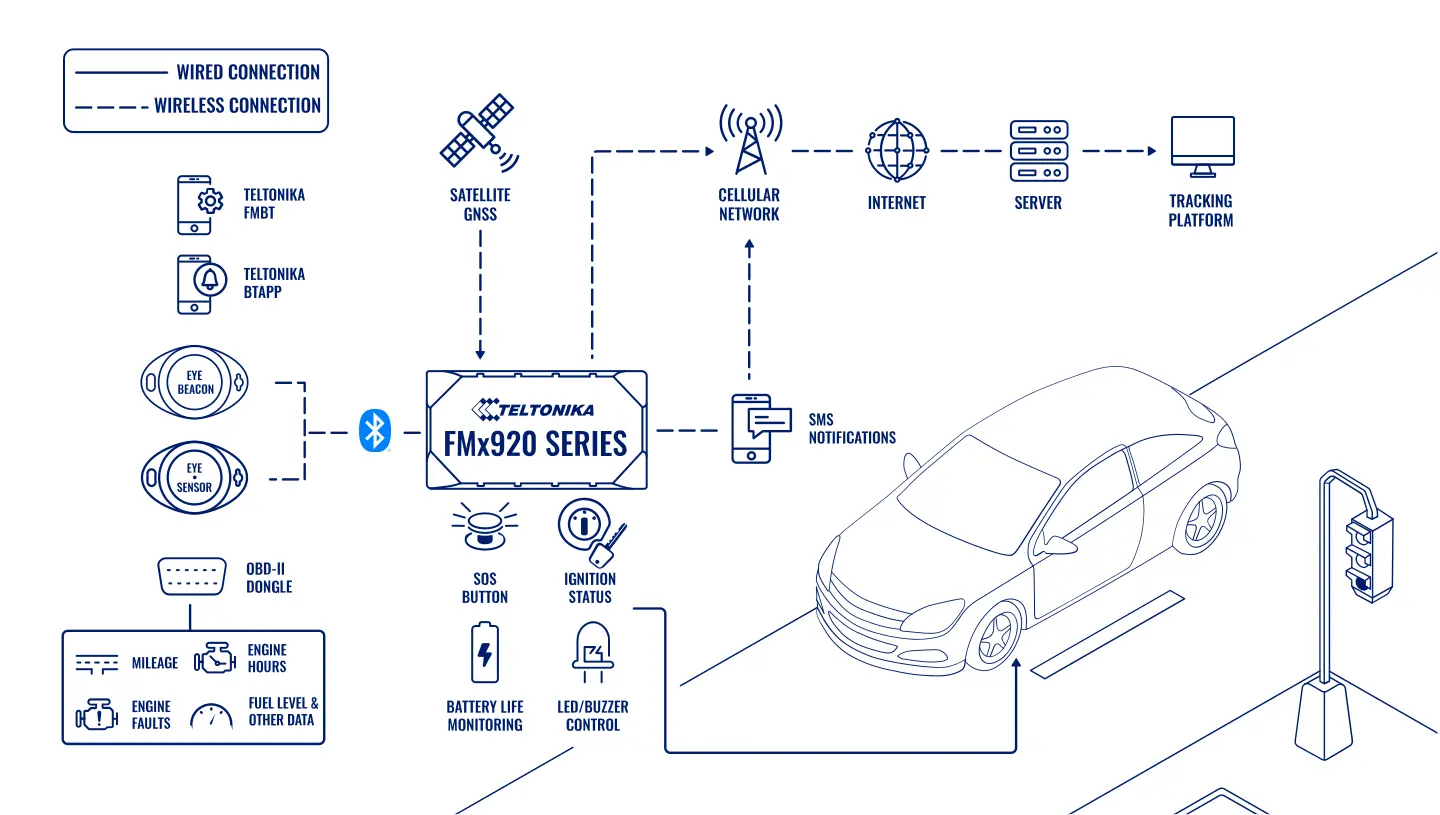
Basic features. Sleep modes to save power, detection of disconnection from the network, different data collection modes — depending on the ignition, on movement and even on which operator the tracker is connected to, on the home network or roaming, for instance. The tracker determines the ignition state in different ways depending on how it has been fitted.
Advanced features. An automatic geofence around the parking spot, towing detection, driving style monitoring (green driving), crash detection, a virtual odometer, notifications over GPRS and SMS. Each is switched on in the configurator or through FOTA WEB when the customer needs it.
Bluetooth widens what is possible. Through a Bluetooth OBD-II adapter the tracker picks up vehicle data: mileage, engine hours, engine fault codes, fuel level. In extended mode EYE Beacon beacons and EYE Sensor sensors connect to it, measuring temperature, humidity and movement. The beacons work as an immobiliser, for identifying drivers and passengers, or for keeping track of cargo in transit, including indoors. The tracker can be configured over Bluetooth as well, from a smartphone.
Tools for the integrator. For working with the Teltonika protocol there is a packet analyser and sample source code for a communication server. The Teltonika Configurator lets you set up, update and check a device. The FOTA WEB platform, access to which is free, manages the whole fleet of trackers remotely: it changes settings and updates firmware. The Bluetooth protocols are open, and you can build your own mobile app on top of them. All the documentation on features and settings is gathered in the Teltonika Wiki.
How it looks in practice. A small company with a dozen vans first fits the FMB920 purely for routes and stops. A couple of months later the owner notices that one vehicle is being moved off the parking area at night. Remotely, through FOTA WEB, the integrator switches on the automatic geofence and towing detection on every tracker — with no visit to the vehicles. Six months after that one van starts carrying cargo that needs a temperature record, and an EYE Sensor is paired with the same tracker over Bluetooth.
What you get
Commissioning in minutes
The FMB920 arrives with a monitoring configuration ready to go; all it takes is a SIM card and the server address.
A track with no holes
128 MB of memory stores the points while there is no connection, and the tracker sends them when the network returns.
Interference does not pass unnoticed
The backup battery makes it possible to report a loss of power, while towing and leaving the automatic geofence create events.
The whole fleet of trackers is managed remotely
FOTA WEB and the Configurator change settings and firmware without visiting the vehicles.
Growth without changing the device
Bluetooth sensors, an OBD adapter and beacons add temperature, vehicle data and identification to a tracker that is already fitted.
Lower maintenance costs
Monitoring driving style, mileage and engine fault codes helps to plan servicing and cut unplanned downtime.
Why this solution
Teltonika's strength is that even an inexpensive tracker gets the same firmware and the same tools as the professional models. The integrator does not hit a ceiling after six months of work: the feature that is needed can be switched on remotely, and sensors can be connected over Bluetooth.
The tools are available straight away and free of charge: FOTA WEB, the Configurator, the packet analyser, sample server code, the Wiki and the technical support forum. Support works not only from the head office but from the company's regional offices too. The devices are manufactured in Europe.
There are limitations as well. The FMB920 works on the 2G network, and where operators are shutting 2G down it is better to choose models with LTE. The tracker has few inputs and outputs, so a fuel level sensor, a tachograph or several wired sensors call for a higher model. The internal backup battery is meant for short operation and an alert, not for long spells of independent tracking.
How this works in Azerbaijan. The FMB920 is the most frequent choice for small fleets in Baku and the regions: taxis, delivery services, sales representatives, private cars that owners want to see on a map. The 2G network of Azercell, Bakcell and Nar covers the whole country, so the tracker holds a connection confidently both in towns and on the M-1, M-2 and M-3 roads. In the mountain districts beyond Guba, Gusar and Sheki the signal drops in places, and here the tracker's memory saves the day: the track does not break up but is uploaded later, when the vehicle comes back into coverage. In summer a vehicle standing in the sun gets very hot, so we fit the tracker away from the dashboard, in a hidden place out of direct sunlight. GPS.az, Teltonika's GOLD partner in Azerbaijan, fits the FMB920, sets up geofences, towing detection and notifications and connects the trackers to the Wialon platform, which the customer reaches through go.gps.az or the mobile app. The equipment warranty is 1 year.
Related case studies
Related rollouts and equipment

Questions about the “Basic GPS monitoring on the FMB920 tracker” scenario
Request a call
A specialist will call back and match a solution to your fleet and your task.