
Theft protection and finding a stolen vehicle
Compact Teltonika FMx920 trackers spot a jammer, a disconnected power supply and a vehicle being towed away, respond by immobilising the starter and locking the doors, and the self-powered FMC234 transmits the coordinates of a stolen vehicle for up to 8 days.
Compact Teltonika FMx920 trackers spot a jammer, a disconnected power supply and a vehicle being towed away, respond by immobilising the starter and locking the doors, and the self-powered FMC234 transmits the coordinates of a stolen vehicle for up to 8 days. Today's thief arrives prepared. He knows where a tracker is usually hidden, carries a cellular and GPS jammer with him, and can quietly get round a factory alarm. He has one aim: to drive away quickly before anyone notices. In this case study Teltonika shows how the set of functions in its trackers turns every minute of a theft into a risk for the thief, and helps find the vehicle if it is taken after all.
What this scenario solves
Vehicle theft remains one of the commonest crimes against property.
In the United Kingdom, according to figures from an association of driving instructors, an average of 159 vehicles are stolen every day.
The police manage to recover fewer than half of them.
Experienced thieves work as a team and are done within seconds.
Vehicle theft remains one of the commonest crimes against property. In the United Kingdom, according to figures from an association of driving instructors, an average of 159 vehicles are stolen every day. The police manage to recover fewer than half of them.
Experienced thieves work as a team and are done within seconds. For them it is a low-risk living, especially where a vehicle is protected by nothing but its factory alarm.
A thief chooses what is easy to take. What matters to him is speed and silence. A vehicle that holds him up even for a couple of minutes becomes a poor target.
An ordinary tracker is easy to fool. A jammer suppresses the GSM or GNSS signal and the tracker stops sending data to the server. If the tracker is found, it is simply pulled out. The vehicle is loaded onto a recovery truck, and on paper it never started and never went anywhere.
After a theft the chances shrink with every hour. The vehicle is moved to a garage, broken up or given new plates. If the owner only learns it is missing in the morning, finding it is already all but impossible.
What Teltonika offers
The tracker in the vehicle recognises the thief's typical methods — jamming, disconnection, towing away — and responds at once: it sets off an additional alarm, immobilises the starter, locks the doors and tells the owner. And a back-up or self-powered tracker keeps following the vehicle even if the main one has been disabled.
Installation and setup
Fitting the device and configuring it for the fleet scenario at hand.
Data transfer
The device collects data and sends it to the monitoring platform; how often depends on the model and its settings.
Analysis and control
The person in charge gets reports and alerts and looks into what stands out.

The main device. For this job Teltonika offers trackers from the FMx920 series, the FMB920 for instance. They are small and easy to hide in the cabin or under the dashboard, and yet they have all the protective functions you need. Another compact option from the range is the FMB020.
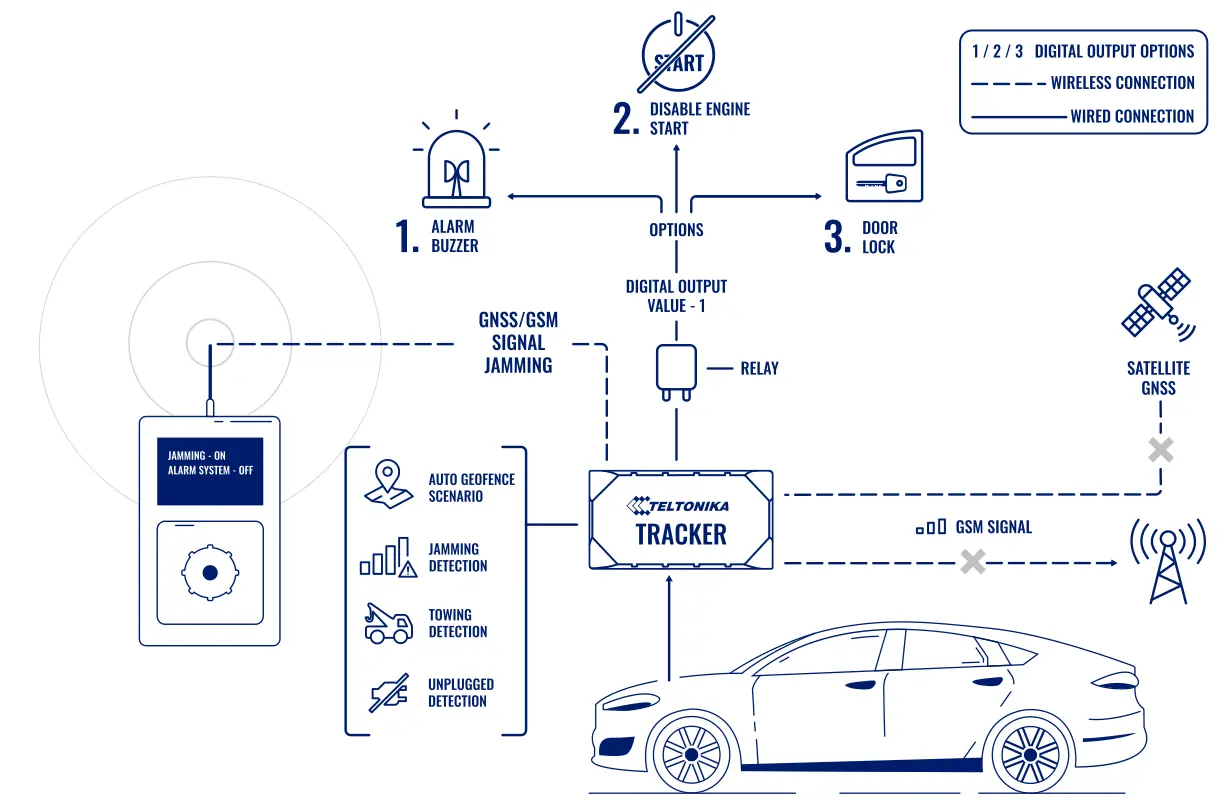
What happens during jamming. The FMx920 can determine that the cellular or GNSS signal is being suppressed. One or several responses can be configured for that event.
An additional siren. A professional thief knows how to switch off a factory alarm, but he does not know about an additional siren connected to the tracker. A loud noise at an unexpected moment often makes him abandon the vehicle.
Starter immobilisation. Through a relay, the tracker prevents the engine from starting. The thief may get into the vehicle but will not be able to drive it away, and the time he spends looking for the cause works against him.
Central locking. The tracker locks all the doors. To get into the cabin he will have to break a lock or a window, and that means noise and extra minutes.
Towing away. The tow detection function creates an event if a stationary vehicle with the ignition off starts moving or is lifted. The owner gets a notification at the moment the vehicle is loaded onto a recovery truck, not when he finds an empty space in the morning.
Disconnecting the tracker. If the tracker is disconnected from the power supply, or reconnected, it generates an event. The owner learns about the interference immediately, even if the thief is sure he has disabled the system.
An automatic geofence. After the vehicle stops and the ignition is switched off, the tracker automatically creates a zone around the last parking place. If the vehicle leaves that zone, an alert arrives. You can choose which event matters: entering the zone, leaving it, or both.
Two trackers on one vehicle. For serious protection a second, back-up tracker is fitted. Thanks to the size of the FMx920 it can be hidden somewhere a thief will not look. If the main tracker is found and disabled, the second one carries on transmitting coordinates.
A self-powered tracker for recovery. The FMC234 runs from a built-in 1000 mAh battery and transmits its position for up to 8 days with no external power. It meets the requirements of the Pulse, Thatcham and Supply Chain Management certifications used in Northern Europe. Those standards require a tracker to work for at least 6 hours on the battery while reporting once a minute, to have an IP67 housing and to support a stolen vehicle recovery function.
What a theft looks like with this protection in place. At night outside the house the signal is jammed so that the thief can approach the vehicle. The tracker records the suppression, immobilises the starter and locks the doors. The thief forces a door but the vehicle will not start, and an additional siren begins to howl under the dashboard. He decides to call a recovery truck and take the vehicle that way. The tracker sends a tow event as soon as the vehicle is lifted, and the self-powered FMC234 in the boot carries on transmitting coordinates while the vehicle is being taken away. The owner and the police have a route and an exact location.
How to configure the responses without excess alerts. Jamming does not only come from thieves: signal suppressors operate near certain sites, and in underground car parks the signal disappears of its own accord. So the responses are graded by seriousness. A first jamming event means only a notification to the owner. Jamming together with a door opening while the ignition is off means starter immobilisation and the siren. Movement with no ignition means an alert and frequent position reporting. That logic protects the vehicle without waking the owner every time the network drops out.
Who can send commands. Rights to send remote commands (immobilise, cancel immobilisation, report positions frequently) are granted to named platform users, and the commands sent are visible in the object's history. That way it is clear who immobilised the vehicle and when.
What the owner does when an alert arrives. The notification reaches the phone together with the location and the type of event. He can open the map, see where the vehicle is and, if necessary, confirm immobilisation remotely. If the vehicle is already moving, position reporting becomes more frequent, and the route can be passed to the police or to a security service in real time.
What you get
A theft takes longer
Starter immobilisation, locked doors and an additional siren make the vehicle an awkward target, and the thief more often goes off to look for another.
A jammer is visible
The tracker recognises suppression of the GSM or GNSS signal and reacts to it, rather than simply losing the connection in silence.
The owner finds out at once
Notifications about the tracker being disconnected, the vehicle being towed and it leaving the automatic geofence arrive at the moment of the event.
Something is still following the vehicle after a theft
A second hidden tracker or the self-powered FMC234 carries on transmitting coordinates even if the main one has been found and disabled.
Up to 8 days without external power
The FMC234's battery buys time to find the vehicle even after it has been cut off from power and hidden.
Why this solution
Theft protection is not one function but a set of responses to the various methods a thief uses. In Teltonika trackers they are gathered in a single device: jamming detection, tow detection, a disconnection event, an automatic geofence, relay control for the starter and the central locking. All of it is configured for the particular vehicle and scenario without separate units.
The range makes it possible to build protection in several layers. A compact FMB920 or FMB020 covers the main job, a second identical tracker becomes a hidden reserve, and the FMC234, with its own battery and certification to the strict standards of Northern Europe, is responsible for recovery after a theft.
The limitations are worth stating. A tracker does not make a vehicle theft-proof: it slows the thief down and helps find the vehicle. Engine immobilisation is properly configured so that it can only take effect when the vehicle is stationary; otherwise you could create a dangerous situation on the road. And a great deal depends on the fitting: a tracker put in an obvious place will be found in a minute.
How this works in Azerbaijan. We hear most questions about theft protection from the owners of expensive four-by-fours and crossovers in Baku and on Absheron, and from companies whose vehicles spend the night in courtyards and open car parks. Commercial fleets care about something else: learning quickly that a vehicle is being moved without a driver, and preventing it from starting. When fitting, we hide the main tracker and, if the customer wants, put a second, back-up unit somewhere else in the bodywork, and we never leave them in the standard places thieves check first. For the self-powered FMC234 we choose a place where it picks up satellites and the cellular network better. SIM cards are chosen from Azercell, Bakcell or Nar. GPS.az, Teltonika's GOLD partner in Azerbaijan, installs the trackers with starter immobilisation, configures the jamming, towing and disconnection events and brings everything onto the Wialon platform, from which notifications reach the owner's phone through the app and Telegram, and the vehicle's route after a theft can be passed to the police.
Related case studies
Related rollouts and equipment


Questions about the “Theft protection and finding a stolen vehicle” scenario
Request a call
A specialist will call back and match a solution to your fleet and your task.