
Barrier from a smartphone: the FMB920 and blockchain
Teltonika has shown how an FMB920 tracker wired into a barrier, together with blockchain keys held in a smartphone, lets ambulance crews, fire brigades and utility teams open an entrance with no security guard and no remote control.
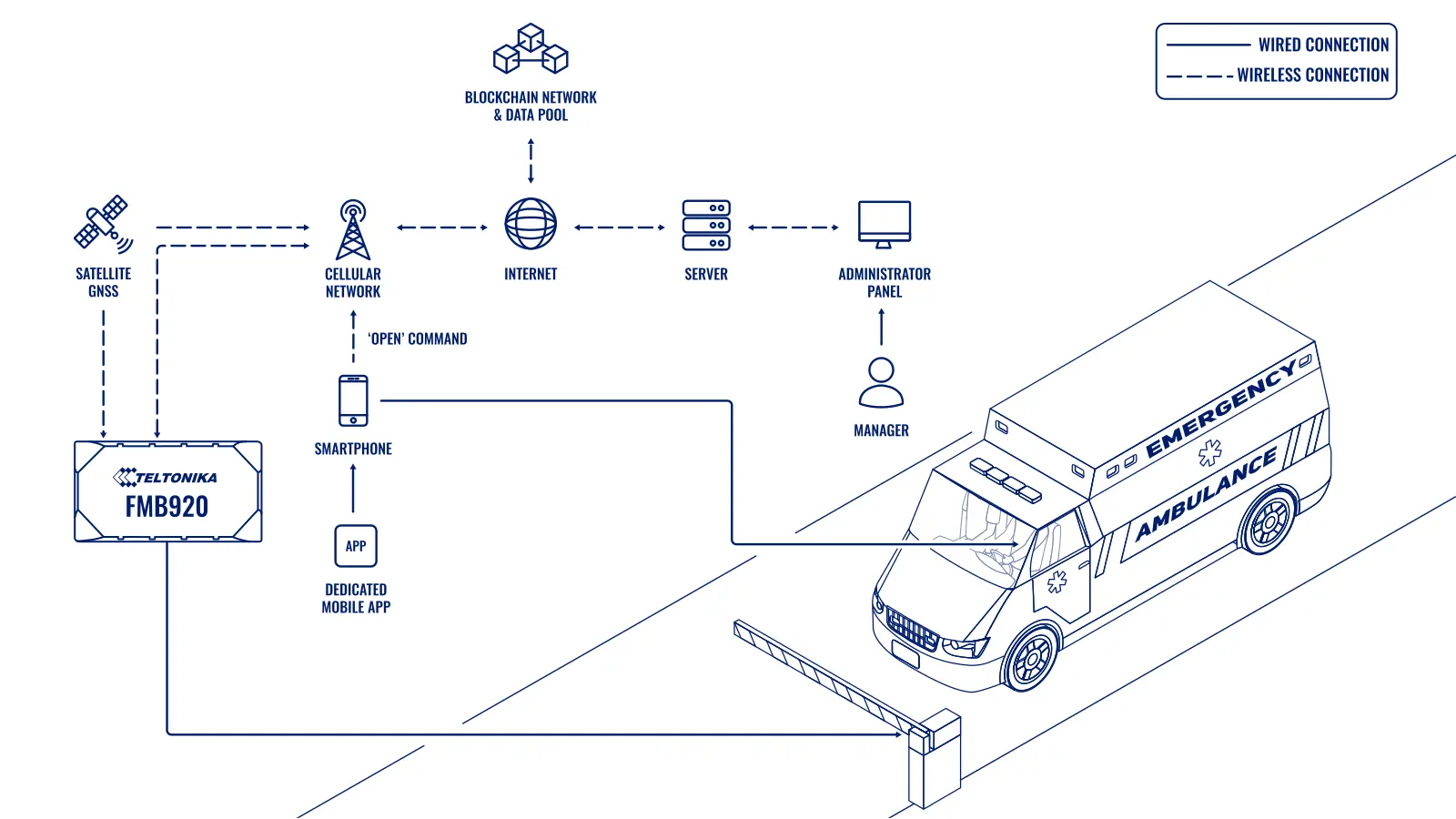
Teltonika has shown how an FMB920 tracker wired into a barrier, together with blockchain keys held in a smartphone, lets ambulance crews, fire brigades and utility teams open an entrance with no security guard and no remote control. The idea is simple. The tracker goes not into a vehicle but into the control unit of a gate or a barrier. It receives the command to open over the cellular network, and the right to give that command is confirmed by a virtual key recorded in a blockchain. The driver pulls up, picks the barrier from a map in the app, and it lifts. This is a Teltonika demonstration scenario with special firmware, not an off-the-shelf product. But the arrangement itself is a good illustration that an ordinary vehicle tracker can act as a remote relay for any actuator.
What this scenario solves
An ambulance loses minutes at a closed barrier in the courtyard of a residential development.
Keys, fobs and remote controls get lost, copied and passed to outsiders.
The guard at the entrance can step away, fall asleep or not answer the phone.
Nobody really knows who opened the gate, or when, in reality.
An ambulance loses minutes at a closed barrier in the courtyard of a residential development.
Keys, fobs and remote controls get lost, copied and passed to outsiders.
The guard at the entrance can step away, fall asleep or not answer the phone.
Nobody really knows who opened the gate, or when, in reality.
In the city it is not only traffic that holds up emergency and utility vehicles. The courtyards of new developments and the grounds of schools, hospitals and office centres are closed off with barriers, gates and pedestrian gates with intercoms. For residents that means order and security; for a crew on its way to a call it is one more obstacle.
Today access past such a barrier is usually sorted out by hand. A phone call to the security post, a hunt for the building's senior resident, a shared remote in the glovebox of the emergency vehicle, a key hanging on a nail in the control room. Every one of those methods breaks down at the least convenient moment: security does not pick up, the remote is dead, the key went off with the other shift.
There is a second side to it too. A physical key or fob is easy to copy. A dismissed employee can keep the remote. The entry log, if one is kept at all, is written by hand and after the fact. When residents or the management company ask who opened the gate at three in the morning, there is usually nothing to answer with.
In an emergency the cost of delay is not measured in money. A fire crew that waits five minutes while somebody finds the gate key arrives at an altogether different fire.
What Teltonika offers
The barrier gets a tracker of its own, and the driver gets a digital key in their phone: the command to open passes through a blockchain network, and only someone holding a valid key can raise the barrier.
Installation and setup
Fitting the device and configuring it for the fleet scenario at hand.
Data transfer
The device collects data and sends it to the monitoring platform; how often depends on the model and its settings.
Analysis and control
The person in charge gets reports and alerts and looks into what stands out.
For the demonstration Teltonika used the FMB920 from the BASIC range. It is a compact tracker with built-in GNSS and GSM antennas, normally fitted to cars. Here it is wired to the control unit of a gate or a barrier through a digital output: the tracker closes the circuit and the drive raises the arm. There is a SIM card in the tracker, so it can be reached anywhere the mobile network works.
The FMB920 knows its own coordinates. So each barrier appears on the map in the app as a separate point, and the user can see exactly which entrance they are opening.
The second layer is the blockchain. Verified users are issued with virtual keys in the form of NFTs, that is, tokens that cannot be forged or duplicated. A key can be permanent, for example for the district emergency service crew, or single-use: for a guest, a courier, a tradesman called out to a job. Every use of a key leaves a record in the network, and that record cannot be altered after the fact.
The third layer is the mobile app. An ambulance driver approaches the development, opens the map on the phone and taps the barrier they need. The app sends a transaction to the blockchain network, the network verifies the key and passes the command to the FMB920. The tracker fires, the arm lifts. The vehicle drives through almost without stopping, and neither the guard nor the remote is needed anywhere in that chain.
For the management company the picture looks different. It issues and revokes keys, sees the opening history for every entrance and can restrict access by time of day. If an employee leaves, their key is simply cancelled, and there is nothing to collect back from them.
What a call looks like in practice. At night the ambulance dispatcher gives the crew an address inside a gated development. While the vehicle is on its way, the crew leader can already see two entrances to that courtyard in the app and picks the one nearer the right stairwell. A hundred metres out he presses the button, the command goes to the network, verifying the key takes seconds, and by the time the vehicle pulls up the arm is already raised. There is no need to call security, and no need to wake the residents' committee chair either. In the morning the management company sees the log entry: entrance no. 2, 03:14, ambulance station key, one passage.
Planned visits work on the same logic. A water utility crew is issued keys to every entrance in the district where mains repairs are going on today, and the keys stop working in the evening. A refuse lorry opens the service gate on a schedule, and its key is inactive at all other times. Access rights are changed in one place, rather than by handing remotes out to vehicles.
What is needed at the barrier end. Besides the tracker, that means steady power from the drive's supply, relay isolation if the drive is switched at a voltage higher than the digital output can carry, and a decent signal level. The tracker goes into the control cabinet or inside the post housing; the FMB920's antennas are internal, so a metal cabinet can degrade reception, and that is checked before fitting. The tracker's built-in battery helps it ride out a short power cut and send an event about the loss of supply, but the drive itself will not raise the arm without electricity.
Is blockchain actually needed here. It is justified when the entrances are used by several independent organisations and none of them wants to trust another with the log: a record in the network cannot be quietly corrected, and a key cannot be copied. If one management company issues the keys, the same job — rights per user and a log of openings — is done by an ordinary server or by a monitoring platform with access levels.
The authorisation scheme. Before go-live it is decided who issues keys, how a user is checked before one is issued, how long a key stays valid and who can revoke it. Permanent keys for emergency services and single-use guest keys are better issued through different people.
If something fails. No connection, no power, the app will not open — the entrance still has to be openable by hand: mechanical release of the drive, a key with a responsible person, a duty officer's phone number. That procedure is written into the site rules, because the tracker does not replace it.
The limits are worth understanding. The arrangement depends on mobile coverage at the barrier and on the driver's phone: in an underground car park with no coverage it will not work. And this is custom firmware for a particular project, not a standard feature you switch on with a tick box in the settings.
What you get
A key that cannot be copied
A virtual key in a blockchain cannot be duplicated, and every opening transaction is recorded with no way of editing it after the fact.
The ambulance does not wait at the gate
The crew opens the barrier from a smartphone on the approach, with no calls to the security post and no hunting for a remote.
Single-use access for visitors
A courier, a tradesman or a crew called out to a job can be given a key for one passage or for a limited time.
A clear entry history
For every barrier it is visible whose key opened it and when, so disputes are settled from the records rather than from a guard's memory.
Less hardware and fewer people at the entrance
No need to buy and hand out remotes, change locks after people leave, or keep a guard at every secondary entrance.
Scale from one courtyard to a whole district
The arrangement works the same for a single barrier and for a hundred entrances shared by several services.
Why this solution
Why was a vehicle tracker the right fit for a job like this? The FMB920 is small, inexpensive in quantity and does what matters: keeps a link to the server over the mobile network, accepts commands and drives a digital output. For a barrier that is enough. It works out its own coordinates, so the entrance point does not have to be typed in by hand.
Teltonika trackers have an open configuration system through the Configurator and FOTA, so firmware for a non-standard scenario can be updated remotely, without taking the device off the post. Across dozens of barriers scattered around a city, that saves site visits.
And one more practical detail. If in a year's time the project is moved off the blockchain onto an ordinary server or a monitoring platform, the hardware stays the same. The logic on the server changes, and the tracker carries on working as a relay with a SIM card and coordinates.
The cost of a mistake is also low. If the tracker in a barrier cabinet fails, it is swapped for an identical one in half an hour, the configuration is loaded from a file, and the entrance is available by key again without reissuing tokens to users.
How this works in Azerbaijan. Gated courtyards with barriers are an everyday sight in the new developments of Baku in the Yasamal, Nasimi, Khatai and Narimanov districts, and in residential developments in Khirdalan and Sumgait. Access for an ambulance, the gas emergency service or a water utility crew is mostly sorted out by a call to the guard. A similar problem exists on the closed sites of industrial facilities on Absheron, where contractors come in on passes. The blockchain part of this use case is development work for a particular project, and it is not deployed as a standard product in Azerbaijan. Remote control of a gate or a barrier through a Teltonika tracker's digital output and a command from the control room, on the other hand, can be set up without blockchain at all. When rolling out it is worth checking the Azercell, Bakcell or Nar signal level at the installation point, especially at entrances to underground car parks, and providing for manual opening in case of a power cut. GPS.az, Teltonika's GOLD partner in Azerbaijan, selects the tracker, wires it to the drive and configures the commands and the event log on the Wialon platform.
Related case studies
Related rollouts and equipment

Questions about the “Barrier from a smartphone: the FMB920 and blockchain” scenario
Request a call
A specialist will call back and match a solution to your fleet and your task.