
A cold chain for medicines and vaccines
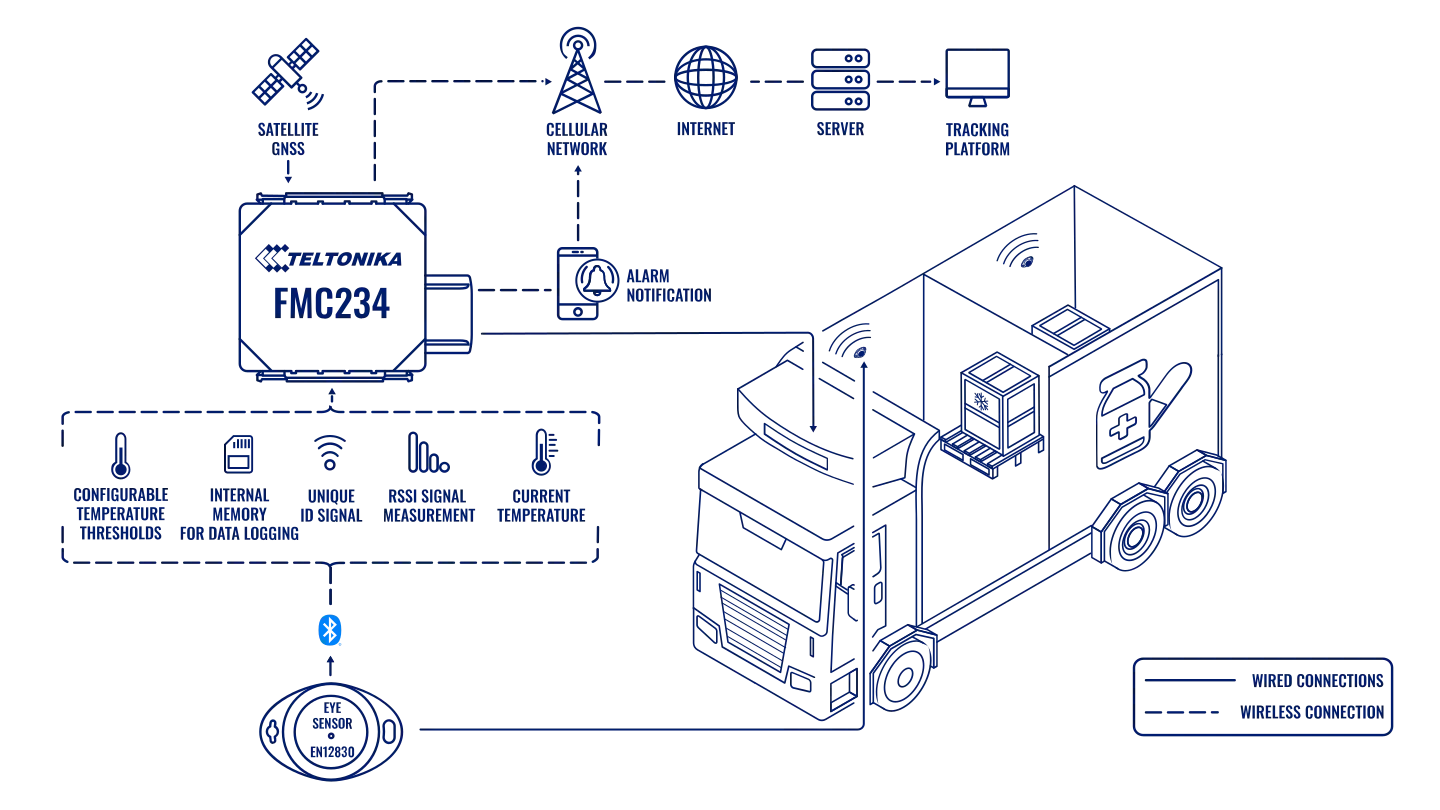
A pharmaceutical distributor monitors the temperature of vaccines and medicines both in the refrigerated vehicle and in the pharmacy fridge: an FMC234 tracker and EYE Sensor EN12830 devices record the readings and raise an alert on a deviation.
A pharmaceutical distributor monitors the temperature of vaccines and medicines both in the refrigerated vehicle and in the pharmacy fridge: an FMC234 tracker and EYE Sensor EN12830 devices record the readings and raise an alert on a deviation. Medicines are more sensitive to temperature than most foods. A few hours outside the range can destroy the active substance, and the product will then either stop working or become dangerous. Outwardly the packaging looks exactly as it did before the journey. Teltonika describes a scenario that covers both parts of the chain: the road from the warehouse to the recipient, and storage in a pharmacy, a hospital or a warehouse. For transport it uses the FMC234 tracker with Bluetooth sensors; for storage, the same sensors and the EN12830 EYE APP mobile application.
What this scenario solves
Temperature swings in transit spoil a noticeable share of heat-sensitive medicines.
Good distribution practice requires a continuous temperature record rather than spot checks.
In many pharmacies and clinics the fridge temperature is still written into a logbook by hand.
The more transfers there are between warehouses, vehicles and countries, the greater the chance that the chain will break somewhere.
Temperature swings in transit spoil a noticeable share of heat-sensitive medicines. Good distribution practice requires a continuous temperature record rather than spot checks. In many pharmacies and clinics the fridge temperature is still written into a logbook by hand. The more transfers there are between warehouses, vehicles and countries, the greater the chance that the chain will break somewhere.
The figures are unpleasant. According to the World Health Organization, up to 20% of heat-sensitive products are damaged in transport because the cold chain is broken. The losses are put at roughly 35 billion dollars a year, and that is without counting the harm to the patients who received a spoiled product.
Pharmaceuticals are tightly regulated. The GDP (Good Distribution Practice) rules require the conditions of storage and transport to be documented along the whole route. If there is no log, or there are holes in it, the company risks fines, claims and loss of reputation. Keeping such records by hand is slow and expensive.
In the original case Teltonika gives the example of Africa. On figures from the Africa Centres for Disease Control and Prevention and the African Development Bank, less than 30% of the medicines consumed there are made locally. Up to 99% of vaccines and from 70 to 90% of medicines and medical equipment are imported. That means products travel through several countries and climate zones, and at every transfer the temperature has to be kept under control.
A handwritten log is poor for obvious reasons. An employee notes the thermometer reading once a shift or to a schedule, may miss an entry, may write the wrong figure or may fill the log in after the event. A deviation that happened at night will not appear in such a log at all. An inspector sees neat lines of writing, and nobody ever learns the real picture.
At the joins there are more problems still. The warehouse dispatched the boxes at the right temperature, the vehicle stood in the sun waiting to be loaded, the pharmacy took the goods in and put them in the fridge an hour later. Every party is sure that everything was in order on their side, and without an end-to-end temperature record an argument about who caused the spoilage leads nowhere. The one who pays is usually the one with the least evidence.
What Teltonika offers
The solution splits into two parts: on the road the temperature is collected by an FMC234 tracker in the refrigerated vehicle, while in the warehouse and the pharmacy the readings of the EYE Sensor EN12830 devices are read by the EYE APP mobile application.
Installation and setup
Fitting the device and configuring it for the fleet scenario at hand.
Data transfer
The device collects data and sends it to the monitoring platform; how often depends on the model and its settings.
Analysis and control
The person in charge gets reports and alerts and looks into what stands out.
Transport. The FMC234 is fitted inside the refrigerated body so that it picks up the Bluetooth Low Energy signal from the sensors reliably. The EYE Sensor EN12830 devices are fixed in the load space or placed directly into the thermal boxes with the products. That way the temperature in particular boxes is visible, rather than a single figure at the outlet of the refrigeration unit.
The sensor works over a range from −20 to +60 °C, which is enough for most medicines apart from deep-frozen ones. Thresholds are set in it, and when they are crossed the sensor raises an alert. Built-in memory keeps a log of the readings, so a short break in communication does not lose data: it is sent on afterwards. That is a requirement of the EN12830 standard for temperature recorders.
The tracker combines the sensor readings with its own position and passes them to the monitoring platform over the cellular network. The logistics manager sees where the vehicle is, what the temperature is now and what it was an hour or a day ago. If a threshold is breached, the notification arrives immediately, and the driver can be called while the product is still intact. After the run a report remains that confirms the conditions of carriage.
Storage. In a warehouse, a pharmacy or a hospital, EYE Sensor EN12830 devices are placed in the medical fridges. The sensor's accuracy is certified to a class of ±0.5 °C: the difference between the real and the measured temperature does not go beyond those limits. For vaccines with a range of +2…+8 °C that margin of accuracy is essential.
Staff look at current and past readings in the EN12830 EYE APP on a phone, with no separate computer and no gateway. The temperature log is exported as a file whenever an inspector or an auditor asks for it. Control over the way vaccines, insulin and biological products are stored thus stops depending on whether a nurse remembered to fill in a notebook.
An example from practice in this scenario. A van is taking a consignment of vaccines from the central warehouse to a district hospital, and on the way its refrigeration unit fails. Within a few minutes the sensor in the thermal box records +9 °C against a threshold of +8 °C, and the logistics manager gets a notification with the vehicle's position. The driver is sent to the nearest warehouse with a cold room, the load is transferred, and the log retains the exact time of the deviation and the maximum temperature. On that data the quality department decides whether the consignment can be used, instead of writing the whole of it off to be on the safe side.
What needs thinking through before the start. How many sensors to put in the load space and into which boxes, which thresholds to set for each group of products, who receives the notifications at night and at weekends, and how long to keep the archive. For a pharmacy it matters that the phone with the application is assigned to a particular member of staff, otherwise there will be nobody to export the log before an inspection.
The limits of interpretation. A sensor in a thermal box measures the air next to the packaging, not the temperature of the product itself, and a short peak by an open door does not always mean spoilage. The deviation log is the raw data for the quality department, which decides the fate of a consignment on the manufacturer's stability data for that product. A check on sensor accuracy is worth including in your own schedule: we confirm the frequency and the procedure against the EN12830 documentation and the requirements of your quality system.
What you get
One system of control in the warehouse and in the vehicle
The same sensors work in storage and in transport, so a product's temperature history does not break at the joins.
An alert before spoilage, not after
The notification about crossing a threshold arrives at once, and the driver or the pharmacist has time to put things right.
Data is not lost when the connection breaks
The EYE Sensor EN12830 writes its readings to internal memory and hands them over once the signal returns.
Your own thresholds for each product
The permitted range is set for the particular load, whether that is vaccines, insulin or ordinary medicines stored at room temperature.
A range from −20 to +60 °C
One type of sensor covers both chilled goods and the monitoring of overheating in summer.
Fitting with no wiring
The sensors talk to the tracker over Bluetooth, take minutes to place and are easily moved to another fridge or another body.
Why this solution
In this scenario Teltonika offers a combination of its own devices: the certified EYE Sensor EN12830 and the FMC234 tracker. For pharmaceuticals the convenience is that one and the same sensor range covers both transport and static storage, while the data from the tracker is accepted by the common monitoring platforms.
Accuracy of ±0.5 °C, a log in built-in memory and instant alerts give the quality department what inspectors ask for: a continuous record of conditions tied to a time and a place. Such data is hard to falsify after the event, unlike a paper log, and that reduces the risk of a recall and of disputes with the recipient.
The FMC234 works on 4G LTE Cat 1 networks with a fallback to 2G. For a distributor that means the tracker will not have to be replaced when operators start switching the old networks off.
How this works in Azerbaijan. The main users of this scenario here are pharmaceutical distributors with central warehouses in Baku, who deliver to the pharmacy chains of Absheron and the regions — to Ganja, Sheki, Lankaran and Guba — and private clinics and hospitals with their own fridges for vaccines. Imported medicines arrive through the cargo terminal of Heydar Aliyev airport and by road from Georgia and Turkey along the M-2 route. The main risk here is summer: at +40 °C a van standing in a queue on the approach to the city, or at a pharmacy with its door open, warms up very quickly, so the sensors are best placed inside the thermal boxes themselves rather than limited to a single sensor on the wall of the body. For pharmacies and clinics the version without a tracker is convenient: just the sensors and the application. GPS.az fits the FMC234, connects the EYE sensors and sets up the thresholds, the notifications and the temperature reports in Wialon, tied to the run and the delivery address. The documents for a particular inspection are best agreed with your quality department in advance, so that the export contains the fields you need.
Related case studies
Related rollouts and equipment


Questions about the “A cold chain for medicines and vaccines” scenario
Request a call
A specialist will call back and match a solution to your fleet and your task.