
Temperature during electronics transport
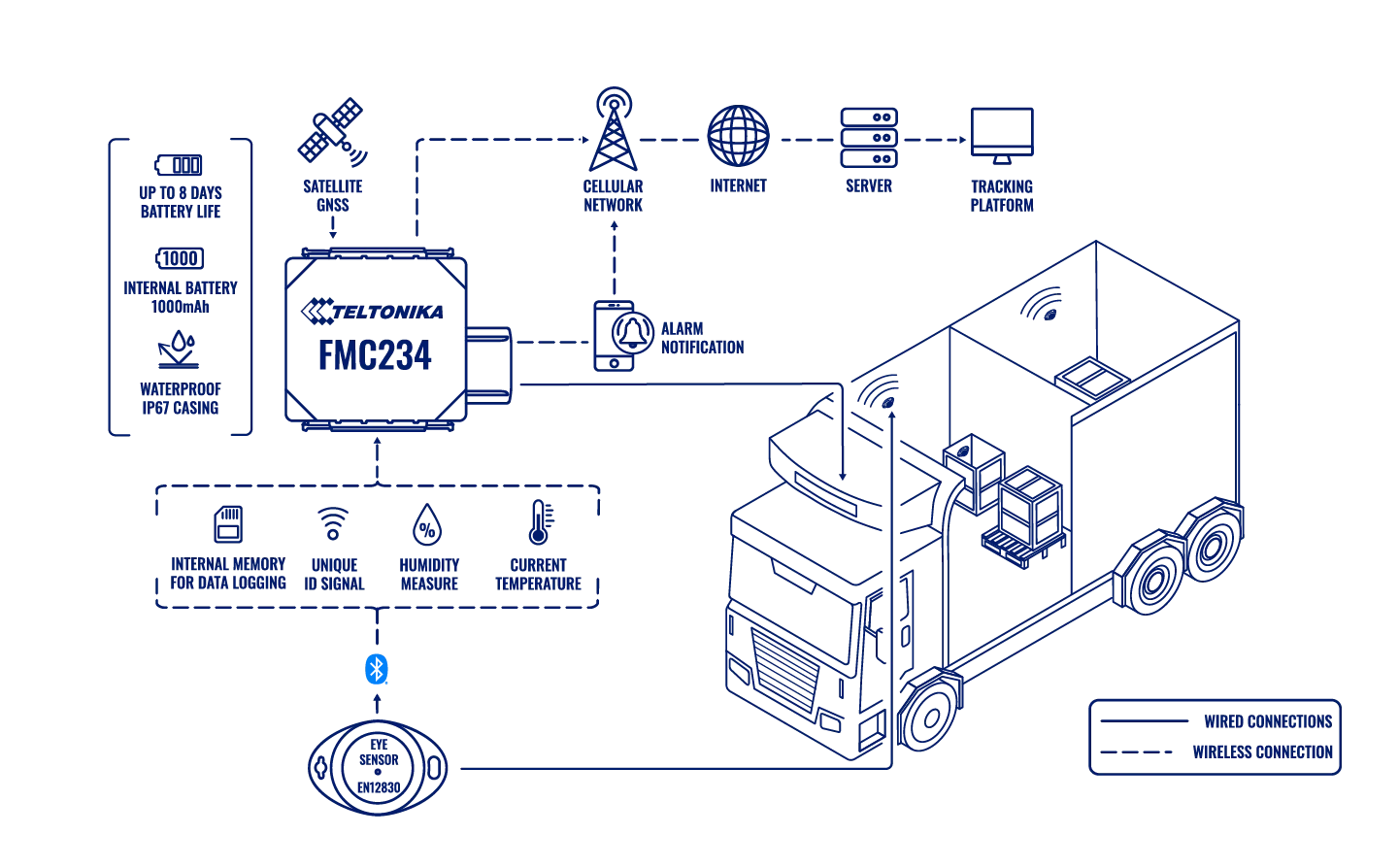
For carrying electronics Teltonika proposes pairing the FMC234 tracker with EYE Sensor EN12830 devices, which log the temperature and humidity of the load all the way.
For carrying electronics Teltonika proposes pairing the FMC234 tracker with EYE Sensor EN12830 devices, which log the temperature and humidity of the load all the way. Semiconductors, lithium batteries, circuit boards and communication modules cope badly with heat, cold and damp. The damage is often invisible on acceptance: the device switches on, but a month later it starts misbehaving, and the sender receives a warranty claim with nothing to counter it. The Teltonika solution covers both sides of the question. First, a departure in temperature or humidity shows up straight away, while the load is still on the road. Second, once it has been delivered there remains a log of measurements that can be shown to the customer or to an inspector.
What this scenario solves
Heat speeds up the chemical degradation of electronic components and can damage soldered joints.
Cold produces condensation and, combined with damp, corrosion and short circuits.
Manual checks with a thermometer every few hours miss short temperature spikes.
Without a log of measurements the sender cannot prove the goods were carried in normal conditions.
Heat speeds up the chemical degradation of electronic components and can damage soldered joints. Cold produces condensation and, combined with damp, corrosion and short circuits. Manual checks with a thermometer every few hours miss short temperature spikes. Without a log of measurements the sender cannot prove the goods were carried in normal conditions.
Electronics are more sensitive to conditions than a sturdy casing suggests. Prolonged overheating speeds up chemical processes inside components, lowers insulation resistance and can damage chips and soldered joints beyond repair. According to Component Sense, cited by Teltonika, every 10 °C above the recommended temperature roughly halves the service life of electronic components. High humidity accelerates failures even further.
Cold brings difficulties of its own. When a cold load meets warm air, condensation forms inside the casings. Some materials become brittle in frost, and electronics develop temporary faults. Add damp to that and you get corrosion, short circuits and damage to the protective coating on boards.
Many senders still check conditions by hand: the driver or the storeman looks at a thermometer and writes the reading into a log. Such checks take time, depend on how attentive a tired person is, and happen once every few hours. A short temperature spike between two entries simply never reaches the log. For lithium batteries and chips, even brief exposure to the wrong conditions can end in irreversible damage, warranty cases and delayed deliveries.
What Teltonika offers
Wireless EYE Sensor EN12830 devices are placed in the packaging or the vehicle body and pass temperature and humidity over Bluetooth to the FMC234 tracker, which sends them to the server together with the coordinates.
Installation and setup
Fitting the device and configuring it for the fleet scenario at hand.
Data transfer
The device collects data and sends it to the monitoring platform; how often depends on the model and its settings.
Analysis and control
The person in charge gets reports and alerts and looks into what stands out.
How it works. The compact EYE Sensor devices with Bluetooth Low Energy are placed directly in the packaging of the load or in the trailer. They pass temperature and humidity readings on their own, with no wiring. The FMC234 tracker fitted in the vehicle scans the air, receives the data from the sensors and sends it to the server. The dispatcher sees on the map where the load is travelling and, in the same record, the current temperature and humidity in the body.
Why the FMC234. The tracker has a built-in 1000 mAh battery, so monitoring is not interrupted even if the vehicle has broken down, the driver has switched the engine off during a long stop, or external power has been lost. Throughout that time the device carries on receiving sensor data and sending notifications about critical temperature changes.
On accuracy. The sensors are certified to the EN12830 standard for an accuracy class of ±0.5 °C: the difference between the actual and the measured temperature does not exceed half a degree. The working range is from –20 °C to +60 °C, which is enough for most routes, from winter passes to summer heat in an unrefrigerated body. The sensors measure humidity in parallel, and excess moisture is no less dangerous to electronics than temperature.
A log for audit. Each sensor holds up to 33,000 temperature measurements in its own memory. If the link drops, the data is not lost. It can be read through the Teltonika EN12830 EYE APP or passed into the monitoring platform the company uses. From the EYE APP the logs are exported for audits, inspections and compliance checks — documentary proof that the goods travelled in permissible conditions.
Tying readings to a consignment. Every sensor has its own identifier. If several consignments travel in one vehicle — semiconductors, boards, batteries — the readings always belong to a specific consignment, and when a claim is examined nobody has to guess whose sensor it was.
Both the sensors and the tracker are protected from dust and moisture to IP67, so the system survives loading, transhipment and work in unheated warehouses. The sender ends up with full traceability of the load, data for analysis and a log of events with which to fend off unfounded warranty claims.
What to watch out for. The range of –20…+60 °C suits ordinary transport, but not goods carried deep frozen. The sensor has to be placed next to the load rather than by the door or by the evaporator of the refrigeration unit, otherwise it will show the temperature of the air and not the conditions the box was in.
Calibration and checking. The sensors are certified to EN12830, but if the consignee or the sender has a quality system of its own, it may require the recorders to be checked periodically. The procedure and the frequency of those checks come from those requirements, not from the monitoring system.
The alert log. Every deviation is recorded with a start and end time, a maximum value and coordinates. It helps to settle in advance who responds: the dispatcher calls the driver, and for a long deviation the person responsible for quality marks the consignment for checking on acceptance.
The limits of interpretation. The sensor shows the temperature and humidity at the point where it lies. That is not the same as the temperature inside a product, especially after short spikes. The log confirms the conditions of carriage, but it does not replace checking the goods themselves.
What you get
Temperature visible en route
The dispatcher gets readings and notifications straight away, while the vehicle can still be stopped or the load transferred.
Accuracy of ±0.5 °C to EN12830
Certified sensors give data you can lean on when a claim over semiconductors, batteries or chips is examined.
Nothing lost when the link drops
Each sensor holds up to 33,000 measurements, and the log stays complete even after long stretches with no network.
Humidity kept in check
A signal about excess moisture helps head off corrosion and short circuits in time.
It is clear which consignment suffered
Each sensor's own identifier ties the readings to a specific load.
Monitoring does not stop at a halt
The FMC234 battery keeps the system running when the vehicle breaks down or the engine is switched off.
Why this solution
Two things matter to a carrier of electronics: not missing a deviation on the road, and having a document after delivery. The FMC234 and EYE Sensor pairing does both, with no wiring in the body. The sensors need no connection to the on-board network, and they can be moved to another vehicle or placed in a particular box.
EN12830 certification and the ±0.5 °C accuracy class matter when it comes to an argument with a consignee or an insurer: readings from a certified recorder carry more weight than an entry in a paper log. The logs are exported through the EYE APP or passed into the monitoring platform the company already uses.
IP67 housings, the tracker's backup battery and the sensors' memory close off the usual weak points of such systems: washing, dust, loss of power and loss of signal.
How this works in Azerbaijan. Electronics and batteries arrive in Azerbaijan in containers through the port at Alat, in lorries from Turkey along the M-2, and in transit along the Middle Corridor into Central Asia. The main risk for such a load here is heat. In summer, inside the body of an articulated lorry standing in the sun in a queue at a border crossing or in a yard near Alat, the temperature easily passes +50 °C, which is already close to the upper limit for many batteries. In winter in the Guba-Gusar region and on the passes the problem is a different one: a cold load is brought into a warm warehouse in Baku and condensation forms inside the boxes. The sensor will show both episodes with a time and a place. Points to allow for: for electronics carried in an ordinary curtain-sided lorry with no refrigeration, notifications are better set not only on crossing a threshold but on duration as well — a short spike and three hours in the heat call for different responses. GPS.az fits the FMC234, binds the EYE Sensor devices to the tracker and sets up temperature and humidity reports and out-of-range notifications on the Wialon platform.
Related case studies
Related rollouts and equipment



Questions about the “Temperature during electronics transport” scenario
Request a call
A specialist will call back and match a solution to your fleet and your task.