
Protecting plant and tools on site: TAT100
The Teltonika TAT100 battery-powered tracker mounts on construction plant, generators, containers and even tool boxes, and reports when something has left the site.
The Teltonika TAT100 battery-powered tracker mounts on construction plant, generators, containers and even tool boxes, and reports when something has left the site. It needs no power from the machine, so it can go on things that have no engine at all. The case is addressed to construction companies, plant hire firms and contractors whose sites are left with expensive machines and tools on them and no round-the-clock security. Below: what theft on a construction site actually costs, how the TAT100 keeps watch over assets and what to do when there is no satellite signal.
What this scenario solves
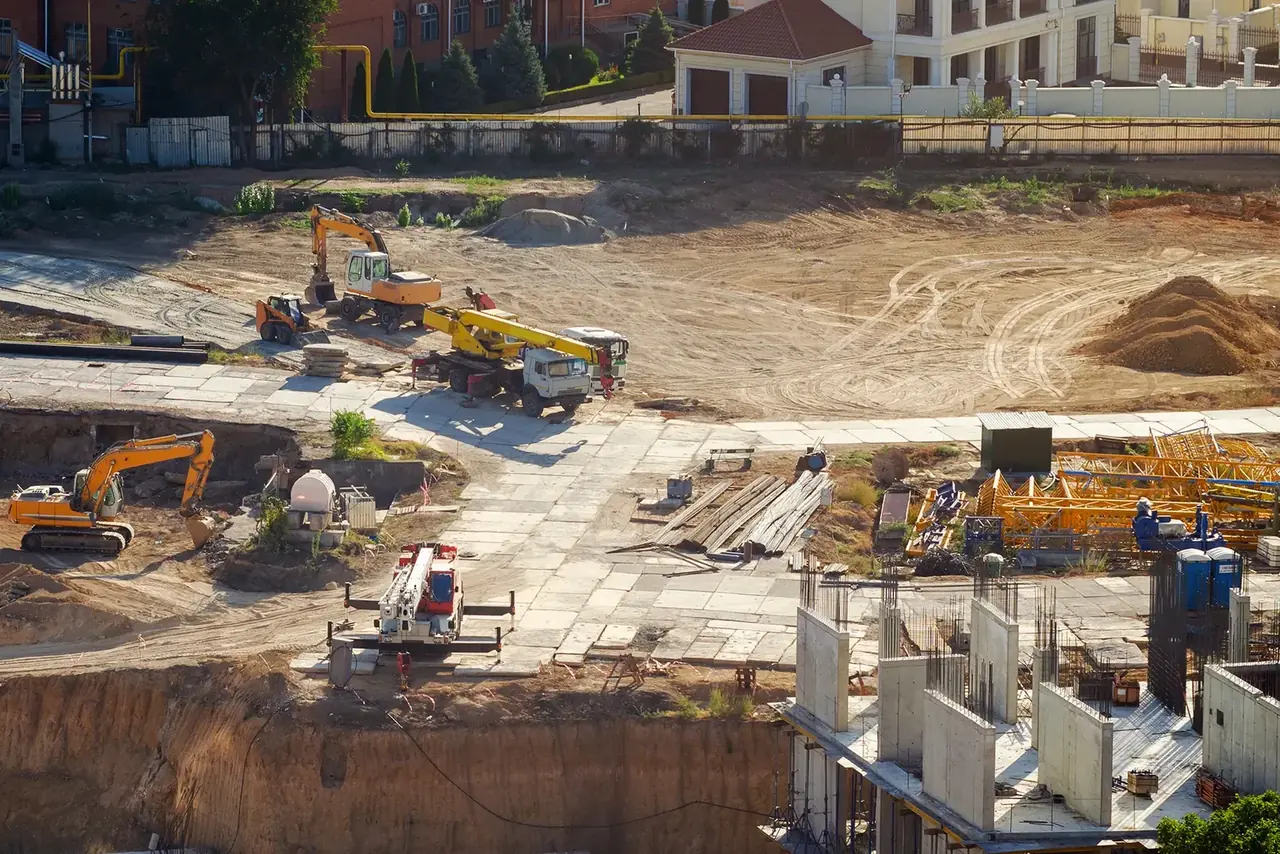
On a construction site, expensive plant and tools are often left out overnight in the open and unattended.
Less than a quarter of stolen equipment is recovered each year.
Individual items cost up to 150,000 euros, and on top of the replacement price come downtime, hire charges and higher insurance.
Many assets — generators, containers, scaffolding — have no power supply of their own, and an ordinary tracker cannot be fitted to them.
On a construction site, expensive plant and tools are often left out overnight in the open and unattended. Less than a quarter of stolen equipment is recovered each year. Individual items cost up to 150,000 euros, and on top of the replacement price come downtime, hire charges and higher insurance. Many assets — generators, containers, scaffolding — have no power supply of their own, and an ordinary tracker cannot be fitted to them.
The construction industry is growing along with infrastructure investment. The more machines there are on sites, the more temptation there is for thieves.
The scale of theft is striking. Worldwide it comes to more than 1 billion dollars a year. In Europe the losses are put at 1.5 billion euros, and in Australia at roughly 650 million dollars.
For a thief, a building site is a convenient target. The fencing is token, one watchman covers the whole area, the machines stand in plain view, and the keys to a mini-excavator or a loader are often universal. Smaller items — laser levels, generators, cable drums — are simply loaded into the back of a vehicle.
The direct loss is only the beginning. Work stops while a replacement is found. Plant has to be hired in, the project schedule slips and insurance premiums rise. These indirect costs often turn out to be larger than the value of the stolen item itself.
What Teltonika offers
To protect construction assets Teltonika offers the TAT100 battery-powered tracker: it fixes to anything, from an excavator to a tool box, and raises an alert when the item leaves the site or a defined zone within it.
Installation and setup
Fitting the device and configuring it for the fleet scenario at hand.
Data transfer
The device collects data and sends it to the monitoring platform; how often depends on the model and its settings.
Analysis and control
The person in charge gets reports and alerts and looks into what stands out.
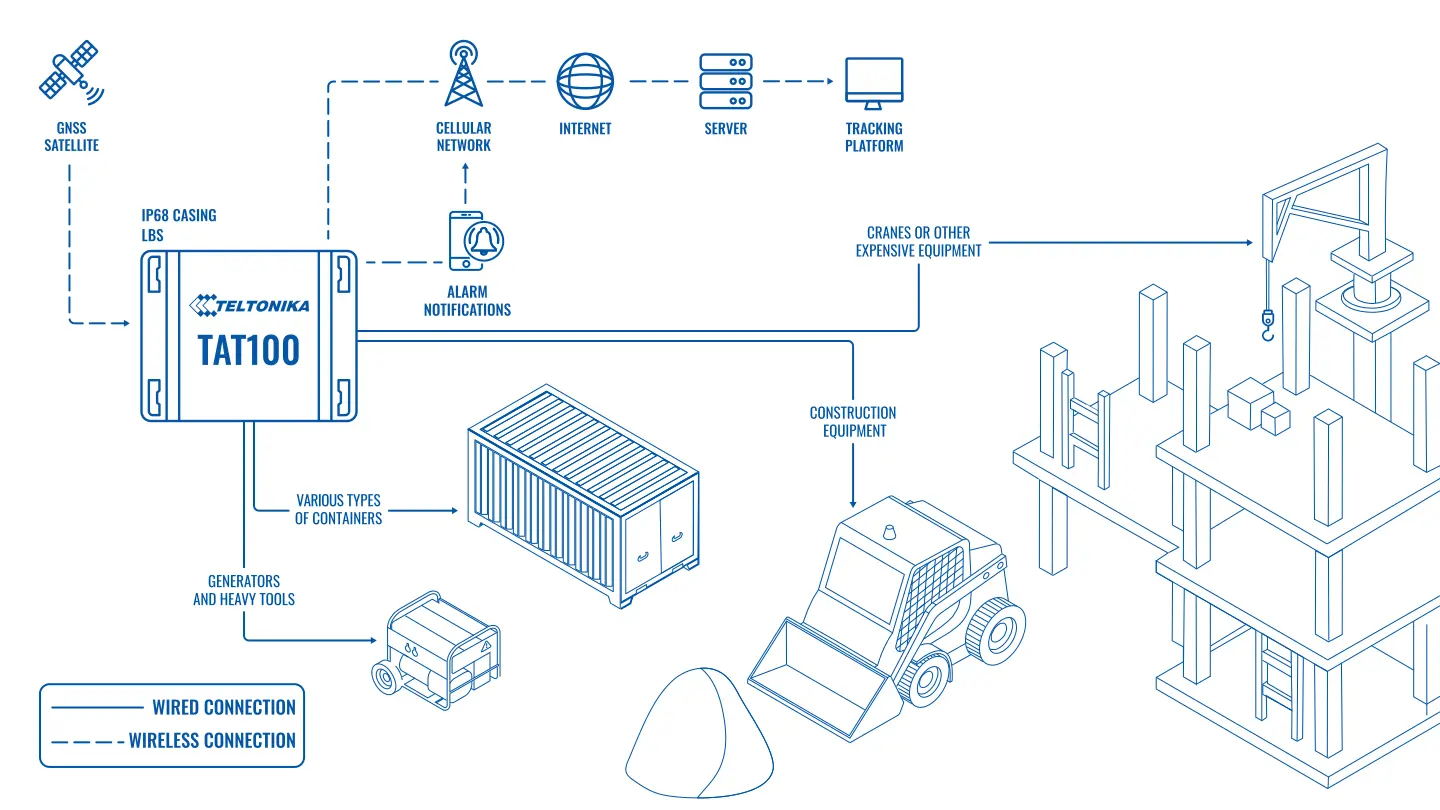
The tracker has several qualities that matter specifically on a construction site. The certified IP68 housing is fully dust-tight and withstands temporary immersion in water. The high-gain GNSS antenna gives some margin on reception, although accuracy drops under metal and concrete. The high-capacity internal battery is replaceable. According to the manufacturer it lasts for up to 1,000 records, or roughly 3 years when data is sent once a day.
The list of things a TAT100 goes on is a long one. Loaders, wheel loaders, bulldozers, cranes, excavators, piling rigs, telehandlers, scissor lifts, forklifts. But also generators, laser levels, ladders, wheelbarrows, cable drums, tool boxes, skips, large tanks and boxes of consumables. The tracker does not care whether the item has an engine.
There are four ways to mount it: with straps, with double-sided tape, on a magnet (which needs the additional TAT Holder) or with screws. Each type of object gets its own option: a magnet is convenient on the steel frame of an excavator, screws or tape on a plastic box, straps on a pipe.
The system works like this. The tracker fixes its position periodically and sends it to the server, at an interval set in the configurator. On the monitoring platform a geofence is drawn around the site or around a particular part of it. If an item goes beyond that boundary, the platform sends an alert straight away, and those responsible have time to call security or the police before the machine gets far.
On a construction site the satellite signal often disappears: the concrete shells of buildings, bridges, flyovers, dense trees. For that case the TAT100 has an LBS scenario: the position is worked out from the mobile network base stations. The accuracy is lower than with GNSS, but it is clear which area the item is in, as long as there is a mobile network.
The housing is designed for hard conditions: sand and dust storms of the kind found in the Middle East, North Africa and Central Asia, monsoon seasons and a humid subtropical climate. It stands up to site dust and rain, provided the housing is closed properly after a battery change.
The firmware and configuration of the TAT100 can be changed remotely through FOTA WEB. There is no need to drive round the sites to change the reporting interval or update a device.
A real night on site with a tracker like this looks roughly as follows. At two in the morning the generator standing by the site hut starts to move: it is being loaded into somebody else's pick-up. The TAT100 wakes on the movement and sends a position without waiting for the scheduled morning report. A minute later the generator crosses the geofence boundary and the platform sends an alert to the duty officer. He sees the direction of travel on the map and calls the police while the vehicle is still a few kilometres from the site.
The reporting interval is matched to the type of object. For large machines that move between sites, sending data several times a day makes sense. For tools that lie in a container for months, the usual setting is one report a day plus an unscheduled position when movement begins. That way the battery lasts longer, but there are conditions: the tracker has to find the network from inside the container, and the alert will arrive with a delay of seconds or minutes, depending on the connection. If the container is metal and windowless, the tracker is mounted outside in a protected spot, or the signal inside is checked before fitting. When the battery comes to the end of its life it is replaced on site, and the tracker stays on the asset and carries on with the same settings.
Site conditions. Three things are established before fitting: whether there is mobile coverage on and around the site, where the assets will stand at night (open ground, a metal container, a shed) and who takes the alert outside working hours. The answers decide where the tracker is mounted, how often it reports and who gets the notifications.
The right mounting. The tracker and its mounting are matched to the object: a magnetic holder for a steel frame, screws for plastic, straps for pipes and tanks. On machines with heavy vibration and pressure washing the mounting is inspected after a week in service.
The duty cycle. For each type of asset the regime is written down: how many reports a day, whether to send a position on movement, which geofence applies. That set of choices is what determines battery life.
Acceptance on the real machines. After fitting, every tracker is checked in place: did it come online, did its position land correctly on the map, does the alert fire when the asset is taken outside the geofence. For that the asset is actually moved beyond the boundary and the time until the notification arrives is noted. The results go into the register of equipped assets.
What you get
It stands up to dust and water
The IP68 housing is fully dust-tight and survives temporary immersion, which suits work on open ground.
It goes on anything
Four mounting methods allow the tracker to be fixed to a machine, a generator, a container or a tool box.
An alert when something leaves the site
A geofence on the platform reports immediately if an item has left the site or its own zone within it.
It is not lost without satellites
The LBS scenario works out the position from the cellular network where the GNSS signal is blocked by concrete or a bridge.
Order among the tools
When it is clear where every generator and level is, fewer of them get left behind on a neighbouring site and less time goes on searching.
Little servicing
The replaceable battery and remote configuration over FOTA WEB cut the number of visits to the trackers; battery life depends on how often the device reports.
Why this solution
The main argument for the TAT100 on a construction site is battery operation combined with toughness. Most of the valuable property on a site has no power supply of its own, and there is simply nothing for a wired tracker to connect to. The TAT100 answers that with a battery that lasts years and a housing that shrugs off dust.
Flexibility matters too. The same model suits an excavator worth hundreds of thousands and a cable drum, and the mounting method is chosen to suit the object. A company does not need to keep several types of tracker.
The limits are worth naming. A battery-powered tracker saves its charge and does not log a track in real time — it reports on a schedule and on movement. For machines where engine hours, fuel consumption and engine operation matter, a wired tracker with an Escort fuel level sensor goes on the machine, and the TAT100 is used as a hidden back-up: if a thief finds and disables the main unit, the second one goes on reporting the position. Inside a metal container the signal weakens, so the mounting position has to be chosen with care. A tracker fixed in plain view can be torn off by a thief, so on valuable machines it is hidden in frame cavities or under covers.
How this works in Azerbaijan. The scenario is in particular demand on the reconstruction sites in Karabakh and East Zangezur, where sites are far from towns and hard to guard, on road works along the M-2, M-3 and M-4 routes, in the quarries of the Garadagh district and on projects in Baku and Sumgait. Summer temperatures up to +40 °C and dust in the quarries are ordinary conditions for this kind of machinery, and the IP68 housing takes them. In mountain districts the mobile network drops out in places: the tracker stores the data and sends it once the network appears, but an online alert cannot be had in a dead zone, and we allow for that at the design stage. The TAT100 works only over the mobile network, so for especially remote sites with no coverage we discuss separate equipment with satellite communication. GPS.az, a Teltonika GOLD partner in Azerbaijan, fits the TAT100 to machines and tools, draws the geofences around the sites and connects everything to the Wialon platform, where the site manager and the security team see the property on the map and receive the alerts. The tracker warranty is 1 year.
Related case studies
Related rollouts and equipment

Questions about the “Protecting plant and tools on site: TAT100” scenario
Request a call
A specialist will call back and match a solution to your fleet and your task.