
Refuelling checks on rental cars: FMC003
The Teltonika FMC003 OBD tracker helps rental companies check whether the customer refuelled the car before bringing it back: it reads the actual fuel level and the mileage since the last refuelling from the vehicle itself, instead of relying on the needle on the dashboard.
The Teltonika FMC003 OBD tracker helps rental companies check whether the customer refuelled the car before bringing it back: it reads the actual fuel level and the mileage since the last refuelling from the vehicle itself, instead of relying on the needle on the dashboard. A case for rental and car-sharing fleets, where a car comes back dozens of times a month and each time somebody has to check the tank. An error one way and the company loses money on fuel; the other way and it argues with the customer and loses their trust. We look at why the fuel gauge misleads, how the Distance Since Refuel parameter works and what it changes in preparing cars for the next hire.
What this scenario solves
The factory fuel gauge still reads a full tank for another 60–80 km after refuelling, and sometimes for as much as 160 km.
A customer may fill up only part way, and nobody notices it when the car is handed back.
Checking every tank by hand slows down preparing the car for the next hire.
Without accurate data, any argument with a customer about fuel comes down to one word against another.
The factory fuel gauge still reads a full tank for another 60–80 km after refuelling, and sometimes for as much as 160 km. A customer may fill up only part way, and nobody notices it when the car is handed back. Checking every tank by hand slows down preparing the car for the next hire. Without accurate data, any argument with a customer about fuel comes down to one word against another.
The rental market is growing: on the forecasts quoted in the original case, it will be worth more than 214 billion dollars by 2027. Demand for flexible mobility keeps rising, and rental companies compete on how fast they can turn cars round and on the quality of their service.
Fuel, meanwhile, remains one of the most underrated items. Most rental firms take a car back by the dashboard: the needle is on F, so the tank is full. But the gauge is deliberately made sluggish, so that the needle does not jump about over bumps and in corners. For the first few dozen kilometres after refuelling it simply sits at maximum.
Several problems follow from this at once. A part-filled tank is invisible. A car that came back full has to be driven to a filling station before it goes out again — and that costs time, fuel and an employee's wages. In season, when cars are taken one after another, delays like this put a direct ceiling on revenue.
The other side is disputes. If the rental firm charges the customer for a short fill and has no evidence, the customer leaves unhappy and writes a review. If it does not charge, the company quietly pays for somebody else's fuel. Fuel theft and journeys that fall outside the hire agreement also go unnoticed.
What Teltonika offers
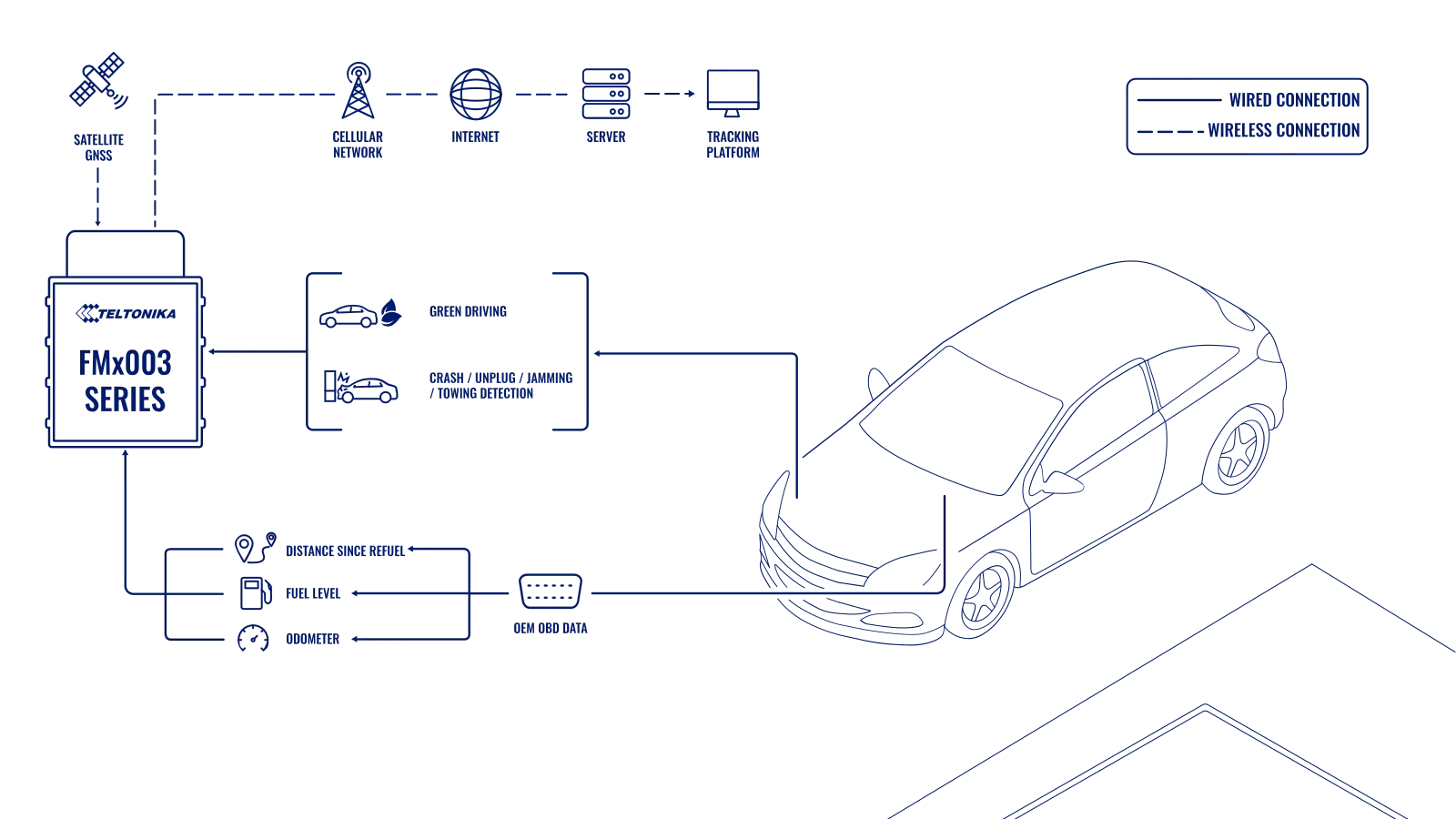
For this job Teltonika offers the FMx003 series of OBD trackers, which read the vehicle's own factory data; the case uses the FMC003 with 4G LTE support — it plugs into the OBD-II socket and sends the server the actual fuel level, the odometer reading and the mileage since the last refuelling.
Installation and setup
Fitting the device and configuring it for the fleet scenario at hand.
Data transfer
The device collects data and sends it to the monitoring platform; how often depends on the model and its settings.
Analysis and control
The person in charge gets reports and alerts and looks into what stands out.
Fitting is simple: the tracker connects to the OBD-II diagnostic socket, which is present in practically any modern car. No wiring has to be cut, and the car can go back into service the same day. The tracker passes data from the vehicle bus in real time.
The key parameter in this scenario is Distance Since Refuel. When the tracker registers a refuelling, it starts an internal counter and from then on counts the kilometres the car has covered since. That figure does not depend on how sluggish the needle on the dashboard is.
How this is used when a car comes back. The customer hands the car over and the gauge shows a full tank. The manager opens the vehicle's record in the monitoring system and sees that it has covered 95 km since the last refuelling. So the tank is not in fact full, even though the needle does not show it yet. The question of an extra charge is settled there and then, with the data to hand.
It works the other way round too. If the tracker shows a refuelling 3 km before the office and the fuel level is close to maximum, the car can go straight to the next customer without a trip to a filling station.
The system itself flags which cars need refuelling before the next hire. Instead of walking the car park and checking every tank, the employee gets a list. The fuel level history also shows behaviour that is out of the ordinary: a sharp drop while the car is parked, consumption that does not match the mileage, journeys that should not have happened.
The FMC003 is built for mixed fleets. The manufacturer claims support for more than 1,500 car models, as well as more than 150 electric models — for those, the battery charge level is available instead of fuel. A rental firm running petrol cars, hybrids and electric vehicles can work with a single type of tracker.
Besides fuel, the same tracker shows the route, the mileage and the speed. For a rental company that is extra protection: it is visible when a car taken for city driving has been driven hundreds of kilometres away, or when a customer speeds routinely. Odometer readings arrive automatically, so the contract mileage does not have to be copied out by hand at every handover. All of this helps take a car back quickly and calmly, without a long study of the dashboard or an argument at the desk. The terms about fuel and speed are worth writing into the hire agreement in advance.
Checking against a reference. Before the tracker's data is relied on in disputes with customers, it is verified on the company's own cars. For each model in the fleet, several control fills to a full tank are made at a filling station with a receipt, and the results compared: did the tracker register the refuelling, how did the fuel level change and did the distance counter reset afterwards. If on some model the level from OBD moves in coarse steps, or refuelling is not detected at all, only the distance since refuelling or a manual check is used for that model.
The event threshold. The rule that a car needs refuelling is set on two conditions: the distance since the last refuelling is above a set number of kilometres, or the fuel level is below a set percentage. The actual values are chosen model by model from the results of the check, not set the same for the whole fleet.
False readings. The fuel level read from the bus fluctuates on a slope, under hard braking and immediately after the engine starts. So a decision about an extra charge is made on readings taken with the car parked and the engine off, together with the distance since refuelling, rather than on a single level value. Doubtful cases are better settled in the customer's favour.
How to measure the effect. Before the start, record how many cars a month had to be driven to a filling station after coming back full, and how much fuel the company paid for on customers' behalf. Two or three months into working with the trackers, compare the same figures. The difference is the fuel effect for that particular rental business; there is no point in transferring somebody else's percentages to your own fleet.
What you get
A short fill shows up at once
The Distance Since Refuel parameter shows how far the car has travelled since the filling station, even while the needle on the dashboard still sits on full.
Faster preparation for the next hire
The employee sees a list of the cars that need refuelling instead of checking every tank by hand.
Disputes are settled with data
At handover the manager shows the customer the distance since refuelling and the fuel level from the system, rather than arguing verbally.
Fewer losses that go unnoticed
The fuel level history helps to identify fuel drains, unusual consumption and journeys outside the terms of the agreement.
One tracker for a mixed fleet
The FMC003 supports more than 1,500 car models and more than 150 electric models.
Why this solution
The strength of the FMC003 is that it takes its data from the car itself. For a fleet of passenger cars that is usually more accurate and cheaper than fitting a separate sensor in the tank: there is no drilling of the tank and no calibration, and therefore no questions from the dealer about interference with the fuel system.
The FMx003 series was designed for light vehicles and quick fitting. The tracker connects to OBD-II in minutes, and the data from the bus arrives in a readable form — fuel level, odometer, distance since refuelling. For large rental fleets this scales without a dedicated fitting crew.
There are limits. The set of parameters depends on the make and model: on some cars the fuel level is not reported over OBD at all, or is reported with poor accuracy. A tracker in the OBD socket is visible, and in theory the hirer can pull it out — that appears in the system as a disconnection, but it has to be allowed for in the agreement. For lorries and plant and heavy equipment, where litres matter down to fractions of a percent, an Escort fuel level sensor is still the better choice.
How this works in Azerbaijan. Car hire here is concentrated in Baku — at Heydar Aliyev airport, near the large hotels and in the centre — and in summer demand rises with the tourists heading for Gabala, Sheki and Guba. Tourists often return a car at the last minute before their flight, and there is no time to check the tank; this is where data from the system really helps. Before deployment we check which parameters a particular model in the client's fleet reports: the Hyundai, Kia and Toyota cars popular with rental firms usually report fuel level, but that is worth confirming on site. GPS.az, a Teltonika GOLD partner in Azerbaijan, fits the FMC003, configures the reading of the fuel parameters and brings them onto the Wialon platform: the manager sees the fuel level and the distance since refuelling right in the vehicle record, and the refuelling report is generated automatically. The tracker warranty is 1 year.
Related case studies
Related rollouts and equipment


Questions about the “Refuelling checks on rental cars: FMC003” scenario
Request a call
A specialist will call back and match a solution to your fleet and your task.