
Fuel and service planning from OBD data: FMC003
A Teltonika scenario for delivery operations: the FMC003 OBD tracker reads the fuel level, the remaining range and the distance to the next service from the vehicle, so that refuelling and servicing are planned in advance rather than after the event.
A Teltonika scenario for delivery operations: the FMC003 OBD tracker reads the fuel level, the remaining range and the distance to the next service from the vehicle, so that refuelling and servicing are planned in advance rather than after the event. In delivery work a vehicle only earns while it is moving with a load. Every extra trip to a filling station in the rush hour and every day in the workshop after a sudden breakdown eats into both time and money. Worst of all is when these things happen unexpectedly, in the middle of a busy route. Most modern vehicles already know everything that matters about themselves: how much fuel is in the tank, how many kilometres it will last, when the next service is due. The task is to get that data out of the on-board computer and in front of the dispatcher.
What this scenario solves
An unplanned repair derails deliveries and costs hundreds of dollars a day in idle time for a single vehicle.
Fuel accounts for almost 30% of the cost of running a fleet.
The dispatcher does not know how much fuel each vehicle has in the tank and cannot build refuelling into the route.
Fleet data is scattered across different spreadsheets, and it is hard to see from them where the money is going.
An unplanned repair derails deliveries and costs hundreds of dollars a day in idle time for a single vehicle. Fuel accounts for almost 30% of the cost of running a fleet. The dispatcher does not know how much fuel each vehicle has in the tank and cannot build refuelling into the route. Fleet data is scattered across different spreadsheets, and it is hard to see from them where the money is going.
Logistics is growing fast, and the global market is forecast to reach 14.08 trillion dollars by 2028. Costs grow along with the volumes: by industry estimates, production costs in logistics have risen by roughly 20% over the past five years because of fuel price swings and increasingly expensive maintenance.
In these conditions, a strategy of filling up when the warning light comes on and going in for a service when something starts knocking is particularly expensive. The driver pulls into a filling station in an awkward place and arrives late at the customer, and a vehicle with a missed service sooner or later ends up on the hard shoulder.
What Teltonika offers
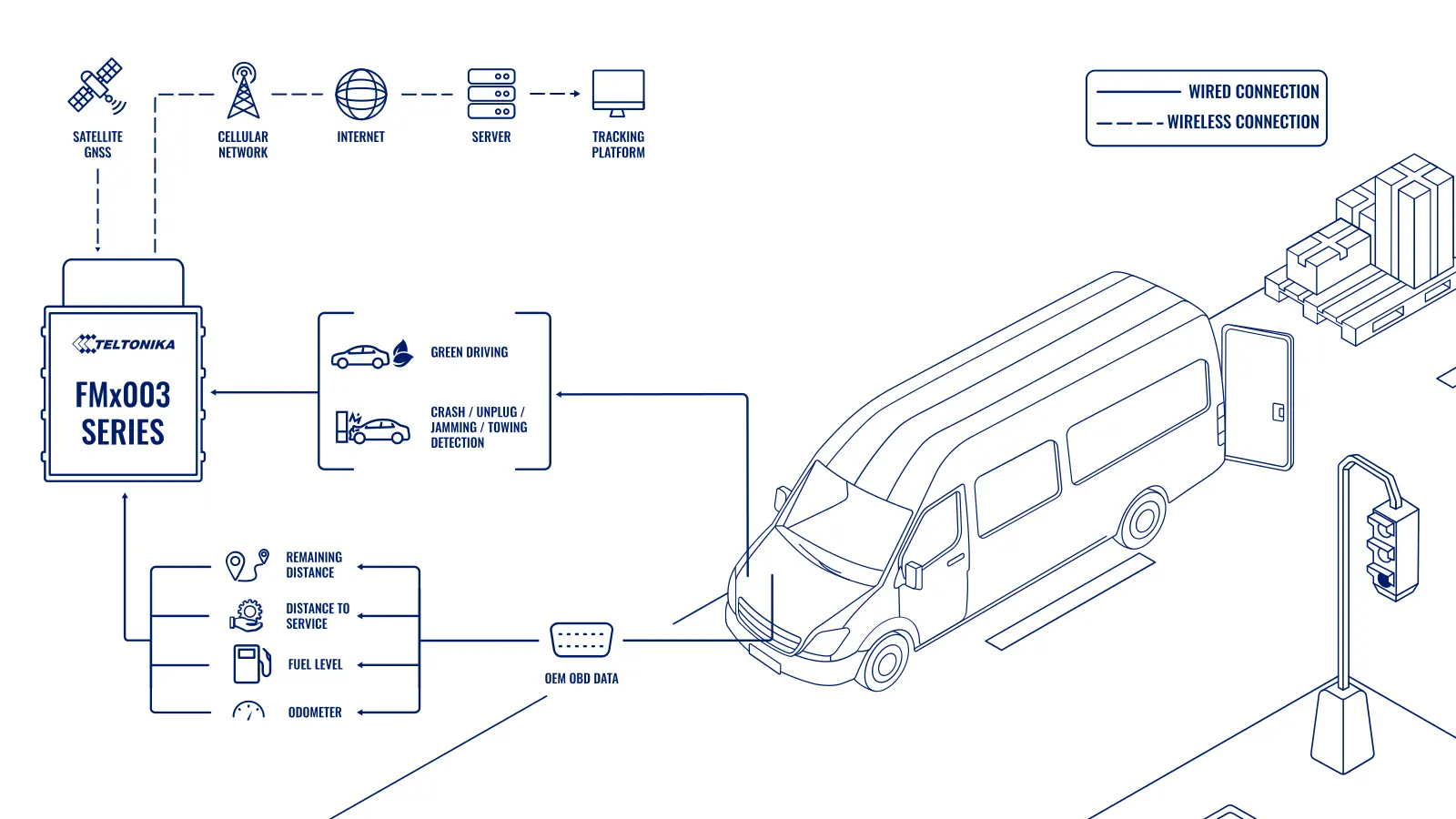
The FMC003 plugs into the OBD-II socket and passes the vehicle's factory parameters to the platform, including the range left on the fuel in the tank and the distance to the next service, and the dispatcher uses those to plan refuelling and servicing together with the route.
Installation and setup
Fitting the device and configuring it for the fleet scenario at hand.
Data transfer
The device collects data and sends it to the monitoring platform; how often depends on the model and its settings.
Analysis and control
The person in charge gets reports and alerts and looks into what stands out.

What the device is. The FMx003 series are compact Teltonika trackers that connect to the OBD-II diagnostic socket. The FMC003 works on 4G LTE networks with 2G as a fallback, and there is a 2G model as well. Fitting takes minutes: the socket sits under the steering wheel and no wiring has to be touched. Teltonika states that the FMC003 is compatible with more than 1300 vehicle models.
What data it reads. Over OBD-II the tracker receives OEM parameters from the on-board computer: the current fuel level, the odometer reading and, on supported vehicles, also the remaining distance (the range on the fuel currently in the tank) and the distance to service. These are the same figures the driver sees on the dashboard, only now the dispatcher sees them too.
How it works in practice. In the morning the dispatcher runs down the list of vehicles: one has 80 km of range left against a 140 km route for the day. Refuelling goes into the route at a convenient point between customers, rather than waiting for the driver to notice the warning light. Another vehicle has 400 km left to its service, so it is booked in for Friday evening, when there are fewer orders, and it does not drop out of the schedule on a busy Monday.
Tied into the route. Because the tracker also reports position, refuelling and servicing can be planned around where the vehicle will be at a given time. Maintenance moves to off-peak hours, and refuelling moves to points the vehicle passes anyway.
Fleet analytics. Over a month the statistics build up: how consumption changes on each vehicle, which models need servicing more often, where the remaining range regularly drops to the minimum. That helps to find the bottlenecks and to decide which vehicles to replace first.
Alerts instead of manual checks. Thresholds are set in the platform: range below 50 km, less than 1000 km to the next service, battery voltage below normal. When a vehicle crosses a threshold, the dispatcher gets a message by email, in the mobile app or in a messenger. He does not have to open every vehicle's card every half hour.
How a fleet rolls it out. It usually starts with a pilot on 5–10 vehicles of different models: the trackers go on, a week is spent seeing which parameters actually arrive from each model, and the reports are then built around that data. The rest of the fleet is fitted afterwards. That shows straight away where OBD delivers everything and where mileage will have to be counted from GPS with an extra sensor fitted.
What the driver gets. Fewer calls from the dispatcher asking how much is in the tank, and a clear refuelling plan on the run sheet.
Where the solution will not work. The remaining distance and distance to service parameters are not available on every make and model: the list has to be checked against the Teltonika support list. The fuel level from OBD is a reading from the standard sender; it is good for planning refuelling, but not for finding fuel drains. If there is any suspicion of drains in the fleet, a separate fuel level sensor is needed.
Checking against a reference. During the pilot, the fuel level from OBD is compared with refuelling receipts and the dashboard readings. For planning refuelling it is enough that a fill-up shows in the data and that the remaining range changes plausibly. If the data jumps about or does not arrive, only mileage and service intervals are kept for that model.
Event thresholds. Low range alerts are set with a margin for the route and for traffic, not at the minimum value. The level from the standard sender fluctuates over bumps and on gradients, so a single dip is not treated as an event.
How to judge the effect. Compare the number of unplanned refuelling stops and sudden departures from the route before and after deployment, on the same vehicles. Fuel savings as a percentage cannot be promised from this arrangement: OBD shows the level but does not catch drains.
What you get
Fewer wasted costs
Refuelling and servicing are planned in advance, so there are no emergency repairs and no trips halfway across town to a filling station.
Vehicles stay in service longer
Maintenance falls in the quiet hours instead of knocking a vehicle out of the schedule on the busiest day.
A refuelling plan inside the route
The dispatcher sees the remaining range and puts the fill-up where the vehicle passes anyway.
More deliveries from the same fleet
Sound vehicles with no sudden downtime take on more orders without buying extra ones.
Lower emissions
Fewer empty runs to filling stations and workshops, and steadier fuel consumption.
Fitted in minutes
The tracker plugs into the OBD socket, so the vehicle does not come off the road while it is installed.
Why this solution
The FMC003 covers a job that used to need a tracker plus separate sensors: everything required to plan refuelling and servicing is already in the on-board computer, and the tracker only has to read it and pass it on. LTE support makes it a durable choice in networks where 2G is gradually being switched off.
For a large fleet there is the further advantage of identical fitting. No fitter with a soldering iron is needed, and the tracker can be moved from vehicle to vehicle as they rotate. Configuration and firmware updates are done remotely over FOTA WEB.
How this works in Azerbaijan. The scenario suits delivery services and distributors in Baku and across Absheron, and regional distribution to Sumgait, Ganja, Sheki and Lankaran. On long runs along the M-2 and M-3, knowing the remaining range means filling up at the usual stations rather than at random points on the road. In Baku traffic and in the summer heat, urban consumption is noticeably higher than the handbook figure, and the OBD data shows that honestly. Before buying, it is worth checking the vehicle models in your fleet against the Teltonika parameter support list — the set of OEM data differs across the commercial vans that are popular here. Connectivity runs over Azercell, Bakcell or Nar SIM cards, and if the signal is lost the tracker holds the data in memory. GPS.az supplies the FMC003, checks compatibility with your vehicles, connects the trackers to the Wialon platform and sets up reports on fuel, mileage and service intervals.
Related case studies
Related rollouts and equipment

Questions about the “Fuel and service planning from OBD data: FMC003” scenario
Request a call
A specialist will call back and match a solution to your fleet and your task.