
Lorry monitoring through FMS and the FMC003
Teltonika proposes connecting the FMC003 OBD tracker to lorries through an FMS adapter: it reads J1939 and delivers engine data without lengthy fitting or vehicle downtime.
Teltonika proposes connecting the FMC003 OBD tracker to lorries through an FMS adapter: it reads J1939 and delivers engine data without lengthy fitting or vehicle downtime. A lorry fleet owner needs more than a dot on a map. They need fuel consumption, engine revs, fault codes and driver behaviour — everything the tractor unit's own electronics already hold. The trouble is that a conventional tracker does not reach that data easily: fitting takes a long time, the wiring differs from make to make, and the vehicle has to be pulled off its run while the work is done. The Teltonika solution is built on FMx003 trackers in 2G and 4G LTE versions. They plug into a connector that is already in the cab and begin sending engine data to the monitoring platform straight away.
What this scenario solves
A lorry needs a tracker that reads the engine electronics, not only coordinates.
Ordinary GPS trackers often fail to make sense of the complex on-board network of a modern tractor unit.
Splicing into the wiring calls for an experienced fitter and for time a busy fleet does not have.
Every hour spent fitting is a vehicle that is not earning.
A lorry needs a tracker that reads the engine electronics, not only coordinates. Ordinary GPS trackers often fail to make sense of the complex on-board network of a modern tractor unit. Splicing into the wiring calls for an experienced fitter and for time a busy fleet does not have. Every hour spent fitting is a vehicle that is not earning.
A lorry fleet operator needs data in real time: how the engine is running, how much fuel is going, how the driver behaves. Without that there is no way to cut costs or to plan repairs. A simple tracker with a GPS module and a couple of inputs shows only where the vehicle is and whether it is moving. Everything held in the control units stays out of reach.
Then there is the sheer variety. Every make, and even every model of lorry, has its own wiring diagram, its own connection points, its own on-board network logic. Only a specialist who knows the particular vehicle can find the right wires without upsetting the factory systems. A fitter's mistake means warning lights on the dashboard, blown fuses or, worse, trouble with the dealer's warranty.
And finally there is time. Long-haul tractor units work to a tight schedule and their service windows are short. The manager has to fit telematics work around planned servicing, or schedule it for nights and weekends. If each vehicle takes half a day, equipping a large fleet stretches over months. And while half the vehicles still have no trackers, comparing them with one another is pointless.
What Teltonika offers
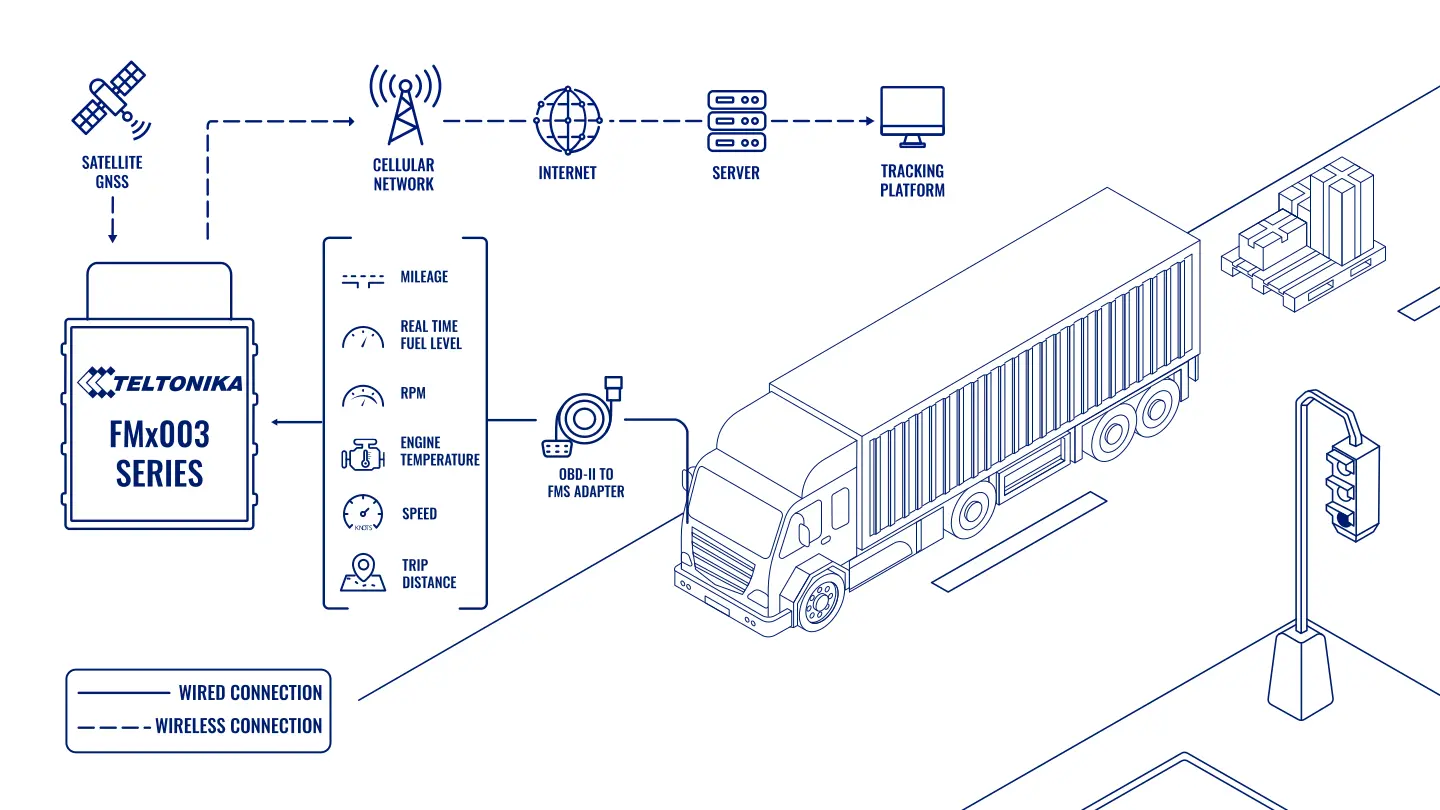
The FMC003 connects to the lorry through an FMS adapter in the OBD socket, reads the SAE J1939 protocol and sends engine data to the platform without splicing into the factory wiring.
Installation and setup
Fitting the device and configuring it for the fleet scenario at hand.
Data transfer
The device collects data and sends it to the monitoring platform; how often depends on the model and its settings.
Analysis and control
The person in charge gets reports and alerts and looks into what stands out.
The FMx003 series comes with 2G (FMB003) and with 4G LTE Cat 1 (FMC003). The Teltonika case study works through the FMC003. The tracker pairs with a Fleet Management System adapter: an interface that links the device to the diagnostic socket of a heavy vehicle on a Plug & Play basis. Fitting amounts to plugging in the adapter and securing the tracker. The installation is discreet and does not get in the driver's way.
How it works. Once connected, the FMC003 starts collecting data: speed, engine parameters, fuel consumption and events tied to driving style. All of it travels over the mobile network to the monitoring platform. A dispatcher or a manager looks at the state of every lorry from the office, from a tablet or from a smartphone, and sees current data rather than yesterday's report. If something is wrong with a vehicle, it can be dealt with immediately, while the lorry is still on the road.
J1939 support is the key here. Heavy vehicles use this protocol to exchange data between their electronic control units, and the tracker gains access to the same things a service scanner sees: engine diagnostics, fault codes and other operating readings. They make it possible to spot a problem in advance and send the vehicle in for service before it breaks down out on the road.
An example from practice. A tractor unit is running loaded and a fault code from the cooling system arrives at the platform. The dispatcher sees it the same moment, calls the driver, and the vehicle pulls into the nearest workshop instead of stopping with an overheated engine halfway along the leg. Without a tracker only the driver would have known about the fault, and then only if he had noticed the warning light.
Servicing the trackers themselves is remote as well. The FMx003 works with FOTA WEB, the Teltonika cloud service used to update firmware and change configuration. If a parameter has to be added or the reporting interval changed, it is done without a visit to the vehicle.
What the fleet manager ends up with. On the map, the position and speed of every tractor unit. In the reports, mileage, engine hours, fuel consumption per 100 km and per engine hour, time spent idling, and a list of fault codes with the date and the place each one appeared. For drivers, the number of harsh braking and sharp acceleration events, speeding, and shift length. These figures can be compared between vehicles of the same model: if two identical tractor units on similar routes burn noticeably different amounts of fuel, the reason to look into it presents itself.
One limitation worth knowing about: the set of parameters depends on what the lorry actually puts out on J1939. On older vehicles with no electronic engine management or no FMS interface this approach will not work, and there conventional fitting with sensors is needed.
Checking the readings at fitting. Straight after connection, the data coming off the bus is compared with the tractor unit's dashboard: mileage, engine hours, fuel level. If the numbers agree, reports can be built on them. If some parameter does not arrive or disagrees, it is written into the installation record so that nobody argues with the report later.
What a service event looks like in a report. A row with the fault code, the date, the time, the coordinates and the mileage at the moment it appeared, and beside it a note of when the code cleared. From that row a mechanic can tell whether the fault was a one-off or has been standing for a week.
What you get
Fitting without downtime
The FMS adapter goes into the socket in minutes, so there is no need to take the vehicle off its run or pull the wiring apart.
The engine under watch
Parameters and fault codes from J1939 let repairs be planned in advance instead of after a breakdown on the road.
Fuel consumption you can read
Accurate consumption figures show which vehicles and drivers use more than they should, and where to look for savings.
Drivers judged on the record
Harsh braking, sharp acceleration and long idling are all logged, so training is built on specific incidents.
Events in real time
Alerts arrive at once, so a problem can be settled while the vehicle is still on its route.
Easier reporting
A detailed operating history for every vehicle helps with record keeping and with answering what customers and regulators ask for.
Why this solution
For a heavy fleet the main thing in this solution is how quickly it can be rolled out. The FMS adapter and the FMC003 make it possible to equip dozens of vehicles in a matter of days, without clearing wiring work with the dealer and without taking tractor units out of service. The data still comes from the factory electronics, so in depth of information the solution is a match for fitting with additional sensors wherever the lorry gives that data out.
Having both 2G and 4G LTE versions gives a choice to suit network coverage along the routes. Remote management through FOTA WEB removes the question of servicing trackers that do not come back to the depot for months. Teltonika trackers are supported by most monitoring platforms, so they are easy to add to an existing system.
How this works in Azerbaijan. The scenario suits hauliers whose fleets hold modern European tractor units — Volvo, Scania, MAN, Mercedes-Benz, DAF — and who carry freight along the Middle Corridor: out of the port of Alat through Georgia into Turkey and Europe, or by ferry to Aktau and Turkmenbashi. Such vehicles rarely sit at the depot, and fitting that takes a few minutes in a lorry park is a real advantage. Points to allow for: we check in advance which parameters a particular model puts out over FMS, because the set differs even within one make. Runs abroad need a SIM with roaming or a multi-operator card, and in the mountains the tracker stores data in memory until the network returns. On older KamAZ and MAZ lorries with no electronic engine management this option will not do — there we fit a tracker with an Escort fuel level sensor. GPS.az connects the FMC003, sets up J1939 reading and brings fuel consumption, engine hours and fault codes into reports and notifications on the Wialon platform.
Related case studies
Related rollouts and equipment

Fuel and service planning from OBD data: FMC003
Logistics and delivery

Servicing a courier fleet on OBD tracker data
Logistics and delivery

Pay-as-you-drive insurance: the FMC003 OBD tracker
Fleet telematics
Questions about the “Lorry monitoring through FMS and the FMC003” scenario
Request a call
A specialist will call back and match a solution to your fleet and your task.