
Servicing a courier fleet on OBD tracker data
A Teltonika scenario for delivery services: the FMB001 and FMC003 OBD trackers count mileage, read fault codes and give advance warning that each vehicle is due for a service.
A Teltonika scenario for delivery services: the FMB001 and FMC003 OBD trackers count mileage, read fault codes and give advance warning that each vehicle is due for a service. In delivery work, being late almost always costs money. The customer is expecting an order by lunchtime, the day's routes are planned out, and one van with the engine warning light on wrecks the whole plan: orders are shifted onto other vehicles, couriers come back after dark, and some recipients do not wait. Most breakdowns of this kind can be foreseen. Oil, brake pads, the timing belt and the battery all have a life you can put a figure on. The trouble is that keeping track of it on paper across a fleet of twenty or thirty vehicles is next to impossible.
What this scenario solves
One broken-down van on a peak day ruins dozens of deliveries.
Mileage for the service schedule is copied off odometers by hand, and the data goes out of date quickly.
A driver may ignore an engine fault for a week, until it turns into a serious repair.
Nobody compares the service log in a notebook or a spreadsheet with the real state of the vehicles.
One broken-down van on a peak day ruins dozens of deliveries. Mileage for the service schedule is copied off odometers by hand, and the data goes out of date quickly. A driver may ignore an engine fault for a week, until it turns into a serious repair. Nobody compares the service log in a notebook or a spreadsheet with the real state of the vehicles.
Courier vehicles work in stop-start conditions: dozens of stops a day, warming up in traffic, short hops. Consumables wear out faster in that regime than the manual's average suggests, and a calendar service schedule cannot keep up with the real wear.
There is the question of people as well. A driver in a vehicle with faulty brakes or an overheating engine is putting himself at risk, and the company is risking the load and its reputation.
What Teltonika offers
The tracker goes into the vehicle's OBD socket in a couple of minutes, sends mileage and fault codes, and the platform keeps the service schedule itself and sends the reminders.
Installation and setup
Fitting the device and configuring it for the fleet scenario at hand.
Data transfer
The device collects data and sends it to the monitoring platform; how often depends on the model and its settings.
Analysis and control
The person in charge gets reports and alerts and looks into what stands out.

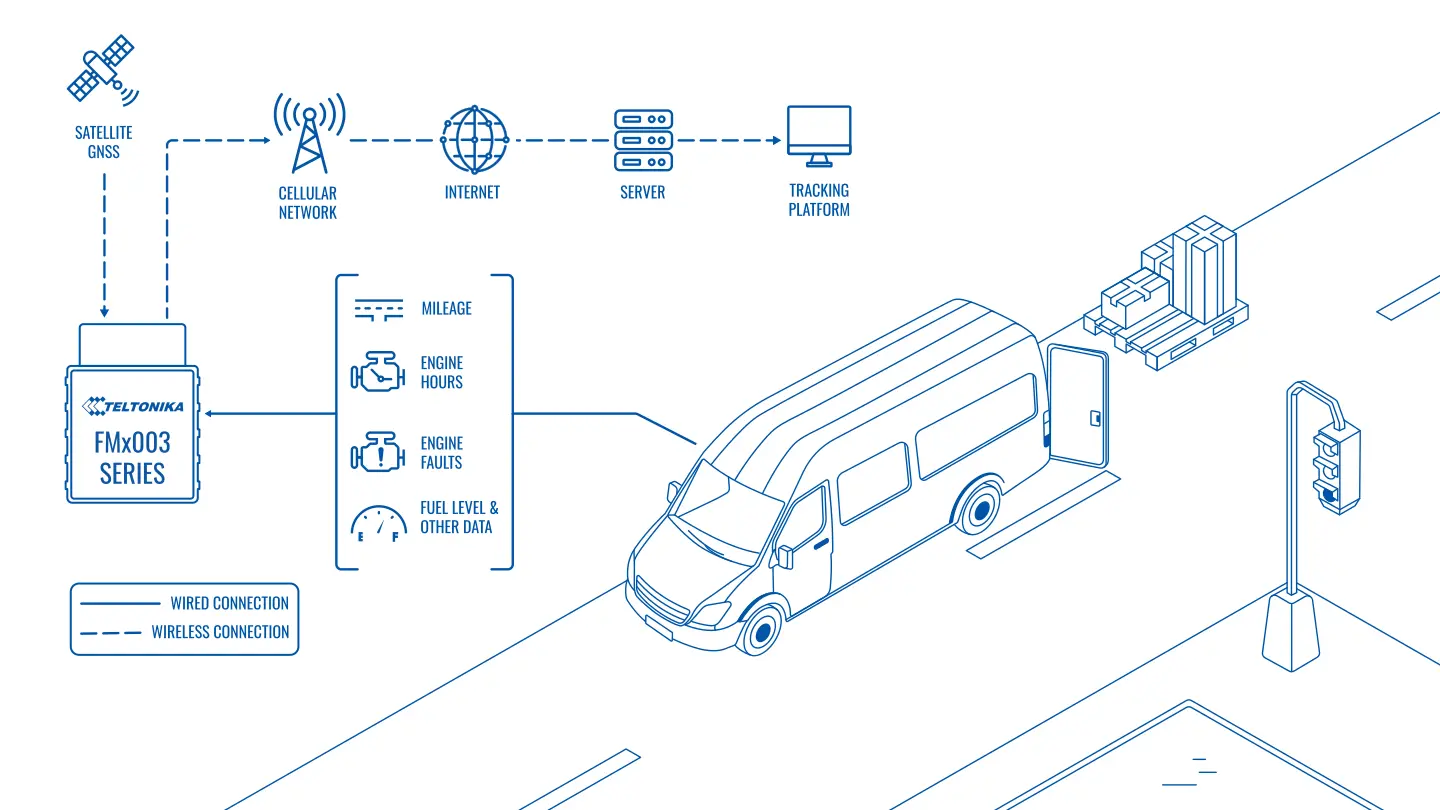
Why OBD in particular. An OBD-II socket is fitted to almost every car and light van built over the past twenty years. An FMB001 or FMC003 tracker needs no splicing into the wiring and no separate fitting work: it is plugged in right there in the yard, and when vehicles change it is moved across in a minute. The FMB001 works on 2G networks, the FMC003 on 4G LTE with a 2G fallback, which is useful where operators are gradually switching the older networks off.
Mileage. The tracker takes it in one of two ways. If the on-board computer gives out the odometer over OBD, the system receives the same figure that is on the dashboard. If it does not, the tracker counts a virtual odometer from GPS coordinates. Either is usually good enough for a service schedule, but in the first case the figures will match the service book.
Diagnostic trouble codes (DTC). When the control unit records a fault, the tracker passes its code to the platform. The dispatcher sees not just that a light is on but the specific fault, and can decide whether to pull the vehicle off its route now or let it finish the shift.
How the schedule is set up. Intervals are set for each vehicle or group: oil every 10,000 km, brake pads inspected every 20,000 km, a general inspection every six months. The system watches the mileage and the dates and warns the mechanic in advance. After the work is done it is marked in the platform, and the counter starts again.
What this looks like on an ordinary day. In the morning the mechanic opens the fleet list and sees that three vans have less than 500 km to go before an oil change, and that one has had a fault code for the oxygen sensor hanging over from the evening. Two vans he books in for the evening, when they are back from their routes, and the third for tomorrow. The dispatcher moves the vehicle with the fault onto a short route nearer the workshop. Nobody rings the drivers or walks the yard with a notepad, and not one delivery is lost.
What the manager gets. Reports on mileage for the month, on the number and types of faults, and on the vehicles that go in for unplanned repair more often than the rest. They show which models in the fleet cost more to run and which are worth keeping when the fleet is renewed.
Other data from OBD. Fuel level, engine revs, throttle position, coolant temperature, engine load. The set depends on the make and year of the vehicle: on some models almost everything is available, on others only the basic parameters.
Sensors and beacons. The trackers support Bluetooth, so a temperature and humidity sensor can be put in the body for food or medicines, and beacons can go on valuable boxes or containers to show that the load is in the vehicle.
An honest limitation: on lorries and on some commercial vehicles the OBD socket gives out little data or is missing altogether. Those need a tracker with a CAN reader rather than an OBD version.
Checking the mileage. When the tracker is connected, the mileage from OBD is compared with the odometer on the dashboard. If the vehicle does not give out the odometer, the current dashboard figure is entered into the platform and the virtual GPS odometer counts on from there. Every few months it is worth comparing the readings again — a small GPS discrepancy adds up over time.
The service record. After the work the mechanic notes the type of work and the mileage in the platform. All the entries stay in the vehicle's history, and it is clear which services were done on time and which late.
What you get
Fewer ruined routes
A vehicle goes in for a service to plan, on a quiet day, rather than on a recovery truck in the middle of a delivery round.
A clear picture of every vehicle
Mileage, the next service and active faults are all in one list, with no ringing round the drivers.
Repairs before they become expensive
The fault code arrives at once, and a small problem is fixed before it drags neighbouring parts down with it.
A digital service history
All the work on a vehicle is held in the platform, ready to show when selling it, during an audit or in an argument with a workshop.
Quick fitting with no specialist
An OBD tracker goes in within minutes, so a new van can be equipped the day it is bought.
Driver safety
Faulty brakes and an overheating engine are spotted before they cause an accident out on a route.
Why this solution
The FMB001 and FMC003 are easy-to-fit OBD trackers that Teltonika makes specifically for light commercial vehicles and cars. They have one job: to connect quickly and give out mileage, faults and engine parameters with no fitting into the wiring.
The choice between the models comes down to coverage. Where 2G is still steady, the FMB001 is enough. For fleets thinking several years ahead, the FMC003 with LTE is better. Both models support Bluetooth sensors and remote configuration through FOTA WEB, so a fleet of dozens of vehicles is looked after without driving out to each one.
How this works in Azerbaijan. This scenario suits courier services and food delivery in Baku and on Absheron, distributors who take goods round the shops in Sumgait, Ganja and Shirvan, and pharmacy and grocery chains. Baku traffic and summer heat of up to +40 °C load engines and brakes harder than the average duty cycle in the manual assumes, so it makes sense to set service intervals shorter than the factory ones. Before fitting it is worth checking what data a particular model's OBD gives out: among the Hyundai, Kia, Ford Transit and Mercedes Sprinter vehicles that are popular here, the set of parameters varies. If drivers might pull the tracker out, it is worth switching on a power disconnection notification. GPS.az supplies and configures Teltonika OBD trackers, connects them to the Wialon platform and sets up service intervals, fault code notifications and mileage reports for your fleet.
Related case studies
Related rollouts and equipment



Questions about the “Servicing a courier fleet on OBD tracker data” scenario
Request a call
A specialist will call back and match a solution to your fleet and your task.