
Monitoring an electric vehicle battery over OBD
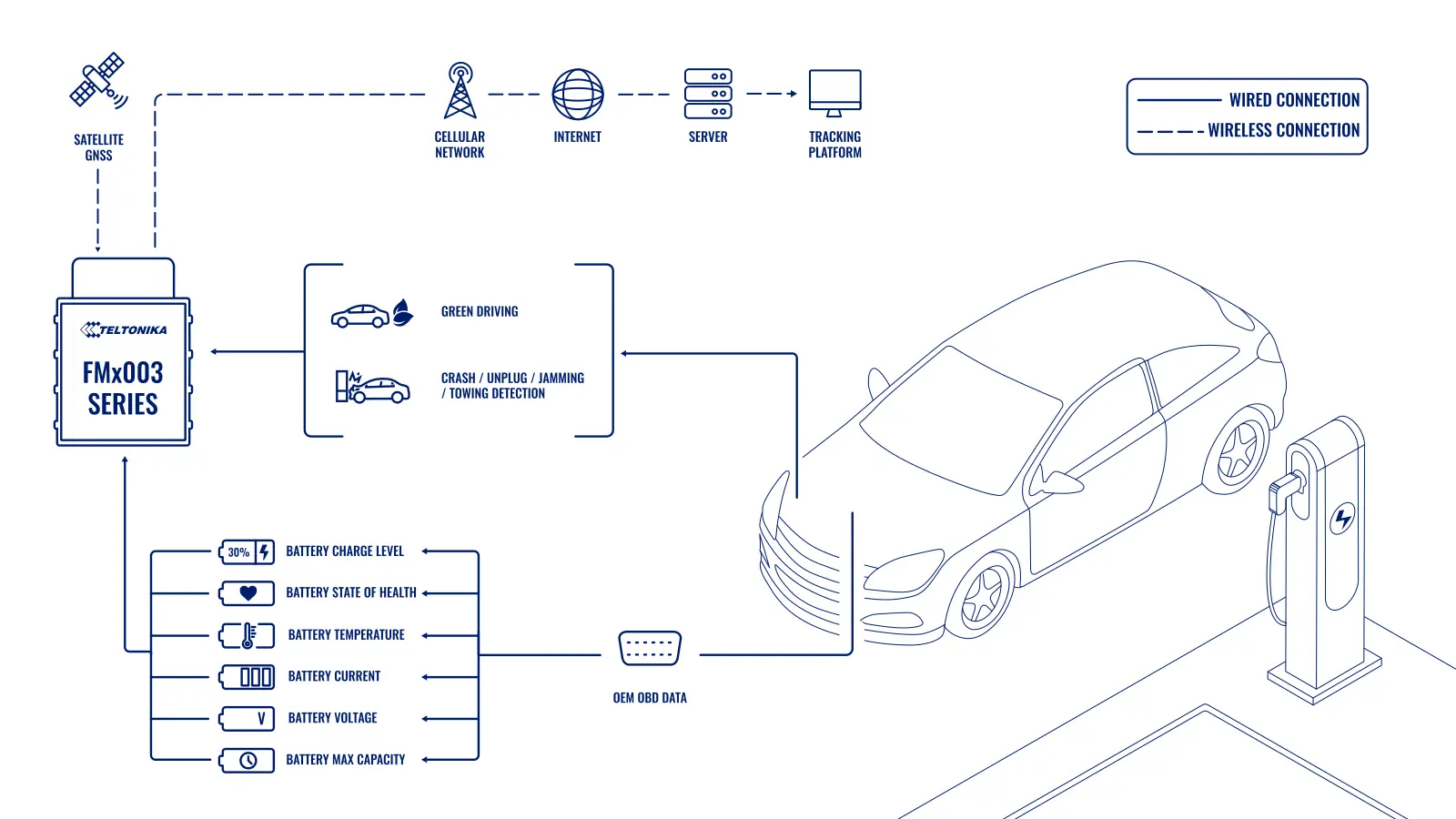
A Teltonika FMC003 tracker plugs into an electric vehicle's OBD-II socket and reports the state of charge, the remaining state of health (SOH) and the temperature of the high-voltage battery, straight from the battery management system.
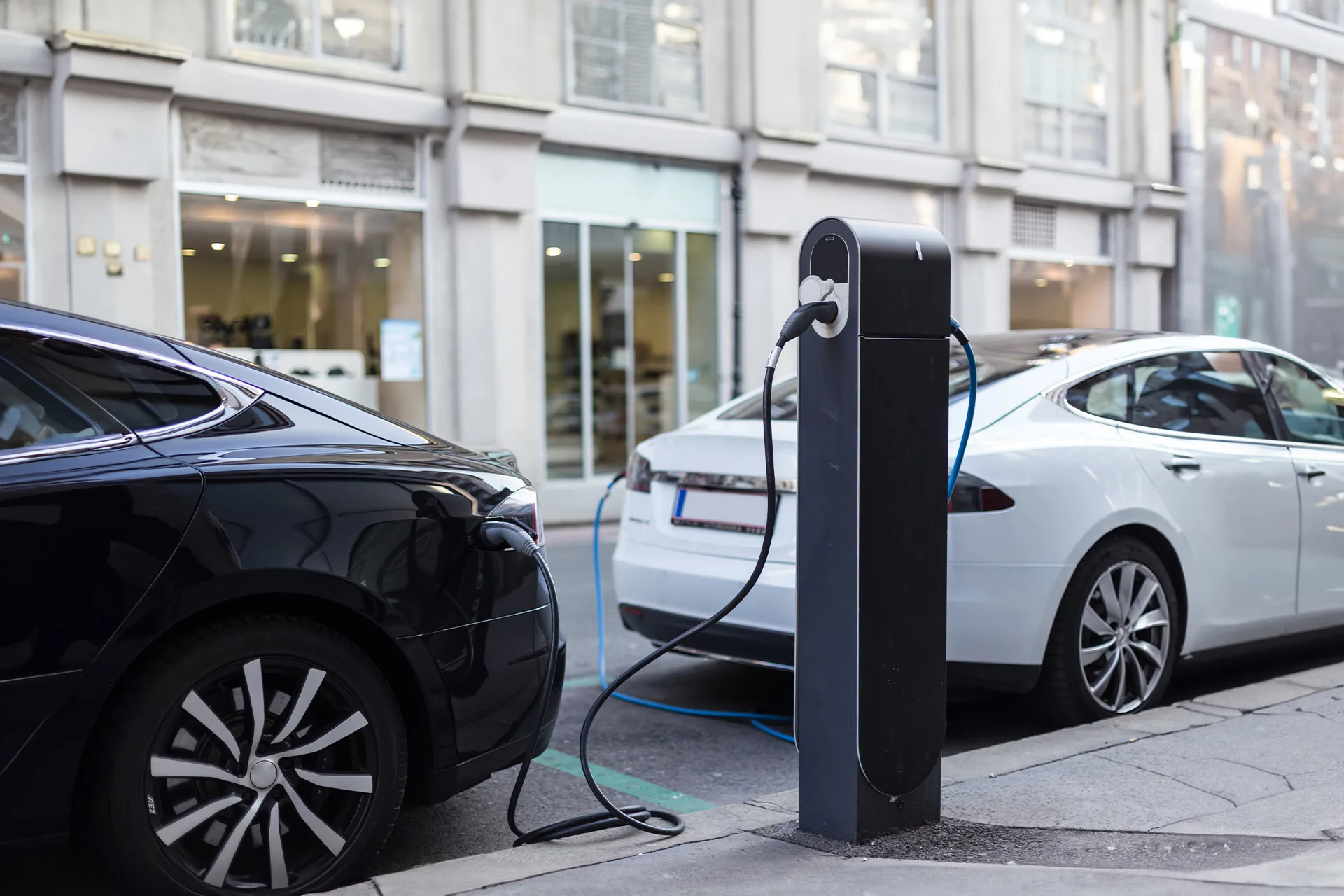
A Teltonika FMC003 tracker plugs into an electric vehicle's OBD-II socket and reports the state of charge, the remaining state of health (SOH) and the temperature of the high-voltage battery, straight from the battery management system. Electric vehicles are appearing in corporate fleets more and more often: cheaper to maintain, lower energy costs, no exhaust in town. But they bring a new concern with them. The main and most expensive component of the vehicle is the traction battery, and its condition cannot be judged from the dashboard. In this case study Teltonika shows how an OBD tracker from the FMx003 range helps the fleet manager see how much charge each vehicle has, how the battery is ageing and whether it is overheating.
What this scenario solves
The electric vehicle market is growing fast: industry forecasts put it above $800 billion by 2027, with average growth of around 21.6% a year since 2020.
Fleet owners are moving to electric vehicles, but many are still managing them with tools inherited from internal combustion vehicles.
The battery is expensive and it ages.
Over time its capacity falls, the range shrinks and maintenance costs rise.
The electric vehicle market is growing fast: industry forecasts put it above $800 billion by 2027, with average growth of around 21.6% a year since 2020. Fleet owners are moving to electric vehicles, but many are still managing them with tools inherited from internal combustion vehicles.
The battery is expensive and it ages. Over time its capacity falls, the range shrinks and maintenance costs rise. Without monitoring, that process goes unnoticed until the vehicle can no longer complete a day's route.
A sudden battery failure takes a vehicle out of service. If the problem was not spotted in advance, the vehicle stops in the middle of a shift, has to be recovered, and its route has to be covered urgently by another vehicle.
The dispatcher cannot see the charge on the dashboard. He does not know which vehicles are ready for a run in the morning and which were not put on charge overnight. Planning who goes out on the road has to be done blind or by ringing the drivers.
Charging the fleet is a headache of its own. If every vehicle is put on charge at the same time in the evening, the peak load on the supply and the electricity bill both rise. Without data on the current charge of each vehicle, spreading charging out over time is impossible.
Without data on charge and remaining capacity, charging is planned by eye. Some vehicles go out on the road undercharged, others sit for weeks at 100%, even though long storage at full charge is generally not recommended for lithium-ion batteries. How much that accelerates wear depends on the battery chemistry and the duty cycle, but it is better decided from figures than from habit.
Temperature is a separate risk. A lithium-ion battery copes badly with overheating and with hard frost. A fleet working in a hot or changeable climate needs to see the battery temperature so that charging and operating regimes can be changed in good time.
What Teltonika offers
The FMC003 plugs into the OBD-II diagnostic socket in a couple of minutes, reads data from the battery management system (BMS) and sends it to the server together with the coordinates, so the dispatcher sees the charge, the SOH and the temperature of every vehicle in real time.
Installation and setup
Fitting the device and configuring it for the fleet scenario at hand.
Data transfer
The device collects data and sends it to the monitoring platform; how often depends on the model and its settings.
Analysis and control
The person in charge gets reports and alerts and looks into what stands out.
The device. FMx003 is a range of compact Teltonika trackers that draw both power and data straight from the OBD-II socket, the vehicle's built-in self-diagnostic system. There are 2G and 4G LTE versions; this case study looks at the FMC003 with LTE. No wiring has to be run: the tracker plugs into the socket under the steering wheel and the vehicle goes out on a run the same day.
What data is transmitted. From the electric vehicle's BMS the tracker reads the state of charge of the high-voltage battery (SOC), the charge level, the state of health (SOH) and the battery temperature. To that are added the usual telematics: position, mileage, speed, operating time.
Charge and vehicle readiness. At any moment the dispatcher can see which vehicles have enough charge for a shift and which need putting on charge. The morning dispatch is planned from actual data rather than from what the drivers report.
The charging schedule. Knowing the charge of each vehicle, you can spread charging out over time: first those leaving earlier or going further, then the rest, in the night hours where possible. That reduces the peak load and helps avoid holding the whole fleet at 100% when there is no need.
Battery ageing. SOH shows how much capacity the battery has left relative to a new one. If SOH on one vehicle is falling noticeably faster than on its neighbours of the same model, that is a reason to have it checked at a workshop before the problem turns into a failure. Comparison within the fleet is especially useful: identical vehicles with identical mileage should age at roughly the same rate, and one that stands out from the row is spotted at once. In the long run this data helps in planning battery replacement and in assessing the residual value of vehicles at sale.
Temperature. The tracker reports battery temperature in real time. If the battery often runs hotter than normal — during fast charging in hot weather, for instance — that shows up on the graph, and the regime can be changed: charge more slowly, park the vehicles in the shade, avoid fast charging in the hottest hours.
Reacting to deviations. Notifications are set up for the parameters that matter: low charge on a vehicle out on the road, battery overheating, a sharp drop in SOH. The dispatcher learns about the problem straight away rather than after a call from a driver on the verge.
An example from fleet life. In the evening the dispatcher opens the vehicle list and sees that three electric vehicles are below 20% charge and are on long routes tomorrow. He puts those on charge first, while for the ones at 60-70% with a short day in town he moves charging to the night. In the morning all of them go out with the reserve they need, and not one stops in the middle of a shift.
Analysis of mileage and energy consumption. Set the charge against the mileage and you can see how much energy each vehicle uses per 100 km. A sharp rise in consumption on one vehicle on the same routes is a reason to check the tyres, the brakes or the driver's style. Hard acceleration in an electric vehicle eats into the range just as noticeably as it eats fuel in a conventional one.
Checking the readings. Before the figures are trusted, they are checked. On a pilot vehicle the charge shown in the platform is compared with the dashboard or the manufacturer's app, and you confirm whether SOH and temperature arrive at all and how often the values update. If SOH on some vehicle has started falling noticeably faster than on its neighbours, that is a reason for service diagnostics at the dealer: the tracker's data shows a trend, and the workshop makes the diagnosis.
Planning replacement. Once the fleet has a year or two of SOH history, you can work out roughly when the batteries in particular vehicles will reach the threshold beyond which the range no longer covers a working day. That makes it possible to put battery replacement or fleet renewal into the budget in advance rather than learning about it from driver complaints.
What you get
Charging to a plan rather than out of habit
Knowing the exact charge of each vehicle lets you spread charging over time, cut downtime and reduce peak electricity bills.
Battery ageing is visible in advance
SOH for each vehicle shows where capacity is falling faster than it should, and the workshop has time to intervene before a failure.
The whole fleet is ready for the shift
In the morning the dispatcher sees the charge of every vehicle and keeps off the road those that will not complete the route.
The battery does not overheat unnoticed
Real-time battery temperature helps tune charging and operating regimes to the climate.
Fewer sudden breakdowns
Notifications about low charge and battery anomalies let you react before a vehicle stops on a run.
Fitted in minutes
The tracker plugs into the OBD-II socket with no wiring and no special skills, and the vehicle stays in service.
Why this solution
An OBD tracker is the simplest way of adding an electric vehicle to a monitoring system. The FMC003 requires no cutting into the wiring, which matters for new vehicles under warranty: the owner does not risk an argument with the dealer over interference with the electrics. The tracker can be removed and moved to another vehicle in minutes if the fleet is renewed.
The main value lies in access to BMS data. An ordinary GPS tracker shows where a vehicle is but knows nothing about its battery. The FMC003 reads charge, SOH and temperature, and those are precisely the parameters that determine both an electric vehicle's working schedule and its costs.
An honest limitation: the set of data available depends on the make and model of electric vehicle. Manufacturers expose battery parameters over OBD in different ways, and on some vehicles certain values, SOH for instance, may not be available at all. So before buying trackers for the whole fleet it is worth checking support on the specific models.
How this works in Azerbaijan. The number of electric vehicles in Baku has grown noticeably in recent years: they are being taken up by taxi services, corporate fleets and city delivery companies. In this climate battery temperature is no formality. In summer a vehicle stands in an open car park on Absheron under the sun at +40 °C, and fast charging in that sort of heat puts the greatest strain on the battery. Temperature data helps decide where to park the vehicles and at what hours it is better to charge them. For trips to the regions — to Ganja, Sheki, Guba — an accurate charge before departure matters: there are still fewer charging stations on the trunk roads than in the capital, and range has to be planned in advance. When fitting the system we first connect a tracker to one or two vehicles of each model in the fleet and see which BMS parameters actually come through, and only then fit the rest. GPS.az installs the FMC003, sets up the data reading and brings charge, SOH and temperature onto the Wialon platform, where graphs, reports and dispatcher notifications are built from them.
Related case studies
Related rollouts and equipment


Questions about the “Monitoring an electric vehicle battery over OBD” scenario
Request a call
A specialist will call back and match a solution to your fleet and your task.