
An OBD tracker for dealer stock
A dealership plugs a Teltonika FMC003 OBD tracker into every vehicle on the forecourt and sees the battery charge, the fault codes, impacts during transport and attempts to move a vehicle with the ignition off.
A dealership plugs a Teltonika FMC003 OBD tracker into every vehicle on the forecourt and sees the battery charge, the fault codes, impacts during transport and attempts to move a vehicle with the ignition off. A dealer has hundreds of vehicles standing on the site, new and used. Some of them are not started for weeks, some are taken out on test drives, some are still on their way from the factory on a transporter. And at the worst possible moment it turns out that the battery is flat in the very vehicle a buyer has come to look at. In this case study Teltonika shows how a simple tracker in the OBD socket helps keep the whole stock in order and avoid losing deals over small things.
What this scenario solves
A dealer's business rests on two lines: new vehicles and used ones.
Margins on new cars are shrinking, and for many dealers it is used vehicles that have become the main source of profit.
Which means every vehicle on the site has to be ready to show.
According to Automotive News, the average European dealer holds 279 new and 317 used vehicles.
A dealer's business rests on two lines: new vehicles and used ones. Margins on new cars are shrinking, and for many dealers it is used vehicles that have become the main source of profit. Which means every vehicle on the site has to be ready to show.
Dealer fleets are large. According to Automotive News, the average European dealer holds 279 new and 317 used vehicles. Keeping an eye on each one by hand is all but impossible.
Vehicles that stand for a long time deteriorate unnoticed. The battery goes flat, only the last few litres are left in the tank, a warning light comes on. All of it is discovered when the customer is already behind the wheel and the vehicle will not start. The deal falls through and trust is lost.
Damage in transit is hard to prove. A vehicle travels from the factory on a transporter or in a container, and it can be knocked during loading on the way. If that is only noticed once it is on the site, the argument with the manufacturer and the carrier about who is to blame drags on.
Staff do not always treat the vehicles carefully. Test drives, moves between sites, trips to the car wash and the workshop — everywhere there is a temptation to see what it will do. Wear and the risk of damage go up, and no trace is left.
The sites are vulnerable to theft too. An open forecourt with hundreds of vehicles on it at night is an attractive target, especially if a vehicle can simply be loaded onto a recovery truck.
What Teltonika offers
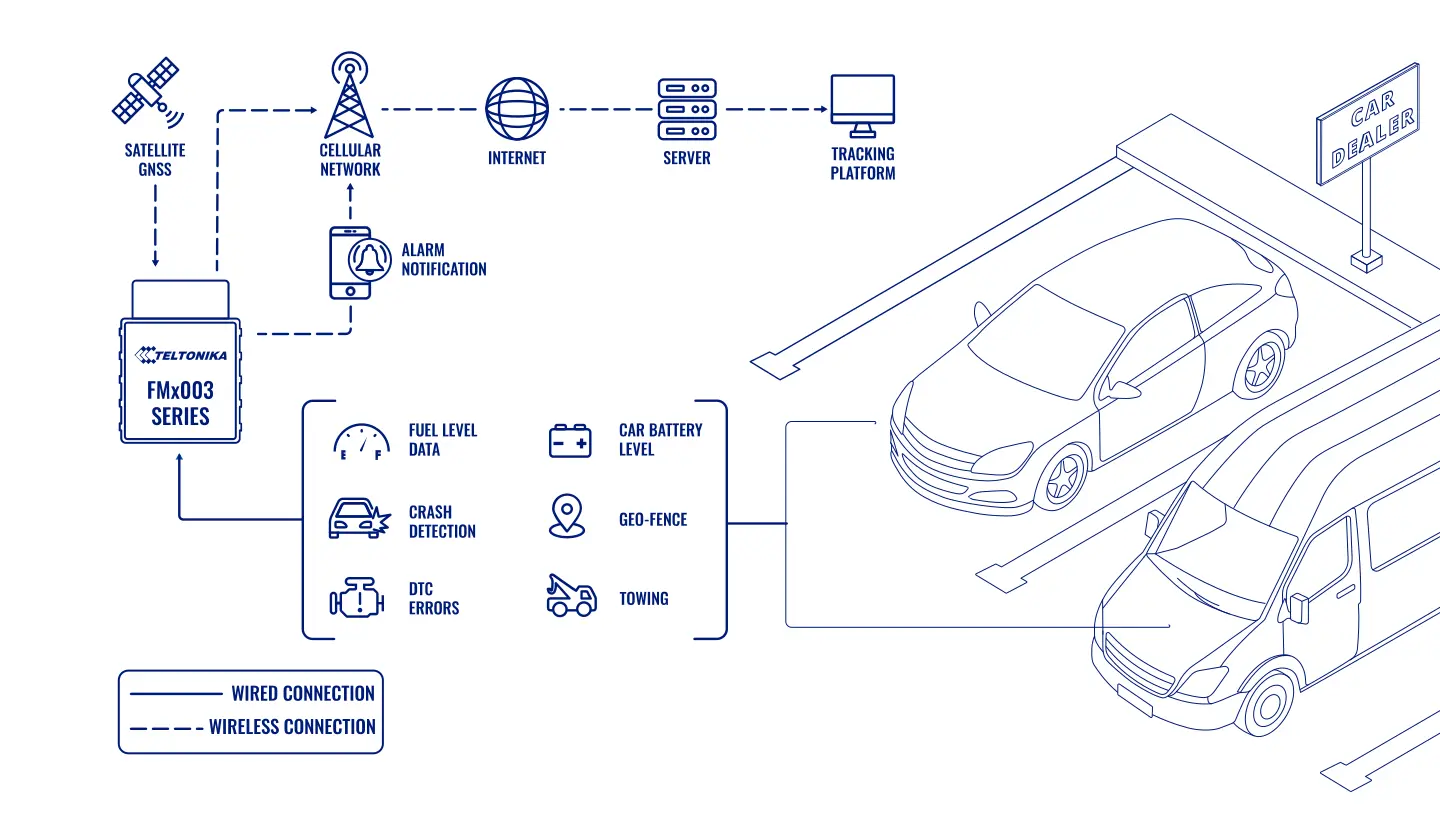
An FMC003 is plugged into every vehicle in stock — a compact tracker with an OBD connector that needs no fitting: it starts transmitting coordinates, battery charge data, fault codes and impact or tow events straight away.
Installation and setup
Fitting the device and configuring it for the fleet scenario at hand.
Data transfer
The device collects data and sends it to the monitoring platform; how often depends on the model and its settings.
Analysis and control
The person in charge gets reports and alerts and looks into what stands out.

The device. The Teltonika FMC003 works on 4G LTE Cat 1 with fallback to 2G, and has GNSS and Bluetooth. It is designed for cars and light commercial vehicles and suits dealers, hire companies and leasing companies. The tracker draws both power and data from the diagnostic socket.
Before the vehicle even reaches the site. The tracker can be plugged in at the factory or at a warehouse before despatch. If the vehicle is knocked while being loaded onto a trailer or into a container, the crash detection function will record the event together with the time and place. The dealer learns at which stage of the journey it happened, has time to put the damage right before the sale, and gains evidence for the conversation with the manufacturer or the carrier: the impact happened after the vehicle left the factory.
Faults during transport. On the way, a vehicle is sometimes started in order to drive it onto a container ship or move it about. If a fault appeared at that moment, the tracker will report the diagnostic trouble code (DTC) and the dealer will start dealing with it before the vehicle reaches the site.
The battery. The tracker monitors the voltage of the vehicle's electrical system. When it falls to a set threshold and the battery is close to being fully discharged, a notification arrives. A member of staff charges the vehicle in advance rather than at the moment a customer is already waiting.
The forecourt under watch. All Teltonika trackers have geofences: the boundaries of the site can be set in the Teltonika configurator, and the system will report if a vehicle has entered or left the zone. The tow detection function, working through the accelerometer, catches movement with the ignition off — in other words the moment someone tries to load the vehicle onto a recovery truck.
Staff behaviour. The FMC003 reports engine revolutions. If revolutions exceed a set limit on a test drive or a move, the dealer receives a notification. That makes it easy to see which members of staff push other people's vehicles hard, and to talk to them about the facts.
An example from forecourt life. In the morning the manager opens the vehicle list and sees three notifications about low battery charge — vehicles that have been standing in the far row for a month. They are put on charge before lunch. During the afternoon a buyer turns up for one of them, the vehicle starts first time, and the test drive passes without surprises.
What is needed from the dealer to get started. A list of the models in stock, the boundaries of the sites for the geofences, the voltage thresholds at which a vehicle needs charging, and the revolutions limit for test drives. The thresholds are better chosen model by model: different vehicles have different electrical systems and different quiescent current.
Fitting. Fitting is usually a noticeable part of the cost of any tracking. With the FMC003 there is almost none of it: the tracker goes into the standard OBD socket in a minute, and when the vehicle is sold it comes out just as easily and moves to the next one.
What you get
The vehicle is ready to show
Notifications about a discharged battery and fault codes arrive in good time, and the customer never meets a vehicle that will not start.
Damage in transit is visible
An impact event with a time and a place shows at which stage of the journey the vehicle was knocked, and gives grounds for a claim.
The forecourt watched round the clock
Geofences and tow detection report any attempt to take a vehicle off the site.
Staff treat the stock better
Monitoring revolutions on test drives and moves reveals hard driving and reduces wear on the vehicles.
Fitting without a technician
The tracker goes into the OBD socket in a minute and moves to another vehicle after a sale.
A history for the buyer
Data about a vehicle's mileage and use can be shown to the customer, and that adds confidence to the deal, especially with used vehicles.
Why this solution
For a dealer it matters that the tracker needs no fitting and leaves no trace. Nobody is going to take apart a new vehicle that will be sold tomorrow for the sake of some wiring. The FMC003 plugs into the OBD socket and comes out just as easily, so one and the same tracker serves dozens of vehicles over a year.
And yet its capabilities are enough for the real jobs a stock of vehicles presents: coordinates, battery voltage, fault codes, engine revolutions, impact and tow detection. The 4G LTE connection with 2G fallback works reliably both in town and at out-of-town warehouses.
By its own account Teltonika has shipped more than 15 million IoT devices, and the company's trackers are manufactured in Europe. For a dealer that means predictable quality and configuration through familiar tools.
The limitation is a simple one: a tracker in the OBD socket is in plain sight, and an experienced thief will find it and pull it out. For theft protection on expensive vehicles it is better to add a hidden tracker. And on some models the OBD socket is placed in such a way that the tracker gets in the driver's way, in which case an extension lead is needed.
How this works in Azerbaijan. Dealerships and used vehicle sites are concentrated in Baku and on Absheron, with large sites in Ganja and Sumgait. A considerable proportion of used vehicles arrive through Georgia along the M-2 and across the border at the Red Bridge, while new vehicles come on transporters and in containers. The transport stage is a long one here, and data about impacts on the way is very useful. On open sites in summer at +40 °C batteries discharge and age faster, while in winter the occasional frost finishes off batteries that are already weakened, so voltage notifications are far from superfluous here. When fitting the system we help set the voltage and revolutions thresholds for the specific models and map out geofences for the sites, and we choose SIM cards from Azercell, Bakcell or Nar. GPS.az supplies the FMC003 and brings the whole stock onto the Wialon platform: a map of the sites, a list of vehicles with low charge and fault codes, tow notifications and test drive reports.
Related case studies
Related rollouts and equipment



Questions about the “An OBD tracker for dealer stock” scenario
Request a call
A specialist will call back and match a solution to your fleet and your task.