
Remote tachograph downloads from vans
A Teltonika solution for vans up to 3.5 t on international work: the FMC150 tracker downloads tachograph and driver card files remotely, while TachoSync or a platform of your own keeps them for inspections.
A Teltonika solution for vans up to 3.5 t on international work: the FMC150 tracker downloads tachograph and driver card files remotely, while TachoSync or a platform of your own keeps them for inspections. From 1 July 2026 the tachograph requirements in the EU extend to light commercial vehicles over 2.5 t working on international runs. Van owners now need what freight operators have long been used to: keeping account of driving and rest time, downloading data regularly and storing it. The difficulty is that vans do not live the way articulated lorries do. They set off on a run quickly and may not call at base for weeks. Teltonika proposes taking manual downloading off them altogether.
What this scenario solves
Under the EU regulation, from 1 July 2026 vans over 2.5 t on international work are obliged to operate with a tachograph.
Daily driving is normally limited to nine hours, and may be extended to ten hours no more than twice a week.
After 4.5 hours at the wheel the driver needs a 45-minute break, or two breaks in a row: at least 15 minutes, then at least 30.
Tachograph and driver card data has to be downloaded regularly, and express vans often do not return to base for weeks.
Under the EU regulation, from 1 July 2026 vans over 2.5 t on international work are obliged to operate with a tachograph. Daily driving is normally limited to nine hours, and may be extended to ten hours no more than twice a week. After 4.5 hours at the wheel the driver needs a 45-minute break, or two breaks in a row: at least 15 minutes, then at least 30. Tachograph and driver card data has to be downloaded regularly, and express vans often do not return to base for weeks. The files have to be kept for at least 12 months, protected from alteration and found quickly during an inspection.
For many van owners this is a new reality. Before, they thought about the route and the delivery deadline. Now driving time, breaks, rest and the driver's other activities all have to be accounted for, and the limits cover the week as well: no more than 56 hours of driving in a week and 90 hours over two consecutive weeks. Runs have to be planned around those limits from the outset.
It is particularly hard in express logistics. An order comes in the morning, a couple of hours later the van is already on its way from sender to recipient in another country, picks up the next load there and so on. It may not see base for weeks. With manual downloading by key, that means missed deadlines and the risk of a fine at the next inspection.
The other half of the task is storage. Downloaded files must be kept for at least a year, protected from unauthorised access and alteration, and found within minutes during an inspection. A folder on the accountant's computer will not do for that: files get lost, versions get confused, everybody has access, and when a member of staff leaves nobody remembers where anything is.
What Teltonika offers
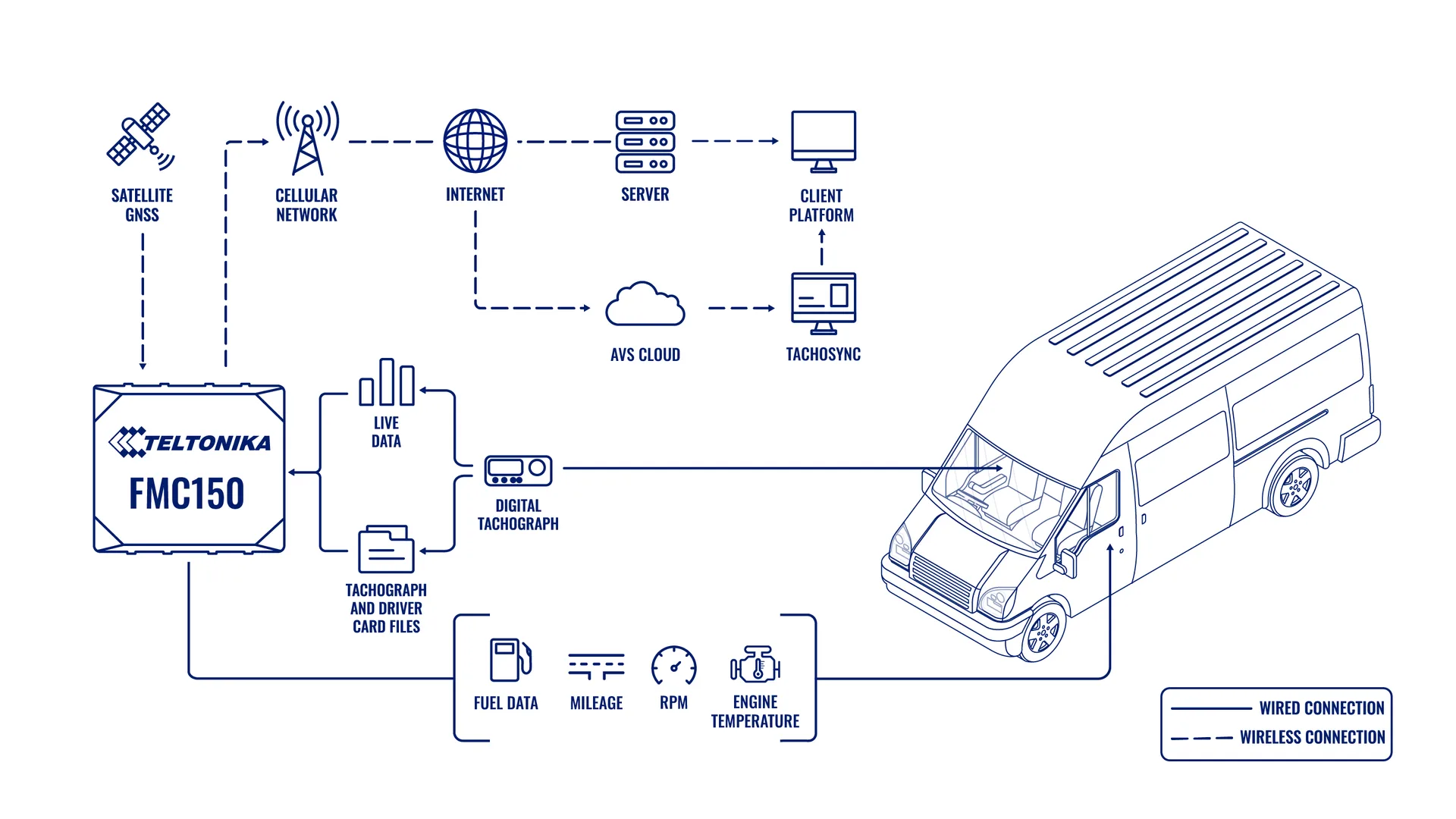
An FMC150 with dedicated tachograph firmware connects to the back of the tachograph and downloads unit and driver card files remotely to a schedule, while TachoSync or the integrator's own platform stores them and hands them out.
Installation and setup
Fitting the device and configuring it for the fleet scenario at hand.
Data transfer
The device collects data and sends it to the monitoring platform; how often depends on the model and its settings.
Analysis and control
The person in charge gets reports and alerts and looks into what stands out.
How it used to be. The van arrives at base, a member of staff puts the download key into the tachograph, downloads the files and then loads them by hand into a program for storage and analysis. It takes a long time, and it all rests on the vehicle having come back in time and the member of staff not having forgotten.
What the FMC150 does. The tracker connects to the tachograph through its rear panel and, on command, downloads data from the driver card and the tachograph unit. In parallel it transmits tachograph statuses in real time: driving, rest, other work. The dispatcher sees how long the driver has already spent at the wheel while the run is still going on. Teltonika publishes the connection diagrams for various tachograph models in its Wiki.
Why the FMC150 in particular. It is a proven tracker with a built-in CAN chip: it reads vehicle data without external adapters and supports more than 100 parameters, including electric vehicle parameters. For Europe, where there are ever more electric vans, that matters. Two CAN interfaces make it possible to download the tachograph and take vehicle data at the same time: fuel level, mileage, speed, engine operation.
The second part of the solution is the software that manages the downloads. There are two options.
The first is for integrators with a platform of their own. Teltonika provides a dedicated communication protocol over which the integrator's server requests tachograph files from the FMC150 itself and receives them. Downloading, storage and analysis become part of the existing monitoring system.
The second is TachoSync, a ready-made service from Teltonika, for those who do not want to develop anything. After the initial setup the FMC150 contacts TachoSync periodically, checks whether a download is due on the schedule and, if it is, requests the files after authorising with the company card. The files are stored in the cloud or passed over the API to a fleet monitoring system or a tachograph analysis program.
The storage supports access control: only those permitted to do so can view, export and pass on files. The main European formats are supported: .DDD, and also the regional ones — the Spanish .TGD and the French .V1B and .C1B. For an operator working in several countries that does away with conversion.
How it looks in practice. A van left Lithuania on Tuesday and until the following Wednesday is working between Germany, France and Spain. Once a week, to the schedule, TachoSync requests the files, the tracker downloads them from the tachograph out on the road, and they go into storage. If a download fails — because the driver took the card out, for instance — the person responsible gets a notification and has time to sort it out before the deadline. At an inspection the file needed is found by vehicle number and date within a couple of minutes.
What to think through at launch. First, the company card. Without it a remote download cannot be authorised, so you have to decide where it physically sits and how it connects to the service: in TachoSync that is done once, during setup. Second, the schedule. The deadlines for downloading the tachograph unit and the driver card are different, and the schedule is better built with some slack, so that one failed attempt because of a poor connection does not lead to an overdue file. Third, changes of driver. If different people drive the same van, their card data has to be downloaded while the card is in the tachograph, which means the driver card download is best tied to the start or the end of a shift.
And one more point — training. Drivers have to understand that taking the card out early or driving without it is not allowed: the system will see it, and it is the company that will answer for it at an inspection.
Compatibility checks and acceptance. Before purchase the manufacturer and version of the tachograph are recorded for each vehicle: the connection arrangement and support for remote downloading depend on it. After fitting, a trial download of the unit and the driver card is made, the resulting .DDD is opened in the analysis program, and the period, vehicle number and driver are checked for a match. Only then is the schedule switched on for the whole fleet.
Keeping track of download failures. A download can fail: the company card is unavailable, there is no driver card in the tachograph, the connection has dropped, the tachograph is busy with another operation. Every failed attempt should appear in a report with its reason, and a repeat download should start automatically. If a file has not been received by the set deadline, the person responsible gets a notification and contacts the driver.
Storage. Files have to be kept unaltered for at least as long as the regulation requires, with a log of who opened or downloaded them and when. Where the archive physically sits — in the TachoSync cloud, on the integrator's server or in the company's own system — is decided before launch.
What you get
The van does not have to call at base
The FMC150 downloads tachograph and driver card files remotely, to a schedule, in any country on the route where the tracker has a mobile connection.
Missed downloads show up at once
The system notifies you if a file has not been received, so deadlines are not missed unnoticed.
Driving and rest time in real time
Tachograph statuses are transmitted online, and the dispatcher plans the run around the driver's remaining time.
Storage ready for an inspection
Files sit for at least a year with access control and are found within minutes.
Formats for different countries
.DDD, .TGD, .V1B and .C1B are supported with no conversion, which suits an international fleet.
One tracker for the tachograph and the fleet alike
Built-in CAN and two interfaces give both the downloads and data on fuel, mileage and the engine.
Why this solution
Teltonika is a European manufacturer, with development and production in Lithuania and more than 28 years of experience. The EU tachograph requirements are not an abstraction for the company but the working environment in which its trackers have long been used on freight transport.
The FMC150 suits vans specifically. It is more compact and simpler than the heavy models for long-haul tractor units, yet it can do everything needed: the tachograph, CAN with no adapter, two interfaces. For light commercial vehicles that is a sensible balance of price and capability.
The choice on the software side matters too. To those who have a platform of their own, Teltonika gives the protocol and lets them build downloading into it. To those who need it quickly, the ready-made TachoSync. There is no waiting months for development while the date the rules take effect draws closer.
And beyond that the tracker goes on working for the fleet's economics: driving style, fuel consumption, data for servicing. The tachograph requirement becomes an occasion to put the whole fleet in order rather than simply one more obligation.
An honest limitation: remote downloading works with digital tachographs that have a suitable interface on the rear panel. On older analogue instruments this scenario is impossible, and before fitting it is worth checking the tachograph model in every vehicle.
How this works in Azerbaijan. The European regulation applies to transport into and across the EU, so it matters first of all to Azerbaijani operators whose vans run to Europe through Georgia and Turkey or along the Middle Corridor. Those working only within the country or with its neighbours should check the tachograph requirements in force separately, but the remote download scenario is useful to them as well: less work by hand and no lost files. For vehicles that spend long spells abroad on a run, roaming and a dependable SIM card matter, and we settle that at the preparation stage. GPS.az fits the FMC150, connects it to the tachograph, sets up the download schedule and delivers the files and driver statuses to the Wialon platform, where they can be viewed alongside tracks, fuel and fleet reports.
Related case studies
Related rollouts and equipment
Questions about the “Remote tachograph downloads from vans” scenario
Request a call
A specialist will call back and match a solution to your fleet and your task.