
Car rental without the queue: FMC150 and EYE Beacon
A Teltonika scenario for large rental operations: an FMC150 tracker in every car, an EYE Beacon Bluetooth tag on every key and a locker unit together let cars be handed over with no desk and no queue.
A Teltonika scenario for large rental operations: an FMC150 tracker in every car, an EYE Beacon Bluetooth tag on every key and a locker unit together let cars be handed over with no desk and no queue. A large rental company earns on turnover: the faster a car goes out to a customer and comes back ready to go again, the more rentals it books in a month. And it loses money on small things — queues at the desk, disputed scratches, tanks returned short of fuel, cars standing idle because a fault went unnoticed. Below we go through how Teltonika proposes to automate handover, record keeping and vehicle protection, and what the fleet manager sees while it happens.
What this scenario solves
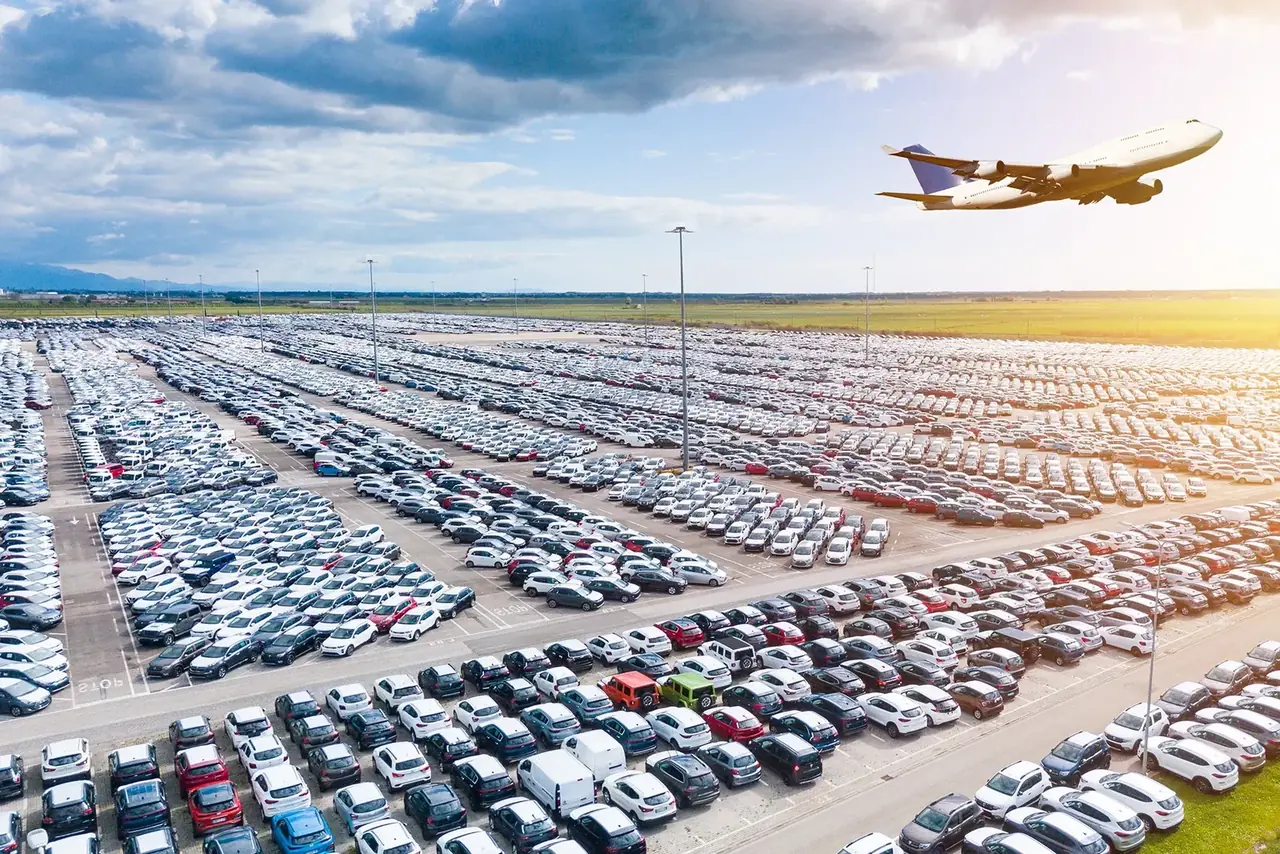
A customer lands at the airport and spends an hour queuing at the rental desk.
Then he hunts for the right grey car among dozens of similar ones in the car park.
Arguments about scratches and dents on return end in complaints and poor reviews.
The manager cannot see what condition a car is in right now or where it is being driven.
A customer lands at the airport and spends an hour queuing at the rental desk. Then he hunts for the right grey car among dozens of similar ones in the car park. Arguments about scratches and dents on return end in complaints and poor reviews. The manager cannot see what condition a car is in right now or where it is being driven.
The market, meanwhile, is large and growing. According to ZIPPIA research, car rental worldwide brings in about 40.65 billion dollars a year. The more customers there are, the sharper the competition on speed and convenience.
The most painful moment is the handover. A flight lands, hundreds of passengers head for the desks at the same time, and half of them need a car. Explaining the rental terms and pointing out existing bodywork damage to a foreign visitor with little of the local language is harder still. For the company this is a direct loss: negative reviews on booking sites, fewer repeat rentals, more staff on shift.
There are problems after the handover as well. A customer may drive aggressively, leave the engine idling for long stretches, or bring the car back with the tank almost empty. Someone may try to steal the car, including by substituting a key. Without data from the car itself, all of this comes to light late and is hard to prove.
What Teltonika offers
Every car carries an FMC150 tracker, every set of keys carries an EYE Beacon tag, and the handover runs through a locker unit and a mobile app: the customer collects the key with a code, finds the car on a map and drives away without visiting the desk.
Installation and setup
Fitting the device and configuring it for the fleet scenario at hand.
Data transfer
The device collects data and sends it to the monitoring platform; how often depends on the model and its settings.
Analysis and control
The person in charge gets reports and alerts and looks into what stands out.
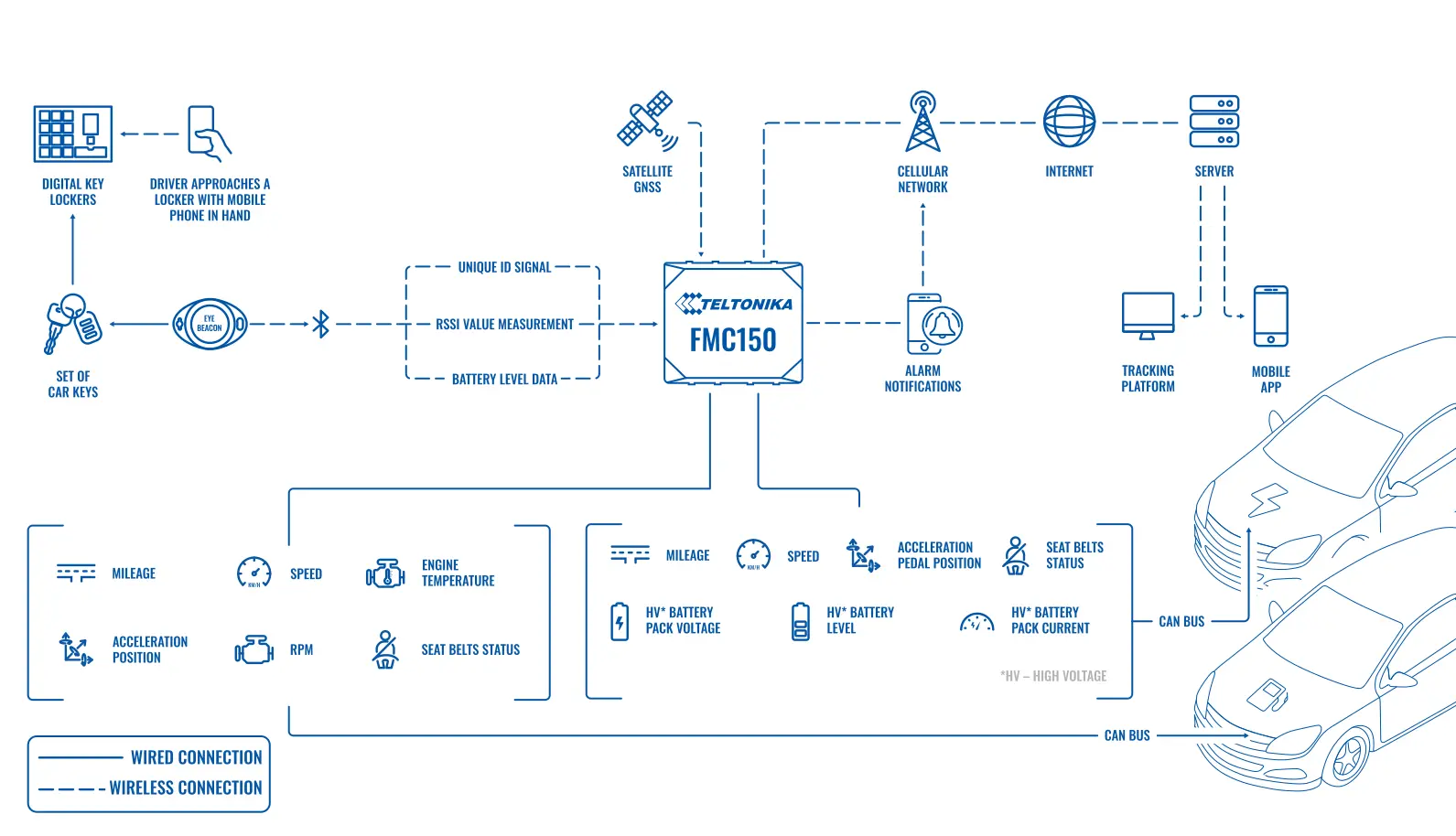
The equipment. The FMC150 is a tracker from the ADVANCED range with a built-in CAN bus processor. It reads more than 25 vehicle parameters, supports more than 1500 car models and sends data over LTE Cat 1. No separate CAN adapter is needed, so fitting is simpler and cheaper. The EYE Beacon is a compact Teltonika Bluetooth tag that attaches to the key fob, and it has its own app for configuration.
What the tracker sees in the car. On petrol and diesel cars: fuel level as a percentage or in litres, total mileage, engine temperature, revs, throttle pedal position, speed, battery voltage and whether the seat belts are fastened. On electric and hybrid cars: battery charge level, voltage, current and power. The set depends on the make and model.
The handover infrastructure. Besides the trackers and tags, the rental point gets a locker unit with key compartments and the company launches its mobile app. The app links the booking, the locker, the key and a specific car.
Step 1. Collecting the key. The customer with a booking opens the app at the locker unit, receives a code and enters it. The compartment opens with the key inside, an EYE Beacon attached to it. The app shows immediately which parking space his car is in.
Step 2. Inspecting the car. At the car, the customer opens a checklist in the app listing all known scratches and dents. If he finds fresh damage, he photographs it and attaches it to the booking. There will be no argument on return: everything was recorded before the rental began.
Step 3. The drive. The customer opens the car, loads the luggage and gets behind the wheel. The FMC150 recognises the tag identifier on the key over Bluetooth and allows the engine to start. The rental has begun, and the tracker knows which key and which booking are in the car.
If the key is absent. If someone tries to start the car without the original key and its tag, the tracker does not see the identifier it expects and blocks the ignition. Stealing a car like that is noticeably harder, and an unexpected immobiliser often puts an intruder off altogether. That protects both the car and the insurer's money.
What the fleet manager gets. Rental billing can be automated: the tracker counts the distance covered and the fuel used, so the surcharge for excess mileage or a short tank is worked out from data rather than by eye. Alerts arrive for accidents, long idling and harsh driving. Oil level, battery voltage and other parameters are visible in real time, so a car that needs servicing is pulled from the fleet before a customer runs into a breakdown.
The return. The customer parks the car and puts the key back in the compartment. The system already knows the mileage, the fuel left and how the car was driven. All that remains for the staff is to look over the bodywork and compare it with the photographs in the app.
Geofences and remote immobilising. Zones are drawn on the map: the rental point's own site, the city, the region where driving is permitted. Leaving a zone sends the manager an alert. If a car is not returned on time and the customer is out of contact, its position is visible on the map, and if need be the engine can be immobilised remotely as soon as the car stops.
Electric cars in a rental fleet. With electric cars the main question is charge. The manager sees the battery level of every car and does not hand a customer a car with 20% charge for a trip to another city. After the return it is clear which cars need to go on charge first.
What a peak evening looks like. Three flights land one after another, the time when rental desks normally have a queue. Here, customers with bookings go straight to the locker unit, collect their keys in a couple of minutes and spread out across the car park, guided by the map in the app. The member of staff on shift deals only with those who have no booking or a question. The manager, meanwhile, sees on screen which cars have already left and which are still in their spaces.
Reports for management. At the end of the month it is clear how many times each car was rented, how long it stood idle, the average mileage per rental, and how many harsh driving and idling events there were. Those figures inform decisions about which models to keep in the fleet, where to open new points and when to sell cars on.
Managing the devices. FMC150 firmware and settings are updated remotely over FOTA WEB. For a fleet of hundreds of cars that means they do not have to be gathered on a forecourt to change a single parameter.
What to bear in mind. The locker unit and the mobile app are the part of the solution built by an integrator or by the rental company itself; the tracker and the tag provide data and immobilising, but they do not replace a booking system. Ignition immobilising is wired so that it cannot engage while the car is moving. The tag's signal strength is set so that the tracker does not pick up keys from neighbouring cars in a tightly packed car park.
Who controls immobilising, and how. A remote immobilising command is sent only by staff with a separate right to issue commands, and every command stays in the log with its time and author. The sequence is best written down in advance: car not returned on time → call to the customer → notice under the contract → immobilise once it has stopped → call the police if there are signs of theft.
What belongs in the rental contract. The customer is told about the tracker, the geofences and possible immobilising, what trip data is collected and how it is used when surcharges are calculated.
Limitations. Immobilising makes theft harder but not impossible. Recovering a car after a theft or a failure to return is police work; the tracker data helps them find the car.
What you get
Handover without a desk
The customer takes the key from the locker unit with a code and finds the car on the map himself, so the peak-hour queue disappears.
Fewer arguments about damage
The checklist and photographs in the app record the state of the bodywork before the drive, so on return nobody has to prove where a scratch came from.
Protection against theft
Without the original key and its tag, the tracker will not let the engine start.
Accurate rental billing
Mileage and fuel consumption come from CAN, so surcharges for excess mileage or a short tank are worked out from data.
Cars in sound condition
Engine and battery parameters are visible in real time, and cars with a problem are pulled from the fleet in good time.
Configured to the size of the site
Tracker configuration, tag signal strength and reporting intervals are chosen to suit both a small city point and a large airport.
Why this solution
The FMC150 combines a GPS tracker and a CAN processor in one housing, so a rental fleet of mixed makes needs no separate adapters. The long list of supported models matters particularly here: a rental fleet turns over quickly, and new cars have to connect without rework.
The tracker and the EYE Beacon together identify the key with no extra readers in the cabin. The same tag can also be used for key accounting: the system sees which fob is in which car at any moment.
The solution scales in stages. You can begin with trackers and reports on mileage and fuel, then add tags on the keys and start-blocking without a key, and launch the locker unit and self-service at one site before rolling it out to the others. The in-car equipment does not have to change along the way.
Teltonika operates in more than 160 countries, its devices are fitted in millions of vehicles, and FOTA WEB lets an entire fleet of trackers be managed from a single panel.
How this works in Azerbaijan. The main setting for this scenario is Heydar Aliyev International Airport in Baku, where demand for rentals rises sharply in season and during major events, and where many customers are foreign visitors. It also suits rental companies with points in central Baku, in Ganja, Gabala and Sheki, where tourists arrive in hired cars. On mountain routes — along the M-4 through Shamakhi or towards Guba and Gusar — alerts for harsh driving and engine overheating are useful. If a renter drives outside the permitted area, towards a border for instance, the geofences show it. Before deployment it is worth checking which CAN parameters are available on the models in your fleet, and settling in advance who builds the app and the locker unit. GPS.az, a Teltonika GOLD partner in Azerbaijan, fits the FMC150 and EYE Beacon, connects the cars to the Wialon platform and sets up reports on mileage, fuel and driving style along with alerts for rental managers.
Related case studies
Related rollouts and equipment

Questions about the “Car rental without the queue: FMC150 and EYE Beacon” scenario
Request a call
A specialist will call back and match a solution to your fleet and your task.