
The hidden TAT140 tracker against vehicle theft
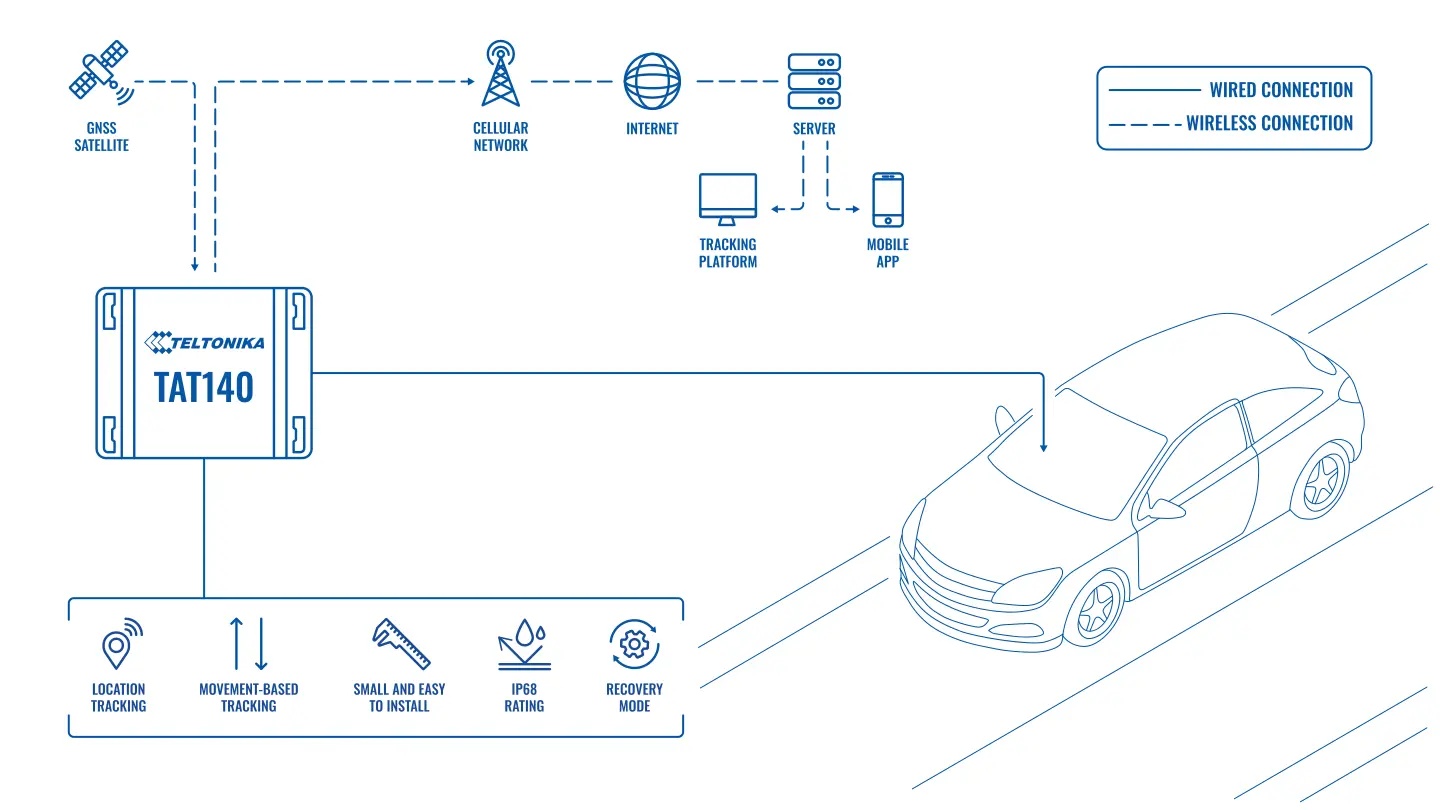
The self-powered TAT140 tracker with LTE can be hidden anywhere in a car without wiring: most of the time it sleeps and stays invisible to thieves' scanners, and on a schedule it wakes up and reports where the vehicle is.
The self-powered TAT140 tracker with LTE can be hidden anywhere in a car without wiring: most of the time it sleeps and stays invisible to thieves' scanners, and on a schedule it wakes up and reports where the vehicle is. For rental and leasing companies theft is a direct loss: the vehicle belongs to them, somebody else is driving it, and not always the person who signed the contract. An experienced thief finds the standard tracker under the dashboard in a few minutes, because he knows where to look for the wire to the battery. The Teltonika case shows how to close that gap with a second, hidden tracker, and where the approach makes sense in Azerbaijan.
What this scenario solves
Vehicle theft is on the rise, and rental companies feel it first.
An ordinary tracker is powered from the vehicle's electrical system, so its location is predictable.
A professional thief knows where to look and removes the tracker before he has driven far.
Fitting a wired tracker in every vehicle takes a fitter's time and costs money.
Vehicle theft is on the rise, and rental companies feel it first. An ordinary tracker is powered from the vehicle's electrical system, so its location is predictable. A professional thief knows where to look and removes the tracker before he has driven far. Fitting a wired tracker in every vehicle takes a fitter's time and costs money.
The scale of the problem. According to the American National Insurance Crime Bureau (NICB), more than a million vehicles were stolen in the United States in 2022 — the highest figure since 2008. The UK's Fleet News recorded a rise in thefts in the first half of 2022, after lockdown restrictions were lifted.
A wired tracker is good for day-to-day monitoring: speed, mileage, ignition, fuel. But as theft protection it has a weak point — the wire. The tracker has to be connected to power, which means it sits where power is easy to reach. An experienced thief checks those places first, and also hunts for the tracker with a radio signal scanner.
There is an economic side too. Every fitting is an hour or two of a fitter's work, and in countries with expensive labour that is a noticeable line in the budget, particularly where rental vehicles turn over often. What is wanted is a tracker you can simply put in the car and forget about.
What Teltonika offers
For this Teltonika offers the TAT140 — a self-powered tracker with LTE and GNSS running on an internal battery: it is hidden in any out-of-the-way spot in the vehicle, with no wiring, and each unit can go in a different place.
Installation and setup
Fitting the device and configuring it for the fleet scenario at hand.
Data transfer
The device collects data and sends it to the monitoring platform; how often depends on the model and its settings.
Analysis and control
The person in charge gets reports and alerts and looks into what stands out.

Reporting modes. The TAT140 is configured to the job in hand, and there are three main options.
The first is periodic reports that take movement into account. On the move, positions come more often; parked up, less often. The battery lasts longer that way and the owner still sees the route.
The second is movement events only. The tracker sends a short record the moment the vehicle starts moving, without waiting for a new position fix (provided a fix had already been obtained beforehand). The message goes out faster and the manager knows straight away that the vehicle has moved. If no journey should be happening at that hour, he can act immediately.
The third is a weekly schedule. The operator picks the days and times for reports. Two positions a day on ordinary days, for example, and three on days when the theft risk is higher in the area where the vehicle is parked.
Why it is hard to find. Most of the time the TAT140 sleeps and emits nothing. A thief with a scanner sweeps the vehicle, but in sleep mode the tracker cannot be detected. Later it wakes on its schedule and sends its position.
What to do after a theft. The operator sends the tracker a command by SMS or GPRS to switch on recovery mode. In that mode the TAT140 reports its position frequently and the chances of finding the vehicle rise sharply. One important detail: a sleeping tracker will only receive the command once it wakes on its own schedule. So the interval between wake-ups is a compromise between battery life and how fast you can react to a theft.
How it works alongside the standard tracker. In practice the TAT140 is most often fitted as a second device. The main wired tracker supplies the day-to-day data while the hidden one stays silent. The thief finds and rips out the main one, assumes the vehicle is clean, and the TAT140 carries on reporting to its schedule.
An example from the rental trade. A customer took a car for three days and stopped answering the phone. The main tracker went quiet that first evening — it was most likely found and disconnected. In the morning the TAT140 wakes on its schedule and sends a position in a different part of town. The operator switches on recovery mode and from the next wake-up the positions come in frequently. The security team has a specific address rather than just a theft report.
What you get
A chance of getting the vehicle back after a theft
The TAT140 reports its position regularly, and frequently in recovery mode.
Fitting without a fitter
The tracker runs on its own battery, so no wiring and no special location are needed.
Every vehicle its own hiding place
With no wiring the tracker can go in a different spot in each vehicle, leaving a thief no pattern to search by.
Invisible to scanners
Most of the time the device sleeps and gives nothing away by radio.
Independent of the vehicle
Battery removed or wiring cut, the hidden tracker keeps working.
Why this solution
The TAT140 is compact, works on LTE networks, lives on its own battery and configures flexibly: reporting frequency, movement events, the schedule and recovery mode are all set in Configurator or remotely. For rental, car-sharing and corporate fleets it is a simple way to add a second layer of protection without reworking any wiring.
TAT140 data arrives in the same monitoring platform as data from the main trackers, so the dispatcher works in one window rather than two systems.
Limitations worth stating up front. A hidden tracker does not replace the main one: it does not read CAN, it cannot see fuel or ignition, and it cannot immobilise the engine. Its job is to find the vehicle. It also needs hiding with some judgement: satellite and mobile signals are weaker under body metal, so the spot is chosen so the tracker can see the sky at least through glass or plastic.
How this works in Azerbaijan. Theft and non-return affect rental companies in Baku that let cars to tourists and visitors, leasing companies, and owners of taxi fleets where vehicles are rented out to drivers. A separate risk is vehicles that someone tries to take out of the country or break up for parts. When implementing this we advise combining a main tracker with engine immobilisation and a hidden TAT140, and setting more frequent wake-ups for vehicles that go on long trips to the regions — Gabala, Sheki, Lankaran. Cabin heat of up to +60 °C in summer shortens battery life, so it is better to hide the tracker somewhere less exposed than under the windscreen. GPS.az fits both main and hidden Teltonika trackers, configures schedules and recovery mode, and brings both devices on one vehicle into Wialon with alerts for unauthorised movement.
Related case studies
Related rollouts and equipment



Questions about the “The hidden TAT140 tracker against vehicle theft” scenario
Request a call
A specialist will call back and match a solution to your fleet and your task.