
Accurate GPS for electric bikes in the city
A Teltonika solution for electric bike and scooter hire: the FTC921 tracker sees up to 41 satellites and holds an accurate position even among tower blocks, while relay control and sleep modes help to manage the machines without flattening the battery.
A Teltonika solution for electric bike and scooter hire: the FTC921 tracker sees up to 41 satellites and holds an accurate position even among tower blocks, while relay control and sleep modes help to manage the machines without flattening the battery. In the centre of a large city the satellite signal bounces off walls and glass, and the tracker starts lying by tens of metres or loses its position altogether. For car sharing that is a nuisance; for electric bike hire it is a direct loss, because the customer cannot find the bike on the map and goes to a competitor. In this use case Teltonika looks at how the FTC921 on the FT platform copes with urban canyons, and what else it gives the operator of an electric fleet.
What this scenario solves
Tall buildings block and reflect the satellite signal, and trackers in the city centre lose accuracy.
A bike or a scooter that is not on the map will be found neither by the customer nor by the service crew.
An ordinary tracker drains the vehicle's battery over long spells of standing.
The operator needs remote control: to immobilise a machine, to learn of a theft, to see it leave the permitted area.
Tall buildings block and reflect the satellite signal, and trackers in the city centre lose accuracy. A bike or a scooter that is not on the map will be found neither by the customer nor by the service crew. An ordinary tracker drains the vehicle's battery over long spells of standing. The operator needs remote control: to immobilise a machine, to learn of a theft, to see it leave the permitted area.
There are more and more tall buildings. In 2023 the number of buildings over 200 metres grew by 16% against 2022, and the average height of new skyscrapers reached 243.1 metres. Urban development is getting denser, and the signal problem only grows with it.
The electric bike market is growing at the same time: the forecast is about 10.4% a year from 2025 to 2029. The more machines there are in hire fleets, the more each positioning error costs. A bike that shows on the map in the middle of the next block means a missed ride, an irritated customer and a needless call-out for a service engineer.
Power supply has its particularities too. Electric scooters, electric motorcycles and electric rickshaws run on different voltages, and the tracker has to connect to them without extra converters. And a hire machine may stand a night, a weekend, sometimes a week without a ride — and the tracker must not flatten the traction battery in that time.
What Teltonika offers
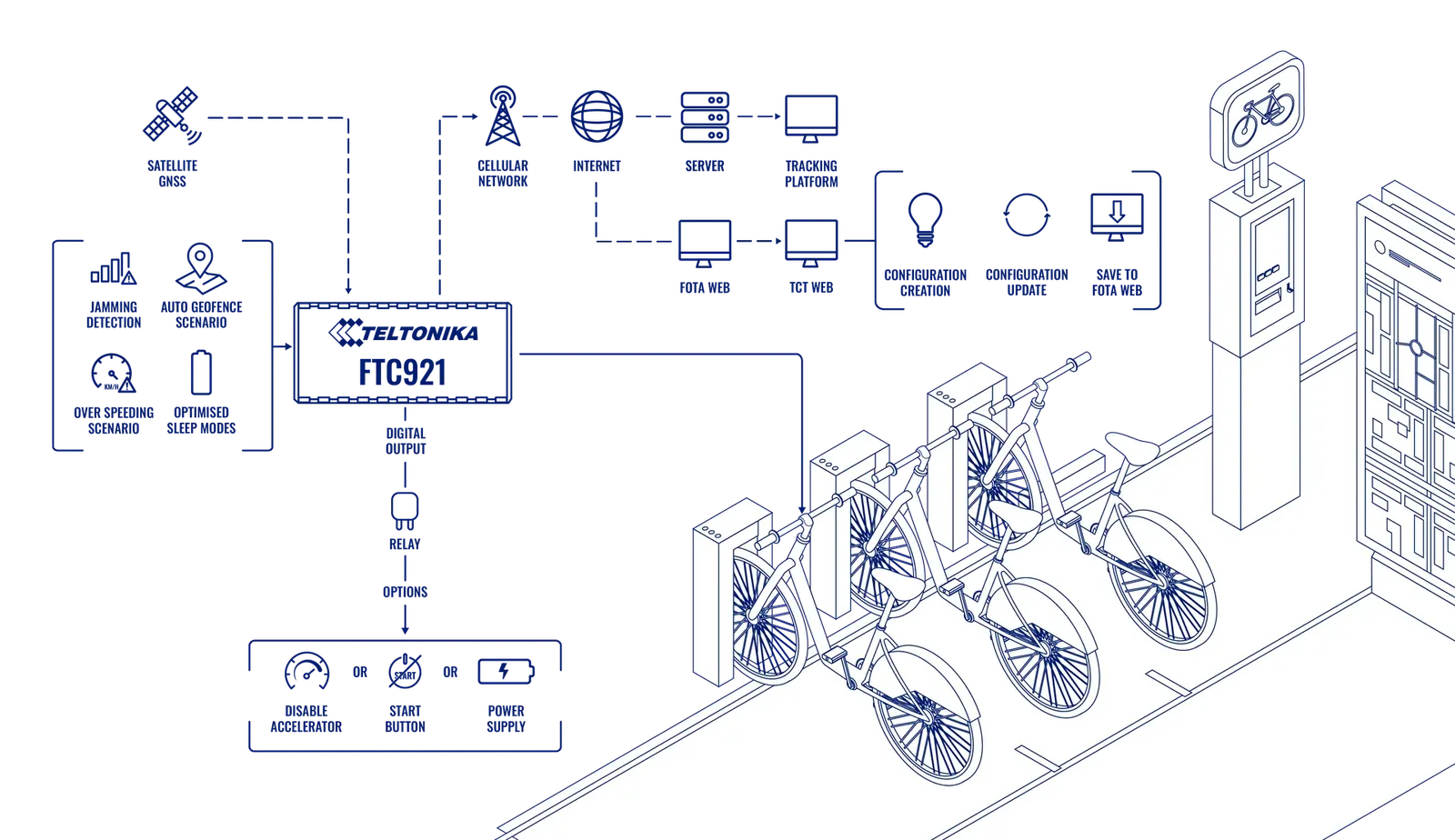
For urban electric mobility Teltonika has chosen the FTC921 on the FT platform: it receives signals from up to 41 satellites, works from 10 to 90 V, controls the machine through a relay and saves energy with three sleep modes.
Installation and setup
Fitting the device and configuring it for the fleet scenario at hand.
Data transfer
The device collects data and sends it to the monitoring platform; how often depends on the model and its settings.
Analysis and control
The person in charge gets reports and alerts and looks into what stands out.
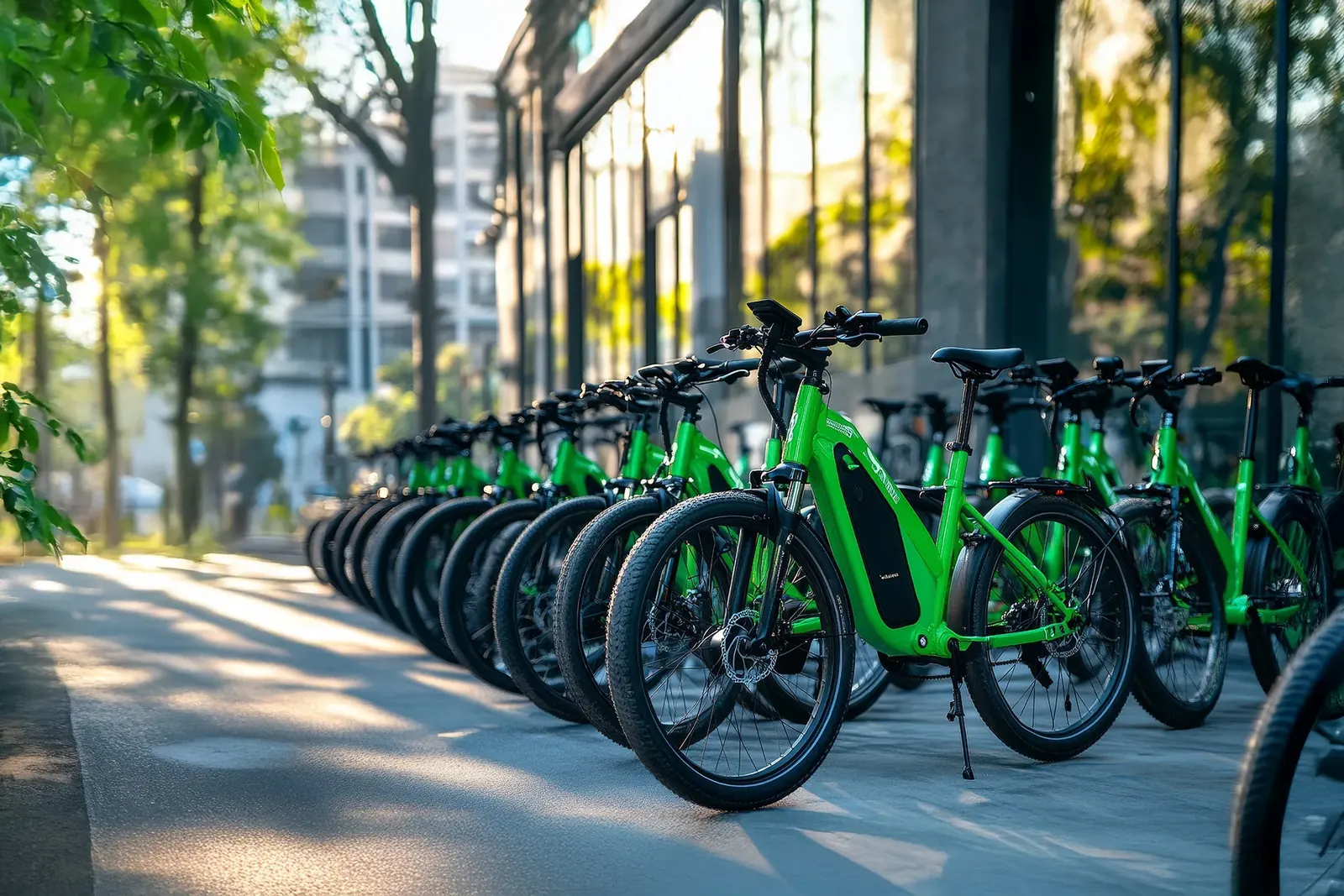
Accuracy. The FTC921's main advantage is a more sensitive GNSS module that works with a larger number of satellites at once, up to 41. The more satellites in the calculation, the less reflected and blocked signals affect the result. In dense development that means the bike on the map jumps about the neighbouring streets less often, though an error of a few metres beside tower blocks is still possible.
Power. The 10 to 90 V range makes it possible to connect the tracker straight to the battery of an electric bike, an electric scooter, an electric motorcycle or an electric rickshaw. There is no need to find a separate converter for each model in the fleet.
Control. The DOUT digital output is linked through a relay to the throttle, the start button or the motor power circuit. The operator sends a GPRS command and the machine is immobilised or released. That is how a rental starts and ends, and how a bike is stopped if someone is trying to take it away.
Energy saving. The FTC921 has three sleep modes: Deep Sleep, Online Sleep and Power Off Sleep. While the machine stands, the tracker uses almost no energy but stays online to whatever extent the operator needs. A hire bike can stand through a weekend and not be drained by the tracker.
Zones and security. The auto geofence scenario sends a notification when a machine leaves the permitted district or enters a forbidden zone. Speeding control helps to train customers into riding safely. Jamming detection shows that someone is trying to jam the tracker's signal — a typical sign of an attempted theft — and the operator gets the alert before the bike disappears from the map, provided the tracker managed to send it.
Administration. Firmware on every FTC921 in the fleet is updated remotely through FOTA WEB: fixes, new features, security updates. For configuration there is the Telematics Configuration Tool (TCT), a configurator for FT platform devices with a clear interface. Across a fleet of hundreds of bikes that saves technicians days of work.
What the operator's day looks like. In the morning the service crew gets a list of bikes with a low charge and their exact coordinates — with no searching round courtyards. During the day a customer leaves a bike by a business centre among tower blocks, and the next customer finds it on the map at the right building. In the evening the tracker on one of the bikes reports signal jamming and a departure from the zone. The operator sends the immobilise command, the motor stops working, and the crew drives to the last coordinates.
What to decide before buying. First, which circuit exactly the relay is to control: the throttle, the start button or the motor power. That determines how the machine behaves if it is immobilised while moving, and for city hire it is safer when the motor cuts out smoothly rather than in the middle of a junction. Second, which sleep mode to choose: if a parked machine has to accept a release command from the app straight away, Online Sleep with the connection kept up will suit; if the battery matters more, then Deep Sleep or Power Off Sleep. Third, how the tracker will be hidden in the frame: the harder it is to get at, the less chance a thief will simply cut the wires.
A pilot on 10 to 20 machines in the densest part of the city will quickly show how far the accuracy satisfies customers and how well the modes are set up.
The configuration for one bike. An FTC921 powered from the traction battery, a relay on the DOUT output in the throttle or start button circuit, the tracker hidden in the frame or under a cover panel. On the server side: geofences for the hire area and the forbidden districts, immobilise commands from the operator's app, notifications about jamming and a low charge.
Conditions for use. The scenario is meant for electric machines with a battery voltage in the 10 to 90 V range and room for a tracker with a view of the sky. If a bike is kept in an underground car park or inside a building, the tracker will show the last known point. Integrating the immobiliser with the hire firm's mobile app takes work by the operator's developers: GPS.az passes data and commands through the platform, while the rental logic is written by the owner of the app.
What the result of a pilot looks like. After two or three weeks the operator has a report on every bike: how many times it was found at the place given in the app, how many complaints there were about finding it, how much charge was used while parked in the chosen sleep mode and how many alerts were triggered. Those figures are what the decision to roll the configuration out across the whole fleet rests on.
What you get
More accurate among tower blocks
Up to 41 satellites in the calculation reduce the effect of reflected signal, and the machine on the map strays less often from where the customer left it.
Direct connection to electric machines
A 10 to 90 V supply suits bikes, scooters, motorcycles and rickshaws with no converters.
Immobilising on command
A relay on the DOUT output cuts the throttle or the motor, and a rental begins and ends remotely.
The battery does not drain while parked
Three sleep modes cut consumption while the machine waits for its next customer.
A signal of an attempted theft
Geofences and jamming detection warn the operator while the tracker is still online.
The fleet is configured remotely
FOTA WEB and TCT do away with handling each device by hand.
Why this solution
For hire firms the main thing is accuracy, and here the FTC921 has a real advantage: a new-generation GNSS module on the FT platform works with a larger number of satellites and copes better with reflected signal. That is precisely the problem customers curse sharing apps for.
The second is the wide supply range. An electric fleet is usually a mixed one, and a tracker that connects directly to any of them simplifies both purchasing and fitting.
The third is control and security in one device: a relay, geofences, speed monitoring, jamming detection. There is no need to add separate modules.
The fourth is tools for scale. FOTA WEB and TCT are built for fleets of hundreds and thousands of devices, and a firmware update does not turn into a tour of the parking areas.
An honest limitation: even the best GNSS module cannot see satellites in an underground car park or inside a building. There the tracker will show the last known point, and that is worth bearing in mind if customers like to leave machines in underground garages.
How this works in Azerbaijan. In Baku electric scooters, electric bikes and electric mopeds have become an everyday sight: couriers use them, tourists on the Boulevard, residents of the new districts. City hire firms and courier fleets face all the same concerns. The tall buildings along Babek Avenue, around White City, by Port Baku and in Yasamal create genuine urban canyons where an ordinary tracker loses accuracy. In summer, at +40 °C, it matters to fit the tracker so that it does not bake in the sun and the machine's battery does not drain while parked. On Absheron there is often a strong dusty wind, so the housing and the connectors need protecting from sand. GPS.az supplies the FTC921, fits the immobiliser relay and sets up geofences, notifications about jamming and speeding, and reports on mileage and idle time on the Wialon platform, and for hire firms helps to integrate the data into their own app.
Related case studies
Related rollouts and equipment


Questions about the “Accurate GPS for electric bikes in the city” scenario
Request a call
A specialist will call back and match a solution to your fleet and your task.