
Recording electric vehicle mileage without surveillance
A Teltonika use case from Estonia: for a government electric vehicle subsidy programme, an FMB130 tracker with an LV-CAN200 transmits nothing but the mileage from the CAN bus, while the coordinates are hidden by private mode.
A Teltonika use case from Estonia: for a government electric vehicle subsidy programme, an FMB130 tracker with an LV-CAN200 transmits nothing but the mileage from the CAN bus, while the coordinates are hidden by private mode. States and cities back the switch to electric vehicles with money, but they want to be sure the car is actually being driven rather than standing still for the sake of a grant. At the same time owners are not willing to hand officials the history of their journeys. In this use case Teltonika shows how a single firmware setting satisfies both requirements: the state sees the kilometres, and nobody sees the route.
What this scenario solves
Estonia gave buyers of electric vehicles a grant of 5,000 euros, but on condition that they covered at least 80,000 km in four years.
The state needs a reliable way of confirming that mileage for every grant recipient.
Many owners regard a tracker in their car as an intrusion into their private life and might have turned the programme down.
The tender therefore explicitly required that only the odometer be transmitted, with coordinates and all other data hidden.
Estonia gave buyers of electric vehicles a grant of 5,000 euros, but on condition that they covered at least 80,000 km in four years. The state needs a reliable way of confirming that mileage for every grant recipient. Many owners regard a tracker in their car as an intrusion into their private life and might have turned the programme down. The tender therefore explicitly required that only the odometer be transmitted, with coordinates and all other data hidden.
The background is straightforward. In most countries transport accounts for more than 20% of greenhouse gas emissions, and governments encourage the move to electric vehicles with subsidies, tax breaks and charging networks. The Estonian grant was paid on purchases from certified dealers belonging to the national car dealers' association AMTEL.
The mileage condition is a logical one: 16,000 km a year on average. The grant is meant to work towards lower emissions, not towards buying a second car that sits in a garage for years. Checking mileage from the instrument panel once a year is unreliable, so the state ran a tender for telematics companies to supply, fit and maintain the trackers.
And this is where the difficulty begins. An ordinary tracker records coordinates continuously. If the state were to receive the routes of thousands of private owners, confidence in the programme would collapse and questions of personal data protection would turn into a scandal. What is needed is a tracker that physically does not send coordinates but honestly reports mileage.
What Teltonika offers
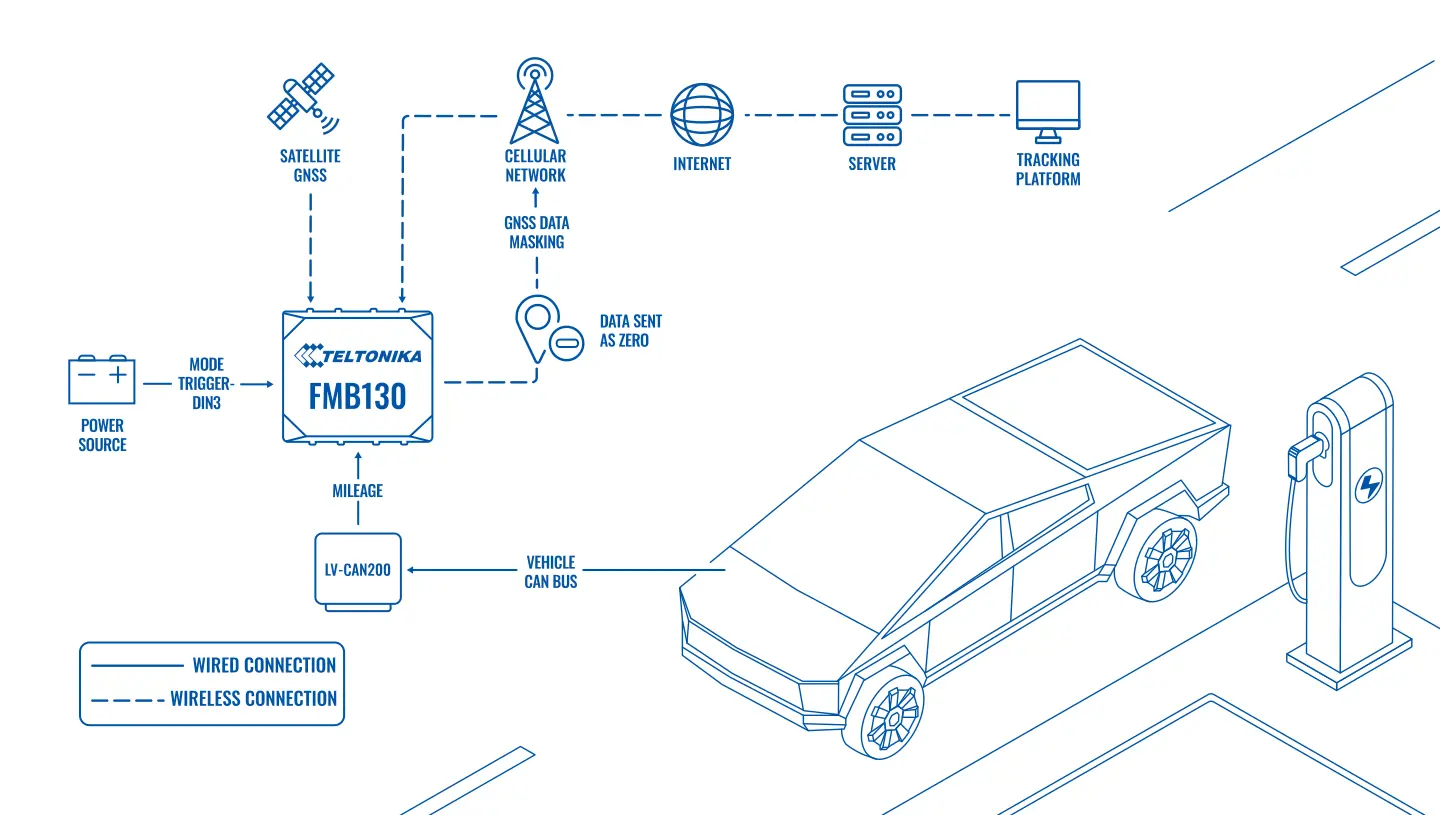
An FMB130 tracker with an LV-CAN200 adapter reads the electric vehicle's odometer from the CAN bus, while the private driving mode in the firmware sends zeros to the server instead of coordinates.
Installation and setup
Fitting the device and configuring it for the fleet scenario at hand.
Data transfer
The device collects data and sends it to the monitoring platform; how often depends on the model and its settings.
Analysis and control
The person in charge gets reports and alerts and looks into what stands out.
The FMB130 is a tracker from the ADVANCED series with 2G connectivity, several inputs and support for external adapters. The LV-CAN200 connects to the vehicle's CAN bus without cutting into the wiring and passes the tracker data from the on-board electronics, including the odometer reading. It was precisely this mileage, rather than a GPS calculation, that the customer needed: it matches what the owner sees on the panel.
The masking is implemented in Teltonika firmware version 03.25.05.Rev.132 and above, in the Private/Business Mode function. For the Estonian project it was configured so that private mode is on permanently.
How it was done. The digital input DIN3 was chosen as the mode trigger, with the input mode set to Button. DIN3 is permanently connected to power, so the tracker always considers the button to be pressed and works in private mode. The driver has nothing to switch, and the masking cannot be turned off by accident either.
The odometer calculation parameter was left enabled: mileage continues to be counted and sent to the server.
In the GPS masking section the option chosen was data sent as zero. In every record the tracker transmits zeros in place of latitude, longitude, altitude and number of satellites, and also in place of the cell identifier and the GSM location area code. From what the tracker sends, the location cannot be reconstructed even from the base stations.
The result is that the server receives exactly what the programme needs: vehicle identifier, time and mileage. No map, no routes. The tender requirements are met with a standard tracker and a firmware setting, with no special hardware developed.
It is worth remembering that this is a special case. The same FMB130 and LV-CAN200 pairing in normal mode can do a great deal more: speed, revolutions, mileage, pedal position, oil pressure and level, temperature, the state of the doors, bonnet and boot. The set depends on the model of the car, its year and its specification. On electric vehicles some parameters relating to internal combustion engines are naturally absent, but mileage and speed are available on most of the models the adapter supports.
If the project later changes its requirements — if operating zones or charging data are needed for a corporate electric vehicle fleet, say — that is handled by reconfiguring the firmware remotely, without a visit to the owner.
How this looks for each side. The owner of the electric vehicle comes in once for the fitting, and after that the tracker can be forgotten: no buttons, no apps, no logging. The programme operator receives a report once a month or once a quarter: this vehicle, this mileage for the period, this much accumulated since the programme began. If somebody is not going to reach 80,000 km by the end of the fourth year, that is visible well in advance rather than at the last moment.
An important point for trust: the owner can be shown the tracker settings and told that the coordinates do not go to the server at all, rather than merely not being displayed. That removes most objections to the fitting while the contract is still being signed.
What to do if the tracker is removed has been thought through as well. Loss of power is recorded as an event, and the programme operator can see if a device has stopped reporting.
What about the battery. The scenario is built on mileage, not on BMS data. State of charge, battery health and charging parameters are not available on every electric vehicle: a particular model either puts them on the bus or does not, and the adapter reads only what is there. If such data is needed, it is checked on one car of each model before purchase.
Powering the tracker. The tracker takes its power from the low-voltage on-board system. In an electric vehicle that system behaves differently when parked than it does in a car with an internal combustion engine, so the tracker's sleep mode consumption and its reporting frequency are configured so as not to drain the auxiliary battery during a long stand.
Connectivity. The FMB130 works on 2G networks. For a programme running several years it is worth asking the operator about its 2G plans in advance, or choosing a model with LTE. Mileage builds up in the tracker's memory and is sent when the network appears, so short breaks in coverage do not affect the final figure.
What you get
Mileage confirmed, route hidden
The state receives the odometer from the CAN bus, and the coordinates never leave the tracker, not even as cellular network data.
The odometer from the panel, not a GPS calculation
The LV-CAN200 gives the same kilometres the owner sees, so there is nothing to argue about.
The owner cannot switch the masking off by accident
Private mode is tied to a permanent signal on DIN3 and is always active.
Standard equipment instead of development work
The tender was met with a production FMB130 and a firmware setting, with no bespoke hardware.
Room for the future
If the programme rules change, the tracker is reconfigured remotely and can transmit more parameters.
Why this solution
The main thing is that the masking is done inside the firmware. The coordinates are not filtered out somewhere on the server, which an administrator has access to anyway; they simply are not sent. For projects involving personal data this is a matter of principle, and it is easy to explain to car owners.
Second, working with CAN without interfering. The LV-CAN200 connects to the bus without altering the factory electronics, and the fitting takes very little time. How the dealer for a particular make will view the tracker connection in a warranty claim is best clarified beforehand.
Third, flexibility of configuration. The mode trigger, the masking method and odometer counting are all set by parameters rather than by separate firmware for each customer. The same device can be used both in the Estonian programme with full anonymity and in a corporate fleet with ordinary monitoring.
An honest limitation: CAN support depends on the particular electric vehicle model. Before fitting in volume you need to check whether the car gives up its odometer through the adapter, especially on models that have only recently come to market.
How this works in Azerbaijan. Electric and hybrid vehicles are becoming noticeably more common in Baku, bought by private owners, taxi operators and corporate fleets alike. For companies that issue staff with electric or hybrid cars and reimburse their costs, this configuration makes it possible to record business mileage without invading people's privacy. It will also suit leasing companies, for which mileage matters when calculating wear but the client's route does not. There are many cars from China on the market, and on some models the CAN data is read incompletely — we check that before buying the trackers. Summer heat of up to +40 °C is no problem for the tracker itself, but we choose a fitting position away from direct sunlight under the windscreen. GPS.az fits the FMB130 with an LV-CAN200, configures private mode to suit your requirements and delivers mileage into reports on the Wialon platform.
Related case studies
Related rollouts and equipment
Questions about the “Recording electric vehicle mileage without surveillance” scenario
Request a call
A specialist will call back and match a solution to your fleet and your task.