
Servicing fire appliances from CAN data
A Teltonika scenario for fire and emergency services: the FMC225 tracker reads vehicle parameters from the CAN bus and gives warning of servicing before the machine lets the crew down on a call-out.
A Teltonika scenario for fire and emergency services: the FMC225 tracker reads vehicle parameters from the CAN bus and gives warning of servicing before the machine lets the crew down on a call-out. A fire appliance serves for 20 years, sometimes longer, and throughout that time it has to start first turn of the key. A pump or a ladder that fails at an incident costs more than any planned repair. In this solution Teltonika ties together three tasks: planned servicing based on real duty, recording accidents involving emergency vehicles, and keeping an eye on how a driver handles the vehicle with the siren on.
What this scenario solves
A fire appliance serves for around 20 years, and in reserve sometimes as long as 25, and towards the end of that life breakdowns become more and more frequent.
Repair after a failure is almost always dearer than planned servicing, and the budget of an emergency service is public money and limited.
Keeping servicing schedules by hand is difficult, because some vehicles stand for hours at an incident with the pump running while others do more driving.
Accidents involving emergency vehicles travelling with beacons and siren happen noticeably more often than average.
A fire appliance serves for around 20 years, and in reserve sometimes as long as 25, and towards the end of that life breakdowns become more and more frequent. Repair after a failure is almost always dearer than planned servicing, and the budget of an emergency service is public money and limited. Keeping servicing schedules by hand is difficult, because some vehicles stand for hours at an incident with the pump running while others do more driving. Accidents involving emergency vehicles travelling with beacons and siren happen noticeably more often than average.
The fleet is not uniform. In the city you need turntable ladders for high-rise buildings, at an airport there are vehicles of its own, in the countryside water tenders with powerful pumps and good off-road ability for forest and field fires. Each type has its own assemblies needing attention: pumps, hydraulics, extending ladders. Holding all of that in a spreadsheet without making a mistake is virtually impossible.
There is also the siren syndrome. A driver with the emergency lights and siren on starts to feel invulnerable and takes more risk than he should. To work on that you need data: exactly how the vehicle was being driven before the accident, at what speed, how it braked. Without them, investigating an accident comes down to one person's word against another's.
What Teltonika offers
Every vehicle is fitted with an FMC225 tracker and an ALL-CAN300 adapter: the system counts the duty hours itself, catches fault codes and warns the engineers about servicing, and in an accident it preserves the picture of the impact.
Installation and setup
Fitting the device and configuring it for the fleet scenario at hand.
Data transfer
The device collects data and sends it to the monitoring platform; how often depends on the model and its settings.
Analysis and control
The person in charge gets reports and alerts and looks into what stands out.
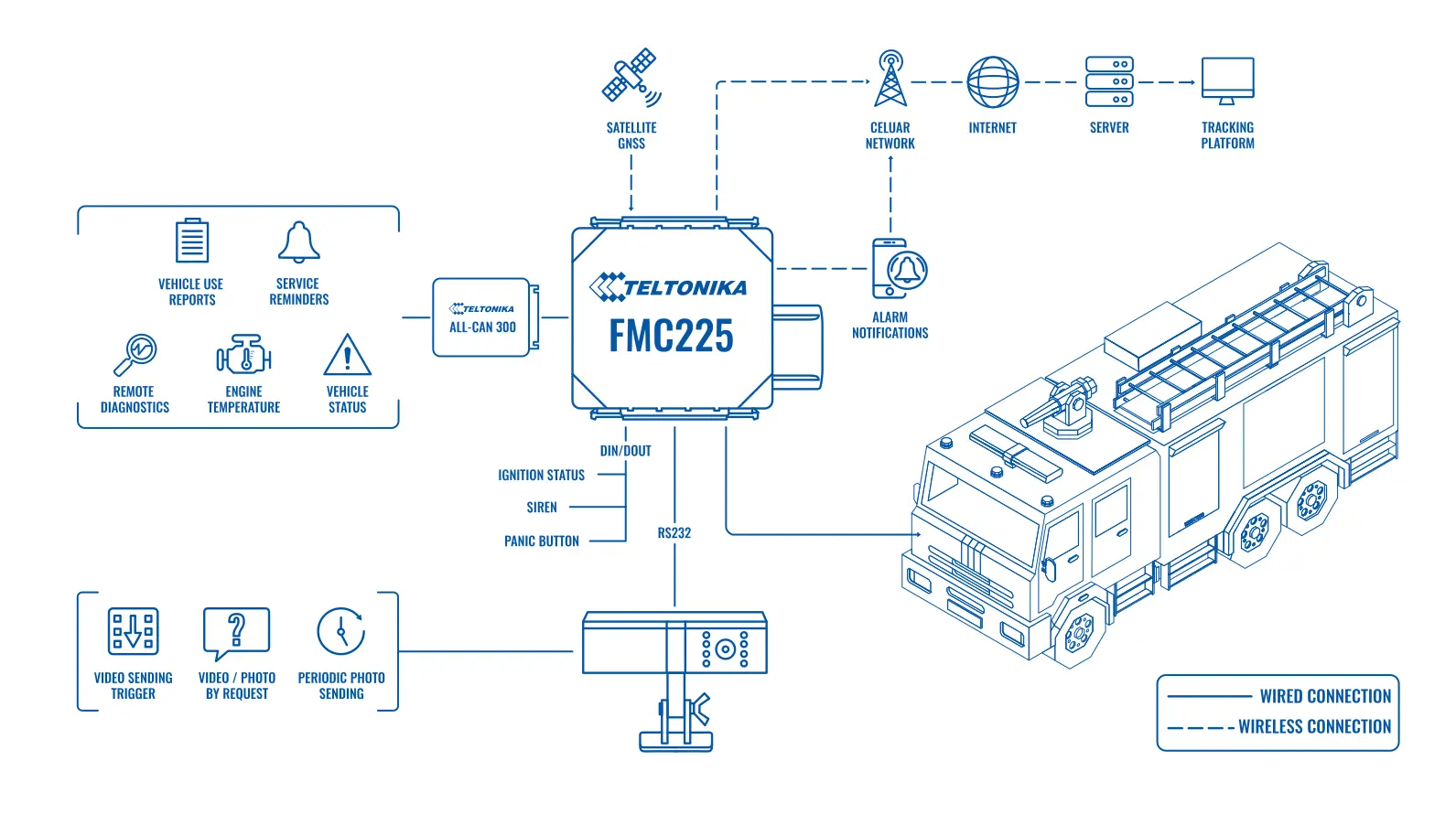
The FMC225 is a PROFESSIONAL series tracker in an IP67 housing; water, dirt and pressure washing hold no terrors for it, which for fire appliances is no formality. Connectivity is 4G LTE Cat 1.
The ALL-CAN300 adapter reads the vehicle's CAN bus without cutting into the wiring. Through it the tracker obtains mileage, engine hours, revolutions, engine temperature, fuel level and fault signals — more than 80 parameters in total, where they are available on the particular vehicle. Together with GNSS coordinates all of it goes to the server.
Service reminders are built on this data. The rules are set for each type of vehicle: for an urban turntable ladder by mileage, for a water tender that pumps for hours at a fire by engine hours. The engineer receives notice in advance, and the fleet manager learns immediately if a warning light has come on in one of the vehicles.
A built-in three-axis accelerometer is used for accident investigation. When the g-force of an impact exceeds a threshold, the tracker records accelerometer data for 15 seconds before the event and 15 seconds after. That recording shows whether there was a sharp attempt to brake, which side the impact came from and at what speed it all happened.
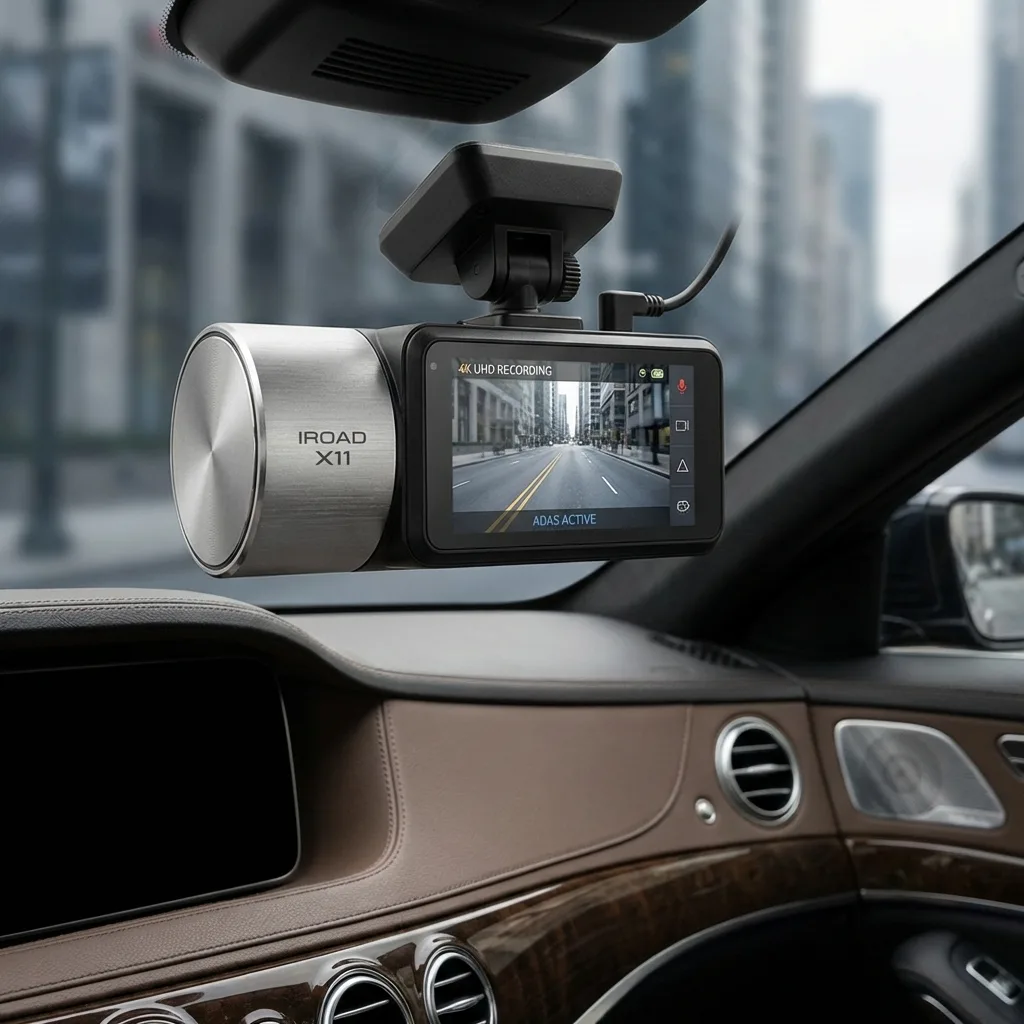
Additional equipment is connected to the tracker through the RS232 port. The first option is a DualCam camera, which films the road and the cab at the same time. In a city, where accidents involving emergency vehicles are most frequent, it helps to counter the siren syndrome: the driver knows his driving is being recorded. Footage of the road also comes in useful in discussions with the insurance company.
The second option, for rural districts, is a Garmin navigator to which the dispatcher sends the incident location remotely. The driver does not have to recall an address in unfamiliar country, and he watches the road rather than a phone.
How it looks in practice. In the morning the garage manager opens the vehicle list and sees that two water tenders are due an oil change in 20 engine hours, that a turntable ladder has been reporting an oil pressure fault for three days, and that a reserve vehicle's battery is going flat because it has not been started for a week. Previously all of this would have surfaced on a call-out. Now he queues the vehicles for service in advance and always knows how many appliances are ready to respond right now.
And if a vehicle is involved in an accident on the way to a fire, management already has the accelerometer recording, the track with speed, a mark showing the siren was on and, where a DualCam is fitted, video. That is the basis for an internal investigation, a conversation with the insurer and driver training, rather than a retelling by those involved.
What is worth settling in advance. The set of CAN parameters depends on the make and year of the chassis: on modern vehicles more is available, on older ones only part of it, and on some specialist chassis the data needed travels on a separate bodywork bus. Before fitting it is therefore worth checking every model in the fleet and deciding where CAN will suffice and where separate sensors need to be added, for example on the pump or the PTO.
How the readings are verified. After fitting, the mechanic copies the mileage and engine hours from the instrument panel and compares them with what has arrived on the platform. If CAN gives mileage but no engine hours, those are counted from the ignition or from a pump running sensor, and that is noted on the vehicle record. A month later the check is repeated: a discrepancy within a few per cent shows that the data can be trusted for a servicing schedule.
What a service event looks like. Intervals are set on the vehicle record: oil by engine hours, for instance, brake pads by mileage, the pump by running hours. When a set margin remains before the threshold, a notification arrives. The mechanic carries out the work, marks it in the platform's maintenance log, and the interval counter starts again. The log then shows how many services were done on time and how many late.
The limit of the scenario. The tracker does not make a diagnosis: it passes on fault codes and parameters, while the decision to repair is the mechanic's. Interpreting the codes of a particular chassis make remains a job for the workshop.
What you get
Servicing based on actual duty
Reminders are built on mileage and engine hours from CAN rather than dates in a logbook, so vehicles are serviced on time.
Engine faults are visible at once
The fleet manager receives a notification about a warning signal while the fault has not yet put the vehicle out of action.
Accident investigation from data
The accelerometer keeps 30 seconds around the impact, and the picture of the accident can be reconstructed without guesswork.
A camera reduces risk on call-outs
The DualCam keeps the driver disciplined under the siren and provides footage for the insurer and for crew training.
Fleet readiness in a single window
The station officer knows at a glance how many appliances are serviceable and able to respond, and which are queued for service or need the mechanic's attention.
The reserve does not die on the yard
The absence of starts and the vehicle system voltage show which reserve appliance is due to be started and checked, before it is needed at a major fire.
Why this solution
First, the housing. IP67 means the tracker tolerates dust and water, and at a fire station the vehicles are washed often and without sparing the water. A device that is afraid of moisture will not last long here.
Second, versatility. The same FMC225 with an ALL-CAN300 goes into vehicles of different makes and purposes: the adapter supports many models, and the fleet does not have to be equipped with a menagerie of different devices.
Third, expandability. RS232 makes it possible to connect a camera or a navigator without changing the tracker. Today the service starts with servicing, tomorrow it adds video, and the equipment in the vehicle stays the same.
Teltonika has worked with emergency services for a long time: its trackers are fitted in police cars, ambulances and fire stations in many countries. The scenarios there are similar, and the solutions have been proven.
And one more practical point. For a publicly funded service it matters that money goes on planned servicing rather than on urgent repair after a failure. A problem caught early from a fault code or a rise in temperature is cheaper to put right than replacing a whole assembly, and the vehicle does not drop out of the operational roster for weeks.
How this works in Azerbaijan. Similar needs exist here at fire and rescue stations, at the emergency crews of the gas and electricity networks, in the ambulance service and in the works fire brigades at the oil and gas facilities of Absheron. Many vehicles in such fleets sit on older chassis where the CAN bus is sparse or absent. In those cases we say so honestly: some parameters cannot be obtained over CAN, engine hours are counted from the ignition or from a pump running sensor, and servicing is built on that data. In summer in Absheron it reaches +40 °C, an engine in pumping mode overheats quickly, and a temperature notification becomes one of the most useful of all. In the districts of the Kura-Aras lowland, where fields and reeds burn in summer, navigation with remotely sent locations comes in handy for rural stations. GPS.az fits the FMC225 and the ALL-CAN300, connects the cameras and sets up servicing intervals, notifications and accident reports on the Wialon platform.
Related case studies
Related rollouts and equipment
Questions about the “Servicing fire appliances from CAN data” scenario
Request a call
A specialist will call back and match a solution to your fleet and your task.