
Where the miners are underground: ATEX beacons
A Teltonika use case for mines and quarries: explosion-safe EYE Beacon ATEX tags on helmets and machinery, together with RUTX10 routers in the tunnels, show where people and equipment are and keep the last known position of every miner.
A Teltonika use case for mines and quarries: explosion-safe EYE Beacon ATEX tags on helmets and machinery, together with RUTX10 routers in the tunnels, show where people and equipment are and keep the last known position of every miner. Underground there is no GPS, while people and machinery move constantly between workings, shafts and work areas. When something happens, the first question the rescue team asks is who is down there now and where they were last seen. Without a positioning system the answer is pieced together from the descent log and the radio. The Teltonika solution is built on Bluetooth: the beacons broadcast their identifier, routers in the tunnels hear them and pass the data on to the server.
What this scenario solves
Mining accounts for about 8% of fatal workplace injuries worldwide, with a far smaller share of the workforce.
There is no GPS underground, and finding a missing person without a positioning system is extremely difficult.
Regulators require the last known location of everyone who has gone down the mine.
A mine may contain explosive gas or dust, and ordinary electronics are forbidden there.
Mining accounts for about 8% of fatal workplace injuries worldwide, with a far smaller share of the workforce.
There is no GPS underground, and finding a missing person without a positioning system is extremely difficult.
Regulators require the last known location of everyone who has gone down the mine.
A mine may contain explosive gas or dust, and ordinary electronics are forbidden there.
The figure of 8% of fatal injuries comes from International Labour Organization data. Behind it lie narrow workings, heavy machinery, unstable rock, water and gas. When a collapse or a flood happens, the rescue team needs to work out who to look for and where.
Pressure from regulators is growing. Teltonika cites the example of the Republic of South Africa: in March 2025 the country amended its health and safety rules for mining operations. Regulation 16.7 on missing person search systems prohibits going underground without an intrinsically safe device that makes it possible to establish a person's last known location.
The requirement also covers opencast operations if a risk assessment shows that people could go missing because of a pit wall collapse or an uncontrolled flow of water, rock or mud. In that case companies are obliged to issue positioning devices to staff and to write the system into the emergency response plan. Battery life, data logging, staff training and device maintenance are all regulated separately.
For a mining company this is not a simple task. The device has to work accurately underground, be safe in an explosive atmosphere, withstand dust, water and impact, and at the same time not get in the way of everyday work on a large and complicated site.
What Teltonika offers
Teltonika proposes a pairing of EYE Beacon ATEX tags, certified for ATEX Zone 1, with industrial RUTX10 routers: the beacons on people and machinery broadcast their identifier over Bluetooth, the routers in the workings pick up the signal and send the data to a monitoring platform.
Installation and setup
Fitting the device and configuring it for the fleet scenario at hand.
Data transfer
The device collects data and sends it to the monitoring platform; how often depends on the model and its settings.
Analysis and control
The person in charge gets reports and alerts and looks into what stands out.
What ATEX Zone 1 means. This is an area where an explosive gas atmosphere may occur from time to time during normal operation. A device for such an area must be designed so that it cannot become a source of ignition. The EYE Beacon ATEX carries that certification, so it can be worn and installed where ordinary electronics are forbidden.
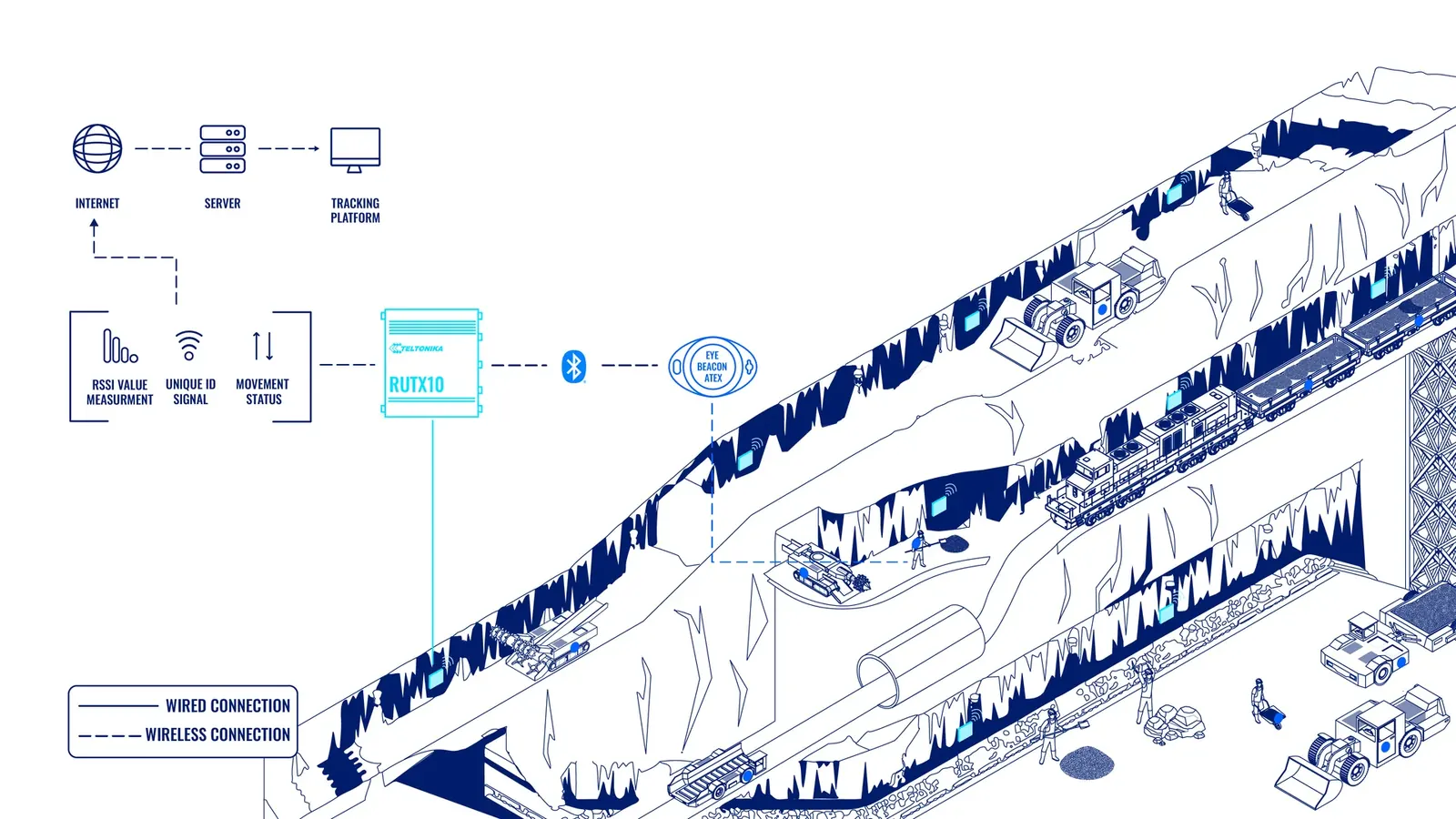
The beacons. The EYE Beacon ATEX is attached to a worker's personal protective equipment — helmet, belt, vest — or to equipment: self-propelled machinery, pumps, fans, tools. Every beacon continuously broadcasts its unique identifier over Bluetooth Low Energy, and the system knows exactly who or what it belongs to. The IP67 housing stands up to dust, dirt and water.
The routers. Industrial RUTX10 routers are installed at key points: along the tunnels, by the shafts, at the entrances to work areas. They play two roles — they receive beacon signals and they provide the network connection that carries the data to the surface.
How the position is established. A router hears the beacons nearby and measures the signal strength (RSSI). From which routers hear a particular beacon, and how strongly, the system works out which piece of infrastructure the person or the equipment is close to. This is not a position accurate to the metre but an association with a section of the workings, and for a mine that is exactly what is needed.
What the operator sees. The tracking platform shows which people and which machines are in each zone of the mine. If a person or a piece of equipment stops reporting, the system shows the last position: the router that last heard the beacon, and the time. The rescue team starts its search not from the whole mine but from one specific section.
Zones. Prohibited sections can be defined: workings closed for repair, blasting areas, sections with poor ventilation. If a worker enters one, the operator receives a notification. The same applies to equipment: if a machine has left its allotted section, that is visible immediately.
An example. After blasting, the operator checks that nobody is in the blast area: according to the system all beacons are outside the danger section. An hour later a collapse occurs on one of the levels. The operator opens the list and sees that two workers were last heard by the router by the third drift seven minutes ago. The rescue team goes straight there.
What has to be taken into account. The routers must cover every working where people go, otherwise the last known position will be too far from the real place. Power and networking for routers underground is a separate engineering project. And the routers themselves are installed only where the explosion protection requirements for that particular section allow it.
Marking and the scope of the certificate. Admission to an explosive atmosphere is determined not by the name of the series but by the marking and the certificate of the specific model and batch: the group and category of the explosive mixture, the temperature class, the zone. These details have to be checked against the zone classification on your site before purchase. The beacon's certificate does not extend to the routers, cables and power supplies: the RUTX10 is an ordinary industrial router, and placing it in an explosive atmosphere requires a separate decision, for example an explosion-proof enclosure or relocation to a safe area.
Fitting and acceptance. Before installation the industrial safety department approves the router layout and the power and network routes. Acceptance is best carried out as a walk-through: a member of staff carrying a beacon walks all the workings while the operator checks which router hears him and how quickly a change of section shows up on the platform. Sections where the beacon cannot be heard are put right before the system goes into service, not after the first accident.
Who needs this first of all. The main customer for this scenario is the HSE and industrial safety department, not the transport department. It is the one responsible for the emergency response plan, the descent lists and the procedure for reacting to an alert about entry into a prohibited area.
What you get
The last known position of every miner
The system remembers which router last heard the beacon and narrows the search area in an emergency.
Wearable in an explosive atmosphere
The EYE Beacon ATEX is certified for ATEX Zone 1 and cannot become a source of ignition.
Not afraid of mine conditions
The IP67 housing copes with dust, dirt and water.
People and machinery in one system
Every beacon has a unique identifier, so both the worker and the individual piece of equipment are visible.
Alerts on entry into a danger area
The operator learns immediately if someone has entered a closed section or a machine has left its own.
Easier to meet regulatory requirements
The system supplies location data and movement history for emergency response plans.
Why this solution
Teltonika has both halves of the system: beacons certified for explosive atmospheres, and industrial RUTX10 routers for connectivity in harsh conditions. They are designed to work together, so there is no need to make equipment from different manufacturers talk to each other and then work out who is responsible for a failure.
The EYE Beacon ATEX runs for a long time on its own battery, and that is one of the regulators' requirements for missing person search systems. Changing batteries does not turn into a monthly exercise across thousands of beacons.
On top of that there is a broad partner network worldwide, which helps with coverage design and with rollout on a particular site.
How this works in Azerbaijan. Metal mining in the country means above all the Dashkasan iron ore deposit and the gold and copper deposits at Gadabay and Chovdar, which have both opencast and underground operations, plus new exploration projects in Kalbajar and Zangilan. The ATEX requirement also matters outside the mining industry: on the oil and gas facilities of Absheron, at refineries and terminals where explosive zones exist. Things to bear in mind: we are not aware of any specific requirement in Azerbaijan comparable to the South African Regulation 16.7, so the solution is rolled out within a company's own internal safety standards; underground coverage has to be designed from the map of the workings; for the surface part of the fleet, beacons can be supplemented with GPS trackers. GPS.az supplies the Teltonika equipment, helps design the placement of the receivers and brings staff and machinery onto the Wialon platform.
Related case studies
Related rollouts and equipment
Containers and site cabins on GPS: the TAT240 tracker
Assets and workforce

The self-powered TAT100 tracker for cargo and equipment
Assets and workforce
Field worker records with the ATC700
Assets and workforce
Questions about the “Where the miners are underground: ATEX beacons” scenario
Request a call
A specialist will call back and match a solution to your fleet and your task.