
Field worker records with the ATC700
A Teltonika scenario for farms and plantations: every worker carries a rugged ATC700 tracker, marks the start and end of a shift or calls for help with one press of a button, and the manager sees on a map who is working on which plot.
A Teltonika scenario for farms and plantations: every worker carries a rugged ATC700 tracker, marks the start and end of a shift or calls for help with one press of a button, and the manager sees on a map who is working on which plot. On a large holding the foreman physically cannot see everybody. People are spread over fields and orchards for kilometres; one came in late, another left early, and a third clocked in for a friend. And when somebody out in the field is taken ill, it can take hours to find him. The ATC700 handles both problems with one device the size of an alarm fob.
What this scenario solves
About a billion people work in agriculture, roughly 28% of the world's entire workforce.
Of them some 450 million are employees on plantations, farms and other holdings.
Agricultural work remains among the most dangerous by rates of injury and death.
Falls from ladders and hoppers, being struck by machinery, tractor rollovers, chemicals, injuries from animals, burns, dust.
About a billion people work in agriculture, roughly 28% of the world's entire workforce. Of them some 450 million are employees on plantations, farms and other holdings. Agricultural work remains among the most dangerous by rates of injury and death.
Falls from ladders and hoppers, being struck by machinery, tractor rollovers, chemicals, injuries from animals, burns, dust. Every such case hits the holding financially, legally and morally, particularly if help arrived late.
The second problem is lost working time. Clocking in for somebody else is estimated to cost businesses in the United States around 373 million dollars a year. Add to that overlong breaks, people leaving their plot and confusion over who is working where.
The third is theft. It has affected 78% of businesses in the industry. Worldwide losses from theft of crops, livestock and machinery, together with the cost of security, are put at 10–15 billion dollars a year. In 2022 the government of India put its own farmers' losses from theft at more than 2 billion dollars.
Rising food and fuel prices make agricultural produce steadily more attractive to thieves, and holdings have no choice but to defend themselves.
What Teltonika offers
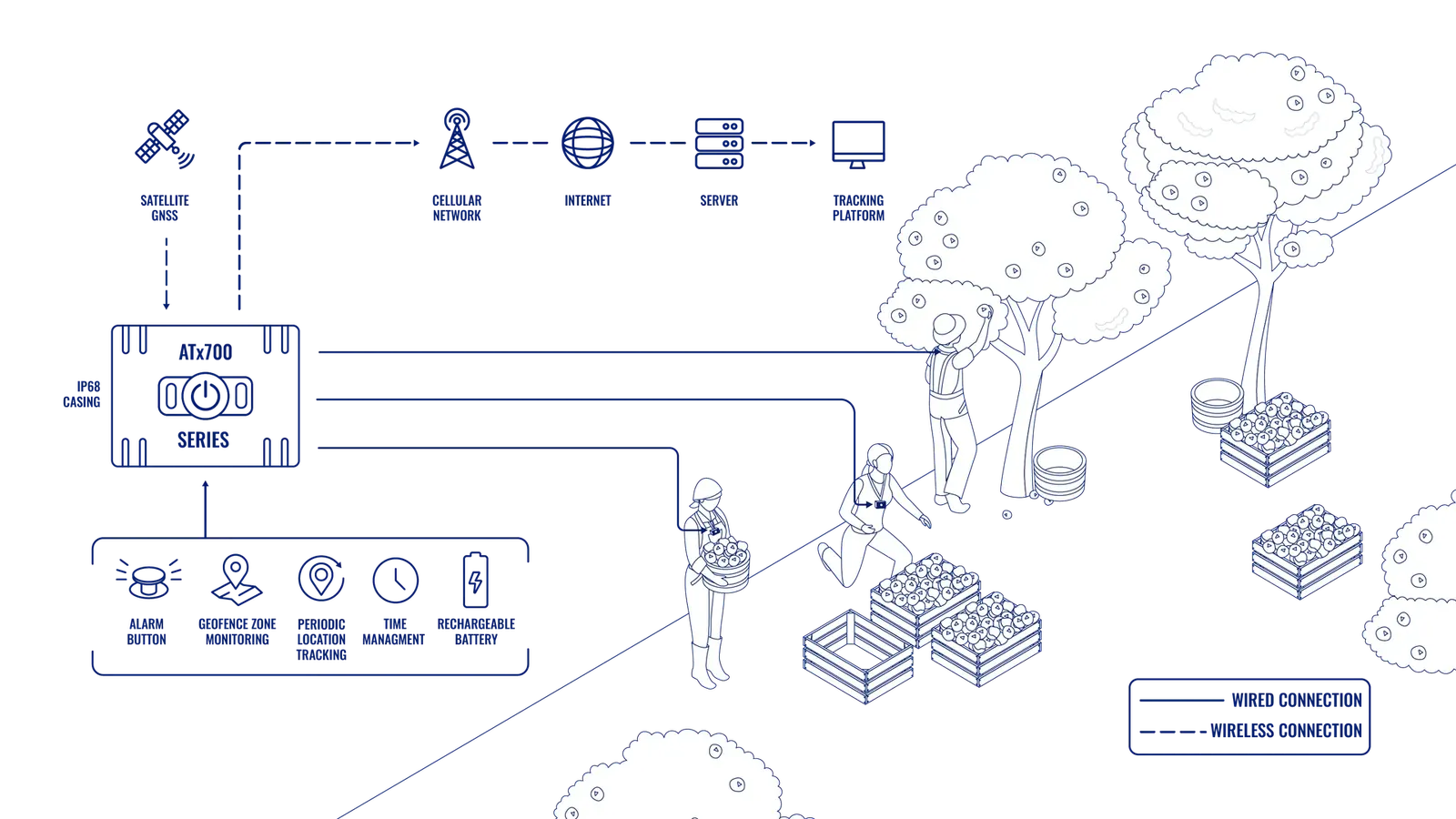
Teltonika proposes handing out wearable ATC700 trackers from the ATx70 series with LTE Cat 1: the device reports coordinates periodically, marks a shift at the press of a button, sends an alert and monitors geofences, and all the data travels over the mobile network to the holding's server.
Installation and setup
Fitting the device and configuring it for the fleet scenario at hand.
Data transfer
The device collects data and sends it to the monitoring platform; how often depends on the model and its settings.
Analysis and control
The person in charge gets reports and alerts and looks into what stands out.
Picture a plantation with hundreds or thousands of workers, each with an ATC700 on a belt or a lanyard. Its IP68-rated housing is untroubled by dust, mud, rain or even a long spell in water — out in a field, in a greenhouse or in a paddy, that matters more than any other specification. The device is light and does not get in the way of working with your hands, even when somebody is picking all day.
The tracker reports its position at set intervals. Across a huge area that is the foreman's main tool: he can see where each gang is at the moment and how many people are on each plot. You choose the interval yourself — more often if responsiveness matters, less often if battery life matters more.
The heart of the ATC700 is its multifunction button. For fieldwork it is normally set up to do two things. The first is clocking in and out: the worker presses the button at the start and end of his shift, and the record reaches the server with a time and coordinates. Clocking in for somebody else while standing in the next village no longer works — the position shows where the tracker was. The second is the alert. If a person is unwell, injured or in a dangerous situation, a press sends a signal to the person responsible with a point on the map. The button can also be reconfigured for other actions: sending notifications or switching the device's operating modes.
Geofences give the manager a tool for allocating people. Gang A is assigned the plot by the river, gang B the orchard on the slope. The system shows who is working where, allows output to be compared plot by plot, and reports if somebody has gone where he should not: into the chemical store, into the area a sprayer is working, onto a neighbouring holding's land.
The battery is designed for a full working day and longer, so the tracker does not go flat by lunchtime even in remote places with nowhere to charge. In the evening it goes on charge from any USB-C source: a mains adapter, a socket in the accommodation block or a power bank. By morning the device is ready again.
How it looks in the harvest season. At 6:00 the foreman opens the system: 180 people have marked the start of their shift, each with a position on his own plot. At 11:40 an alert comes in from a worker at the far end of the orchard — he has fallen off a ladder. The foreman sees the point, sends the nearest vehicle, and help is there within eight minutes. At the end of the day the bookkeeper exports hours worked for each person without any paper sheets, and the manager compares the gangs' output plot by plot.
All the data — coordinates, shift records, alerts — travels over the mobile network to the server. The head of the holding and the security team see it in real time and in reports for any period.
On theft. A tracker on a person does not guard the store, but it helps in working things out: if sacks of produce went missing from the store overnight, the movement history shows which workers were nearby at an odd hour. And the same ATC700 units, fitted to trailers, drums or crates of produce, will show where those were taken.
A seasonal pilot and how the records are kept. Better to start with one or two gangs at the beginning of the season: check coverage on the plots, the habit of pressing the button, charging in the accommodation block and how the foreman responds to alerts. Time worked is counted between the start and end of shift records, while the positions during the day serve as a check that the person was on his own plot. The tracker does not measure output in kilograms or hectares; that is still recorded on the scales or from work sheets, and the tracker adds the time and the place to them.
What you get
Help arrives quickly
An alert from the ATC700 button goes straight to the person responsible with a point on the map.
You can see where people are working
Periodic coordinates show how the gangs are placed across a large area.
Shifts marked with one button
Working hours are logged with a time and a place, and padding and clocking in for others disappear.
People on their own plots
Geofences allocate the gangs, close off dangerous areas and make output comparable.
A whole day without recharging
The battery lasts a shift in the field and charges from ordinary USB-C.
Decisions on data
Deploying people, planning the season and calculating pay all rest on real hours and real plots.
Why this solution
The ATx70 series was conceived as a universal wearable tracker: for cargo, for machinery and for people. The ATC700 takes from it everything a field needs — IP68, LTE Cat 1, long battery life and a configurable button. A holding does not need separate devices for time recording and for a panic button: one covers both.
The button, the transmission intervals and the geofences are all set in the configuration and on the platform, so the same device can be rebuilt for a different season or different work. Out of season the same trackers can be hung on trailers, drums or attached equipment so they do not sit idle.
Honest limitations. The tracker works over the mobile network, and on distant plots with no coverage records and alerts will arrive late, once there is a signal. If the alert is critical, coverage across the whole area is worth checking before the season. The tracker has to be charged every evening, and in an accommodation block housing two hundred people that is a job in itself: it is easier to set up a common charging station and issue the devices in the morning against a signature. And last: people have to understand what the tracker is for. Brought in purely as surveillance, the devices will start being forgotten and left in vehicles. Explain that it is a button for calling help and an honest record of hours, and the attitude is different.
How this works in Azerbaijan. The scenario suits holdings that take on tens and hundreds of seasonal workers: the cotton fields of the Kur-Araz lowland, the hazelnut orchards in Sheki, Gakh and Zagatala, the tea plantations in Lankaran and Astara, the apple orchards in Guba, the vineyards in Shamakhi and Goygol, and the large greenhouse complexes in Absheron. In summer at +40 °C heatstroke in the field is a real risk, and a panic button on the belt stops being a formality. In mountain orchards Azercell, Bakcell or Nar coverage can be weak, so we check it before the devices are issued and choose the operator to suit the particular locality. GPS.az supplies and configures the ATC700, draws plot geofences in Wialon, sets up alert notifications to foremen in Telegram, and builds an hours-worked report that can be handed to the accounts department.
Related case studies
Related rollouts and equipment
Questions about the “Field worker records with the ATC700” scenario
Request a call
A specialist will call back and match a solution to your fleet and your task.