
FMx800 OBD trackers for premium car rental
A Teltonika use case: a premium car rental company plugs an FMC800 or FMM800 tracker into the OBD socket in a few minutes, without touching the wiring and without any risk of losing the manufacturer’s warranty.
A Teltonika use case: a premium car rental company plugs an FMC800 or FMM800 tracker into the OBD socket in a few minutes, without touching the wiring and without any risk of losing the manufacturer’s warranty. Renting expensive cars is a growing business. Custom Market Insights values the global luxury car rental market at roughly 84.3 billion dollars, most of it short-term hire. Customers want to take a car quickly and without paperwork, while the rental company wants to know where the car is and how it is being treated. The difficulty is that premium cars are often on lease, and any interference with the wiring can cost the warranty. Teltonika offers the FMx800 series of OBD trackers, which go into the factory diagnostic socket and come out just as easily.
What this scenario solves
Most premium cars in a rental fleet are on lease and may not be modified.
Fitting a tracker in the classic way means cutting into the wiring, and that risks losing the manufacturer’s warranty.
Servicing such cars costs several times more than ordinary ones, so losing the warranty is particularly unwelcome.
Customers behind the wheel of a powerful car speed more often and are more likely to damage it.
Most premium cars in a rental fleet are on lease and may not be modified. Fitting a tracker in the classic way means cutting into the wiring, and that risks losing the manufacturer’s warranty. Servicing such cars costs several times more than ordinary ones, so losing the warranty is particularly unwelcome. Customers behind the wheel of a powerful car speed more often and are more likely to damage it.
What is happening in the market. According to Business Market Insights, the large rental operators are optimising their fleets with programmes for settling claims after an accident, flexible payment schemes, well-judged tariffs and popular routes. All of that needs data from every car: where it is, how far it has gone, how it has been driven. Without a tracker there is no way to get it, and with a classic tracker the warranty becomes a problem.
What servicing costs. On the estimate Teltonika cites, the maintenance costs of a luxury car over ten years are on average twice those of an ordinary one. An example from the use case: an oil change on an Audi may cost about 150 dollars, while on a Bugatti it can be up to 25,000 dollars. Against that background the manufacturer’s warranty means very specific money, and nobody wants to risk it for the sake of a tracker. The lessor is against it too: the contract usually forbids interference with the car’s electrics outright, and the car is inspected on return, where traces of cutting into the wiring can turn into a claim.
Customer behaviour. Behind the wheel of a Porsche the temptation to see what the car can do is noticeably stronger than behind the wheel of a Volkswagen. Speeding, hard acceleration, and sometimes an accident after which the customer insists it was nothing like that. A rental company needs objective data to go through such cases and to charge fairly.
What Teltonika offers
Teltonika offers the FMC800 and FMM800 trackers: compact OBD-II Plug & Play devices that go into the car’s factory diagnostic socket. No tools are needed, no qualified fitter is needed, the car’s wiring stays untouched and the manufacturer’s warranty is preserved.
Installation and setup
Fitting the device and configuring it for the fleet scenario at hand.
Data transfer
The device collects data and sends it to the monitoring platform; how often depends on the model and its settings.
Analysis and control
The person in charge gets reports and alerts and looks into what stands out.

How the models differ. The FMC800 works on the LTE Cat 1 network, the FMM800 on LTE Cat M1. Both are suitable for work in practically any region. Besides the standard CE/RED, E-Mark, REACH and RoHS certificates, the FMC800 has RCM certification for the Australian and New Zealand markets. That matters, because the Asia-Pacific region is forecast to become the main market for premium car rental.
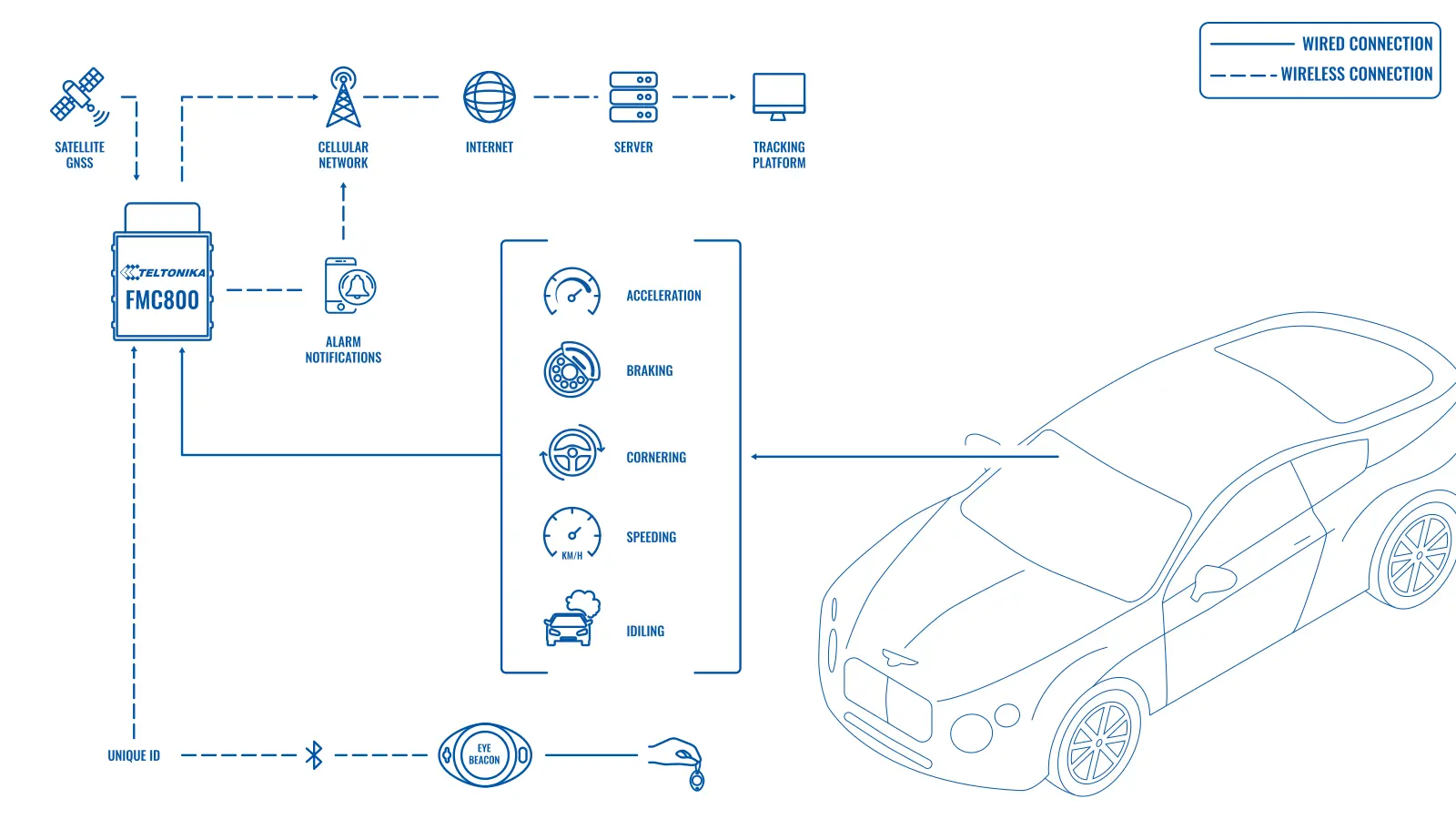
How the tracker goes in. Thanks to its small size the tracker fits by the OBD socket in almost any car. If the socket is in an awkward place, or the tracker has to be hidden, an extension cable is used: the device can be placed up to 50 cm from the port, behind trim for instance, where it is not visible as somebody gets into the car.
Accident detection. The tracker’s built-in accelerometer follows acceleration on three axes — X, Y and Z. On a sharp impact the FMC800 saves a trace of the crash according to the parameters set — the accelerometer sampling rate, the duration of the acceleration recording and the duration of the GNSS recording — and sends it to the server. From that data the picture can be reconstructed: how fast the car was going, where the impact landed, what happened in the few seconds before it. An argument about who was at fault is settled sooner.
Charging for actual driving. The trip detection and driver behaviour functions provide the data for calculating the rental: speed, mileage, the zones the car has driven in, the length of time at the wheel. If the customer has exceeded the contractual limits — speed, mileage or zone — the company can add a charge and back it up with the data.
An episode. A customer takes a sports coupé for the weekend. The contract has a mileage limit and a ban on leaving the region. On Monday the car comes back, and the report shows that on Saturday night it twice ran at over 180 km/h and left the permitted geofence. The manager shows the customer the trip data and adds the charge set out in the contract, with no argument over words.
Bluetooth for further tasks. The FMx800 series trackers support Bluetooth and work with EYE beacons and sensors. Through them a driver can be identified, door opening can be monitored, or a second layer of protection can be added — a pairing of two devices, where a backup beacon or tracker helps to find the car if the main tracker has been pulled out of the socket.
The kit, and the limits of the scenario. The minimum is an FMC800 or FMM800 tracker in the OBD socket, an extension if needed, and the geofences and limits from the rental contract set up in the monitoring platform. An EYE beacon can be added if wanted, to identify the driver or as a backup in case the tracker is pulled out of the socket. Remote engine immobilisation is not described in this scenario: if it is needed, the direction to look is a wired tracker with an output for a relay, and that is already interference with the wiring.
What the manager gets at the end of a rental. A report on the car for the rental period: mileage, maximum speed and speeding, departures from the permitted geofences, harsh manoeuvres, impact events with the acceleration recording. That is enough to check the trip against the terms of the contract and to show the customer the data when adding a charge.
When a car leaves the fleet, the tracker is simply pulled out and put into the next one. For a rental company that renews its fleet every year or two, that is an appreciable saving on fitting.
What you get
Works in almost any country
LTE Cat 1 and Cat M1 connectivity allows cars to be tracked in practically any region, and the set of certificates makes launching on different markets easier.
The manufacturer’s warranty is preserved
The tracker goes into the OBD socket with no interference with the wiring, so it can be used in leased and rented cars.
Fitting in minutes
No tools and no visiting engineer are needed, the tracker can be fitted as the car is handed over and moved to another one when it leaves the fleet.
Data on accidents and on behaviour
The accelerometer records a trace of an impact, while the driving monitoring functions show speeding and harsh manoeuvres for a fair review and for calculating the rental.
Extension over Bluetooth
EYE beacons and sensors add driver identification, door monitoring and a second layer of protection against theft.
Why this solution
The FMC800 and FMM800 cover the basic monitoring tasks without fitting in the usual sense. For a rental company that matters most of all: there are many cars, they change often, and spending half an auto electrician’s day on each one does not pay. The tracker goes in and the car is on the map.
Teltonika works with partners and customers in more than 160 countries, so the FMx800 series models were designed from the start for different markets and certifications. For companies working in several countries at once that makes life simpler: one tracker model for the whole fleet.
The limitations are worth knowing in advance. An OBD tracker is easier to find and pull out than a concealed wired one, so for protection against theft it is better supplemented with an EYE beacon or a second device. The data a tracker reads over OBD depends on the make and model of the car: on some more parameters are available, on others fewer. Some cars are sensitive to constant consumption in the socket when they stand for a long time, and the tracker’s sleep mode has to be configured to suit the fleet.
How this works in Azerbaijan. Premium car rental is concentrated in Baku: handovers at Heydar Aliyev airport, at hotels and in the business districts, hire for weddings, business visits and major international events. Many cars in such fleets are on lease or under an official dealer’s warranty, so the OBD tracker format is particularly apt here. When rolling it out, bear in mind that customers often drive off on holiday to Gabala, Sheki, Guba or the coast at Nabran: geofences and mileage limits are worth writing into the contract and into the settings in advance. For cars that stand for long periods in heat of up to +40 °C, the tracker’s sleep mode is chosen so as not to drain the battery. GPS.az, as a Teltonika GOLD partner in Azerbaijan, supplies the FMC800 and FMM800, configures trips, geofences and accident scenarios and brings the data onto the Wialon platform, where the rental manager sees the whole history of every car.
Related case studies
Related rollouts and equipment


Questions about the “FMx800 OBD trackers for premium car rental” scenario
Request a call
A specialist will call back and match a solution to your fleet and your task.