
Servicing construction lorries by engine hours
A Teltonika scenario for construction fleets: the FMC250 tracker, with its built-in CAN processor and IP67 housing, reads engine hours, oil pressure and level, AdBlue and other parameters so that lorries and plant go in for servicing on time.
A Teltonika scenario for construction fleets: the FMC250 tracker, with its built-in CAN processor and IP67 housing, reads engine hours, oil pressure and level, AdBlue and other parameters so that lorries and plant go in for servicing on time. A construction site runs on heavy machinery. Tippers haul soil and aggregate, mixers haul concrete, tractor units with low loaders move excavators, mobile cranes stand on site for weeks. When a machine like that stops, a whole section of the works stops with it: the gang waits, the programme slips, the contractor pays a penalty. And construction plant does not wear in the way a long-haul tractor unit does, so the familiar mileage-based service schedule suits it badly. The Teltonika solution is built on data the machine already knows about itself — it only has to be read off the CAN bus and sent on.
What this scenario solves
Construction lorries travel little but work hard in one place, and a mileage-based service schedule misses hundreds of engine hours.
Dust, dirt, damp and heat all accelerate engine wear.
Low oil level or pressure is noticed when the engine has already suffered.
Without AdBlue a modern diesel loses power, and breaching emissions rules risks a fine.
Construction lorries travel little but work hard in one place, and a mileage-based service schedule misses hundreds of engine hours. Dust, dirt, damp and heat all accelerate engine wear. Low oil level or pressure is noticed when the engine has already suffered. Without AdBlue a modern diesel loses power, and breaching emissions rules risks a fine.
The market is growing along with urbanisation and infrastructure spending. Forecasts put the construction market at roughly 1.17 trillion dollars by 2028, growing at about 5.1% a year. More projects mean more heavy machinery carrying materials, equipment and people to sites and back.
The main trap is the pattern of work. On road works a machine may cover a couple of dozen kilometres in a week and clock up hundreds of hours in the process: standing with the engine running, turning a drum, holding hydraulics, working off the power take-off. The odometer barely moves while the engine wears. If servicing is counted in kilometres, the machine goes in for maintenance enormously overdue in engine hours — and then breaks down with no apparent warning.
A contractor needs a different approach: watch the condition of the machines continuously and react to problems before they become breakdowns. That calls for data in real time, not the mechanic's notes once a month.
What Teltonika offers
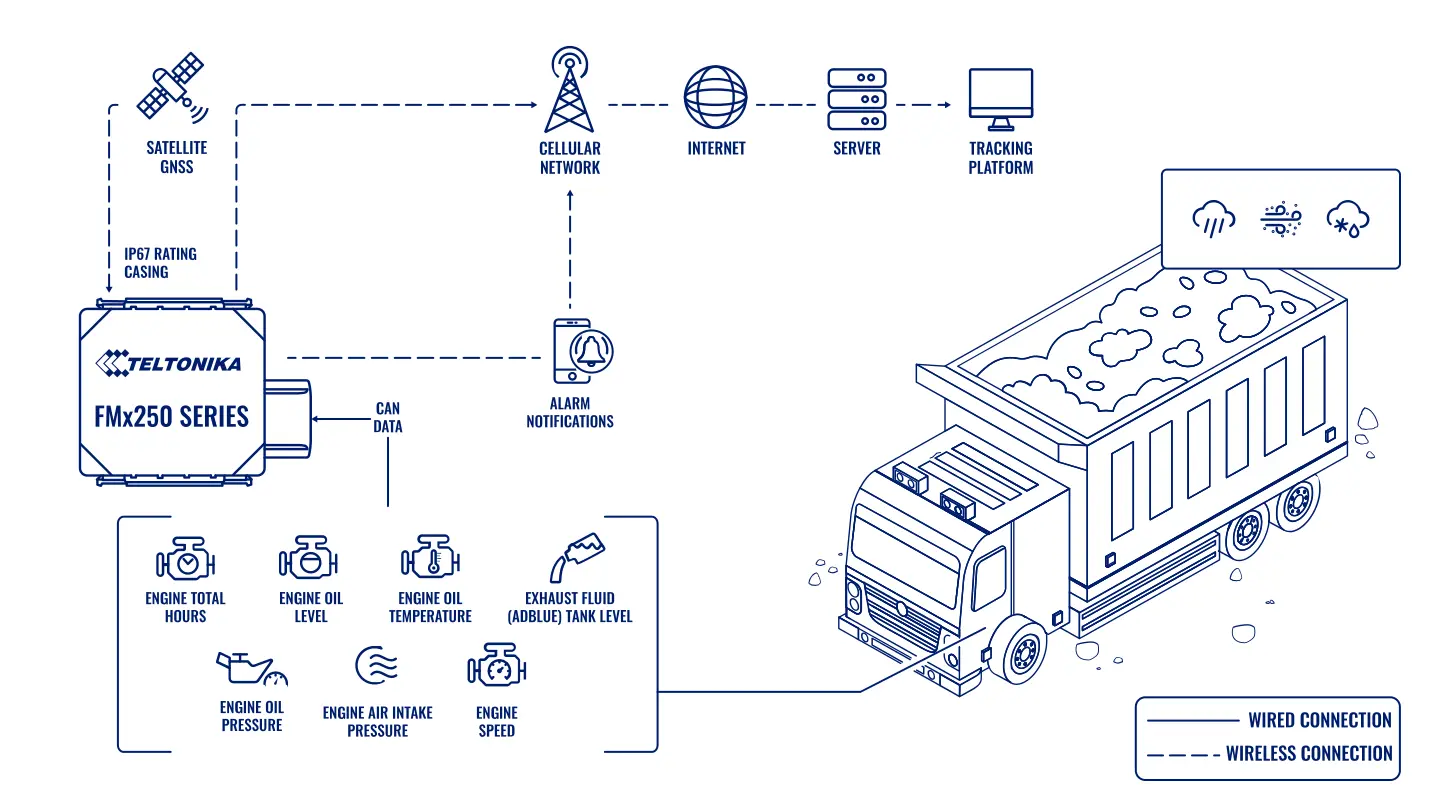
The FMC250 connects to a lorry's CAN bus, reads more than 90 parameters including total engine hours, oil level, pressure and temperature, AdBlue and boost pressure, and sends them to the platform, where a service schedule based on real running time is built from them.
Installation and setup
Fitting the device and configuring it for the fleet scenario at hand.
Data transfer
The device collects data and sends it to the monitoring platform; how often depends on the model and its settings.
Analysis and control
The person in charge gets reports and alerts and looks into what stands out.

What the series is. The FMx250 are Teltonika trackers with a built-in CAN data processor for heavy machinery. There are versions with LTE Cat 1 and with LTE Cat M1. The IP67-rated housing is unbothered by dust and water, and the clip-together construction simplifies fitting. In this example it is the FMC250 with LTE Cat 1.
Compatibility. The FMC250 supports more than 1810 vehicle models: lorries, vans, buses and plant. The tracker reads the CAN bus and receives the same information the machine's own on-board diagnostics see. No separate CAN adapter is needed.
Which parameters matter for servicing. There are more than 90 in total, and in practice these are the ones most often used for maintenance.
Total engine hours. The key parameter for construction plant. Intervals for changing oil, filters and other consumables are counted from it. A machine that stood on site with the engine running will be serviced on time even if it barely moved.
Engine oil level. A low level shows immediately rather than at the next inspection. Topping the oil up is cheaper than replacing bearing shells.
Oil temperature. Overheating is a common problem on heavy machines in hot weather and under load. A rising temperature warns of cooling trouble before the engine is damaged.
Oil pressure. A drop in pressure points to circulation problems: the pump, the filter, wear. An early warning here can save a whole engine.
AdBlue level. Modern diesels with SCR limit their power without urea, and running without it breaches emissions rules. A low level noticed in time means a planned top-up rather than a machine in limited-power mode in the middle of a run.
Inlet air pressure. Shows whether the engine is getting enough air. On a dusty site a clogged air filter is an everyday occurrence, and it affects power and fuel consumption directly.
The tracker also reports fuel level and engine revs, which show how much of the time the machine is idling. On a construction site that is a common source of losses: a tipper waits half an hour for the excavator to load it with the engine running, and those hours also come off the engine's life.
How the service schedule is set up. For each model of machine, intervals in engine hours are taken from the manufacturer's schedule, and shortened where necessary to allow for dust and heat. For machines that both work in place and travel on the road, two counters can be run at once, in engine hours and in mileage, with the machine going in for service on whichever comes first. After the work is done the mechanic marks it in the platform and the count starts again.
What the contractor's manager gets. Reports for each machine: engine hours over the period, the share of idling, the number of oil and temperature alerts, the service history. They show which machines cost more to maintain and which sites wear the plant hardest. That helps to plan the repair budget and to decide which machines to replace and which can still work for a few more seasons.
What the mechanic and the manager see. The data goes to the monitoring platform in real time and can be opened from a computer in the office or from a tablet or smartphone on site. For each machine you see the current engine hours, how long is left until the next service, and the latest oil, temperature and AdBlue values. Alerts are set on threshold values: oil pressure has fallen, temperature is above normal, AdBlue is below 10%.
What it looks like on site. A concrete mixer works on one site for three days, covers 30 km and clocks up 40 engine hours. A week later the system warns the mechanic that there are 20 hours left to the oil change. The machine goes in for service at the weekend, when no concrete is being poured. On another day a tipper in a quarry loses oil pressure. The driver gets a call from the dispatcher within a couple of minutes, shuts the engine down, and the mechanic drives out with the right parts — instead of a full rebuild it came down to a new sensor and a top-up.
How readings are verified at the start. Before purchase, the make, model and year of each machine are checked against the Teltonika supported vehicle list, and on a pilot machine you see which parameters actually arrive. After fitting, the engine hours and fuel level in the platform are compared with the dashboard: if the values agree, the service counter is started from that mark. The first service event is a check in itself: the mechanic records the service in the platform, and the count to the next one should start again with the correct interval.
What to bear in mind. The set of parameters depends on the make, model and year of manufacture: on some machines every oil and AdBlue reading is available, on others only engine hours and fuel. The list has to be checked before purchase. On older plant with no CAN bus the tracker will get no CAN data — there, engine hours are counted from the ignition or from an engine running sensor. The tracker shows condition but does not replace an inspection: belts, hoses and running gear are still checked by the mechanic's own eyes. The mounting position is chosen so that the tracker is protected from direct impacts and from pressure washing: IP67 saves it from dust and water, but not from a jet held point-blank or from stones thrown up by the wheels.
What you get
Works in dust and dirt
The IP67-rated FMC250 housing withstands the dust and water of a construction site.
Engine condition under control
Oil, temperature, pressure and AdBlue are visible in real time, and deviations are noticed before a breakdown.
Fewer emergency repairs
Servicing is planned in advance, so expensive failures and downtime on site happen less often.
A service schedule in engine hours
Intervals are counted from real running time rather than from mileage, which barely grows on construction plant.
Plant lasts longer
The right temperature, oil pressure and clean inlet air all extend engine life.
Project deadlines hold
Machines go in for servicing at a convenient time instead of stopping in the middle of the works.
Why this solution
The FMx250 was made for heavy machinery specifically: a built-in CAN processor, a long list of supported models and a clip-together IP67 housing in one device. For a construction fleet of mixed makes that means identical fitting and an identical set of data, with no hunting for an adapter to suit each machine.
The availability of LTE Cat 1 and Cat M1 versions allows the connectivity to be matched to the region: Cat 1 for fast data transfer, Cat M1 for districts where signal penetration matters more.
Teltonika has shipped tens of millions of devices and works with thousands of customers and partners in more than 160 countries. Tracker firmware and settings are updated remotely over FOTA WEB, which is especially convenient when the plant is scattered across different sites.
How this works in Azerbaijan. The scenario speaks directly to the reconstruction projects in Karabakh and East Zangezur, where tippers, mixers and plant work far from depots and workshops, and equally to road building on the M-1, M-2 and M-3, to the quarries and crushing sites in the Garadagh district, and to construction in Baku and across Absheron. In summer at +40 °C engines under load overheat, and quarry dust clogs air filters quickly — oil temperature and boost pressure are particularly telling here. On remote sites the mobile signal can be weak; the tracker holds data in memory and sends it when a network appears, and if a site is entirely outside coverage it is worth discussing a satellite channel. Before purchase, check which CAN parameters your machines deliver: the European lorries popular here have the full set, while some Chinese and Russian machines offer a reduced one. GPS.az fits FMC250 trackers, connects them to the CAN bus and sets up service intervals in engine hours and engine condition alerts for each machine in the Wialon platform.
Related case studies
Related rollouts and equipment

Keeping track of site tools with BLE beacons
Agriculture, construction and mining

Plant tracking with no jumps or gaps in the track
Agriculture, construction and mining
Service schedules for farm machinery from CAN data
Agriculture, construction and mining
Questions about the “Servicing construction lorries by engine hours” scenario
Request a call
A specialist will call back and match a solution to your fleet and your task.