
Keeping track of site tools with BLE beacons
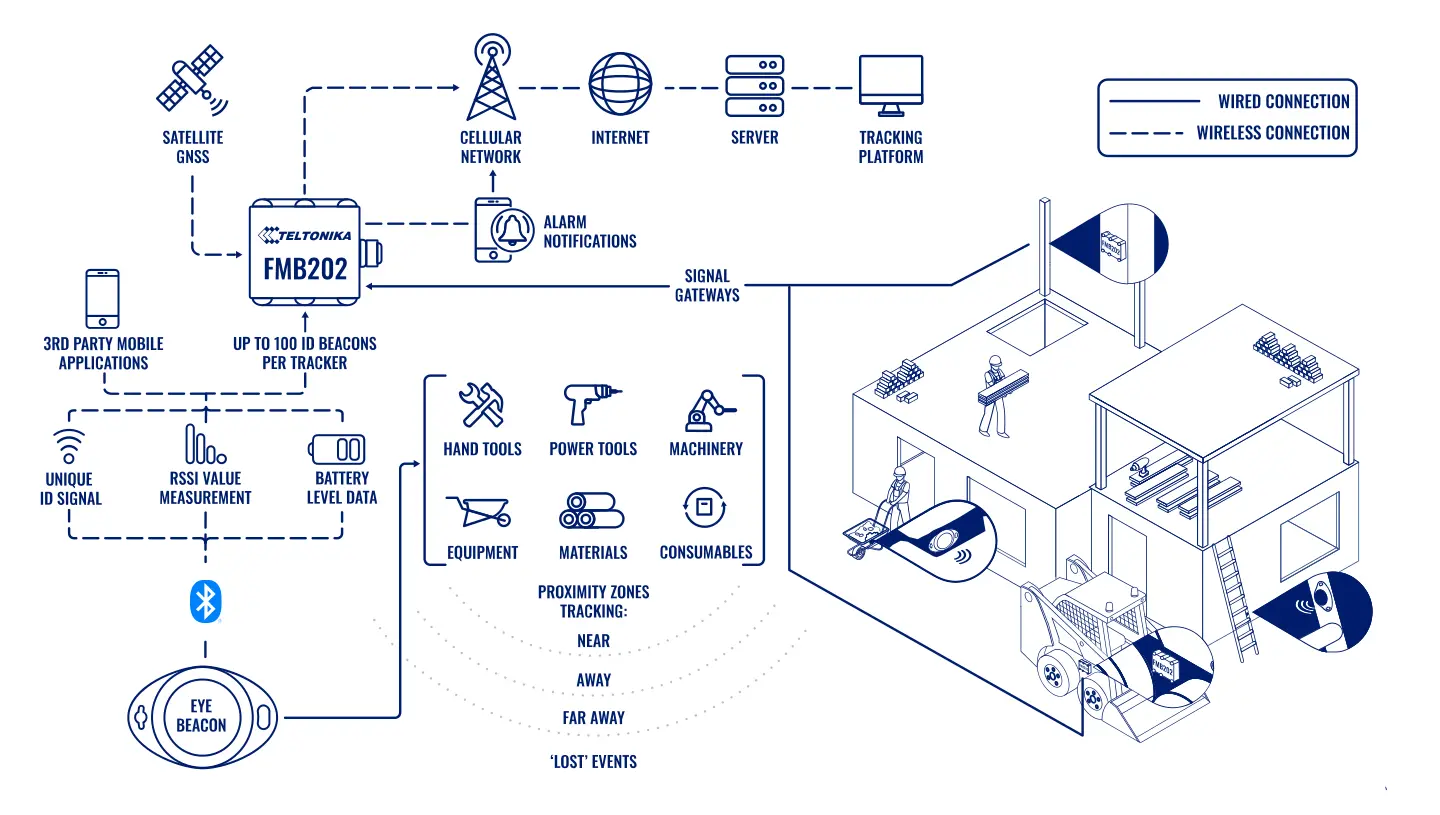
EYE Beacon Bluetooth beacons are stuck to tools and equipment, and FMB202 trackers fixed on the floors and in the stores of a construction site pick them up and send to the server where each item is and when.
EYE Beacon Bluetooth beacons are stuck to tools and equipment, and FMB202 trackers fixed on the floors and in the stores of a construction site pick them up and send to the server where each item is and when. On a building site something is always going missing. The breaker was left on the seventh floor, the neighbouring gang borrowed the laser level, cable and copper went over the fence at night. The site manager spends an hour looking for something that ought to be in the site hut, and every quarter the accounts department writes off tools that nobody ever lost. This Teltonika use case describes how to close that gap with an inexpensive combination of beacons and trackers, and what to bear in mind when putting such a system on a site in Azerbaijan.
What this scenario solves
Theft on building sites happens almost everywhere and costs a great deal.
Thieves are after copper, timber, small tools, power tools and even heavy equipment.
Site managers and foremen lose working time searching the site for the things they need.
A paper record of tool issues does not show where a tool is now or who has it.
Theft on building sites happens almost everywhere and costs a great deal. Thieves are after copper, timber, small tools, power tools and even heavy equipment. Site managers and foremen lose working time searching the site for the things they need. A paper record of tool issues does not show where a tool is now or who has it.
The figures in the original use case speak for themselves. According to the London police, in 2020 tools worth 17.5 million pounds were stolen in London alone — about 57 thousand a day. In a survey by the British Federation of Master Builders, 51% of builders had experienced tool theft at least once. In Canada, losses from theft of building materials, equipment and machinery are put at between 300 million and 1 billion dollars a year.
After the COVID-19 pandemic the situation grew worse. Materials and tools were in short supply, prices rose, and with them the profit to be had by thieves.
The usual measures do not help much. CCTV cameras cost money and require somebody to watch the recordings. Taking the batteries out of cordless drivers at the end of a shift is a nuisance. Lockable containers, penalties and strict rules make the work harder and produce middling results.
There is a second side to it: not theft but disorder. The foreman cannot remember who he gave the demolition hammer to. The generator is on a different section. The welding set has sat in the store doing nothing for two weeks while a gang in the next block is waiting for it. The paper issue log is kept irregularly, the entries diverge from reality, and nobody can say where an item is now.
What is needed is a system that knows by itself where every valuable item is and asks nothing extra of the workers.
What Teltonika offers
The Teltonika solution: EYE Beacon beacons are stuck to valuable items, FMB202 trackers are hung around the site as Bluetooth gateways, and the server shows which zone each tool was in and when.
Installation and setup
Fitting the device and configuring it for the fleet scenario at hand.
Data transfer
The device collects data and sends it to the monitoring platform; how often depends on the model and its settings.
Analysis and control
The person in charge gets reports and alerts and looks into what stands out.

Why Bluetooth rather than GPS. The satellite signal inside a building under construction, in a basement, on a staircase or in a narrow street between blocks is weak and jumps about. Fitting a separate GPS tracker to every cordless driver is expensive and pointless. A Bluetooth Low Energy beacon is small, cheap and runs for years on its built-in battery, and its signal is picked up by any Teltonika tracker nearby.
The equipment:
• EYE Beacon — a compact beacon in a rugged IP67 housing, unfazed by dust and rain;
• FMB202 — a waterproof tracker with Bluetooth that catches the beacons' signals and passes them to the server along with its own location.
One Teltonika tracker can work with a hundred beacons at once, so a large site does not need all that many gateways.
How it is arranged on site. The FMB202 is fixed under the ceiling or high on a wall: on every floor, in corridors, on staircases, in the car park, in material storage areas, in the site huts and in the store. Each of those trackers becomes the ears of its own zone.
The beacons are attached to tools and equipment. For permanent records, with screws; for temporary ones, with ordinary or double-sided tape. Fitted in a minute, removed in a minute when the item is written off or sold.
Each beacon continuously transmits its identifier in iBeacon or Eddystone format. The tracker hears it, estimates the distance from the signal strength and sends to the server: this beacon, this zone, this time. The site manager opens the map on a smartphone and sees that the level is on the fifth floor at the moment and the generator is in the store.
The movement history shows something else as well: which tools are actually in use and which have lain in the site hut for months. That helps to avoid buying more than you need and to move idle equipment to sites where it is wanted. A stocktake turns from a week of counting into an export of the list of beacons by zone.
What can be configured. In the beacons themselves — signal power and transmission interval: stronger and more frequent for large zones, weaker and rarer so that the battery lasts longer. In the tracker — proximity events, when a beacon comes close or disappears from the zone, and filtering by name, so that the tracker reacts only to your own beacons rather than to every Bluetooth device around.
Beacons can also be issued to people, in the form of a badge. You can then see which zone a gang worked in and how long it spent on site. There are mobile apps for monitoring too, including a customer's own app, if the company wants to build beacon data into its own system.
How this catches a theft. At night the breaker's beacon disappears from the store zone and five minutes later turns up in the zone of the tracker by the gates. The system sends a notification to security. Or the beacon simply vanishes from every gateway on site outside working hours — reason enough to check before morning, rather than finding out a week later at a stocktake.
Last detection. If no gateway can hear a beacon, the server retains the zone and time where it was last seen. For searching, that is often more useful than a current position: you know which floor it went from and at what hour.
A limitation: the system shows a zone, not a point to within a metre. If a tool is carried beyond all the gateways, its beacon can no longer be traced — plant and expensive equipment need a GPS tracker of their own.
What you get
You can see where the tools are
The site manager opens the map on a smartphone and finds an item by zone instead of walking the site floor by floor.
A theft is noticed at once
A beacon that leaves the store at night or disappears from every gateway becomes a notification for security.
Flexible events and filters
Proximity events and filtering by name cut out the needless noise and show only what matters for a particular zone.
Configuration to suit the site
Beacon signal power and transmission interval are matched to the size of the zone and the battery life you need.
Order in issuing tools
Once the workers know that every item is on the books, they stop leaving things anywhere and taking them home.
Cheap and cable-free
A beacon goes on in a minute, and a lost or broken beacon is easily replaced with a new one.
Why this solution
Teltonika has everything for this arrangement from one manufacturer: EYE Beacon beacons with IP67 protection, trackers with Bluetooth that take up to a hundred beacons, and mobile apps for Android and iOS through which beacons are configured, scanned and checked right there on site.
The FMB202 was not chosen by accident. On a building site a tracker hangs in dust, in the rain, on an unheated floor, and here a waterproof housing matters more than any other specification. It has a built-in battery, so temporary power cuts on site do not stop the gateway working.
Teltonika manufactures in-house, in Europe, its quality system is certified to ISO 9001, and its trackers work on construction sites and in logistics in many countries.
Honestly about the preparation. The layout has to be thought through before fitting: which zones matter, where the gateways will hang, where there is power and mobile coverage. Gateways on concrete floor slabs hear beacons less well than on open ground, so the layout is checked by walking round with a smartphone.
How this works in Azerbaijan. The problem is a very familiar one: high-rise blocks in Baku and Absheron, where several subcontractors work on one site, and reconstruction projects in Karabakh and East Zangezur — Fuzuli, Aghdam, Shusha, Lachin — where sites are a long way from base and tools are carried hundreds of kilometres. Coverage is weak in the mountains there, so the tracker builds up data in memory and sends it when an Azercell, Bakcell or Nar network appears. Summer heat of up to +40 °C and dust hold no terrors for IP67 beacons, but the gateways are better hung in the shade. GPS.az supplies the beacons and trackers, helps to position the gateways around the site, and in Wialon sets up the zones, notifications for tools leaving the perimeter and movement reports. On site machinery and generators we fit separate GPS trackers, and all of it is visible in one account.
Related case studies
Related rollouts and equipment

The GH5200 personal tracker for workers
Agriculture, construction and mining

Recording farm machinery and implements with the FMB140
Agriculture, construction and mining
Service schedules for farm machinery from CAN data
Agriculture, construction and mining
Questions about the “Keeping track of site tools with BLE beacons” scenario
Request a call
A specialist will call back and match a solution to your fleet and your task.