
Service schedules for farm machinery from CAN data
A Teltonika scenario for farms: an FMB130 tracker with a CAN reader keeps track of engine hours on tractors and combines by itself and reminds you when a service is due.
A Teltonika scenario for farms: an FMB130 tracker with a CAN reader keeps track of engine hours on tractors and combines by itself and reminds you when a service is due. A farm rarely runs a single make of machinery. A tractor, a combine, a self-propelled sprayer and a mower work side by side, each with its own schedule: oil every 250 engine hours, filters every 500, belts and bearings before the season. While there are five machines the mechanic keeps it all in his head. When there are thirty and the harvest is running in two shifts, a schedule in a notebook stops working. The solution rests on a simple idea: the machinery itself reports how much it has worked and what has lit up on its dashboard, and the system counts the intervals and gives a reminder at the right time.
What this scenario solves
A combine that stops in the middle of the harvest costs the farm more than the repair itself.
A paper service log is kept late, and often filled in after the event.
Engine hours are copied off the dashboard by hand, and a single wrong digit shifts the whole servicing plan.
The mechanic learns about an oil pressure warning light only when the tractor driver calls him.
A combine that stops in the middle of the harvest costs the farm more than the repair itself. A paper service log is kept late, and often filled in after the event. Engine hours are copied off the dashboard by hand, and a single wrong digit shifts the whole servicing plan. The mechanic learns about an oil pressure warning light only when the tractor driver calls him.
In the season the load on machinery swings wildly. A tractor may stand idle for a week and then work 16 hours a day on ploughing. Counting service intervals by the calendar in those conditions is pointless: by the planned date one machine has not used up its allowance yet, while another passed it long ago.
There is a safety question too. Worn brakes or low tyre pressure on a heavy machine with a trailer are dangerous for the driver and for everyone near by in the field or on the road between plots.
What Teltonika offers
The FMB130 tracker together with the ALL-CAN300 reader takes engine hours, mileage and faults off the machine's bus, and the platform turns that data into a service schedule with reminders.
Installation and setup
Fitting the device and configuring it for the fleet scenario at hand.
Data transfer
The device collects data and sends it to the monitoring platform; how often depends on the model and its settings.
Analysis and control
The person in charge gets reports and alerts and looks into what stands out.
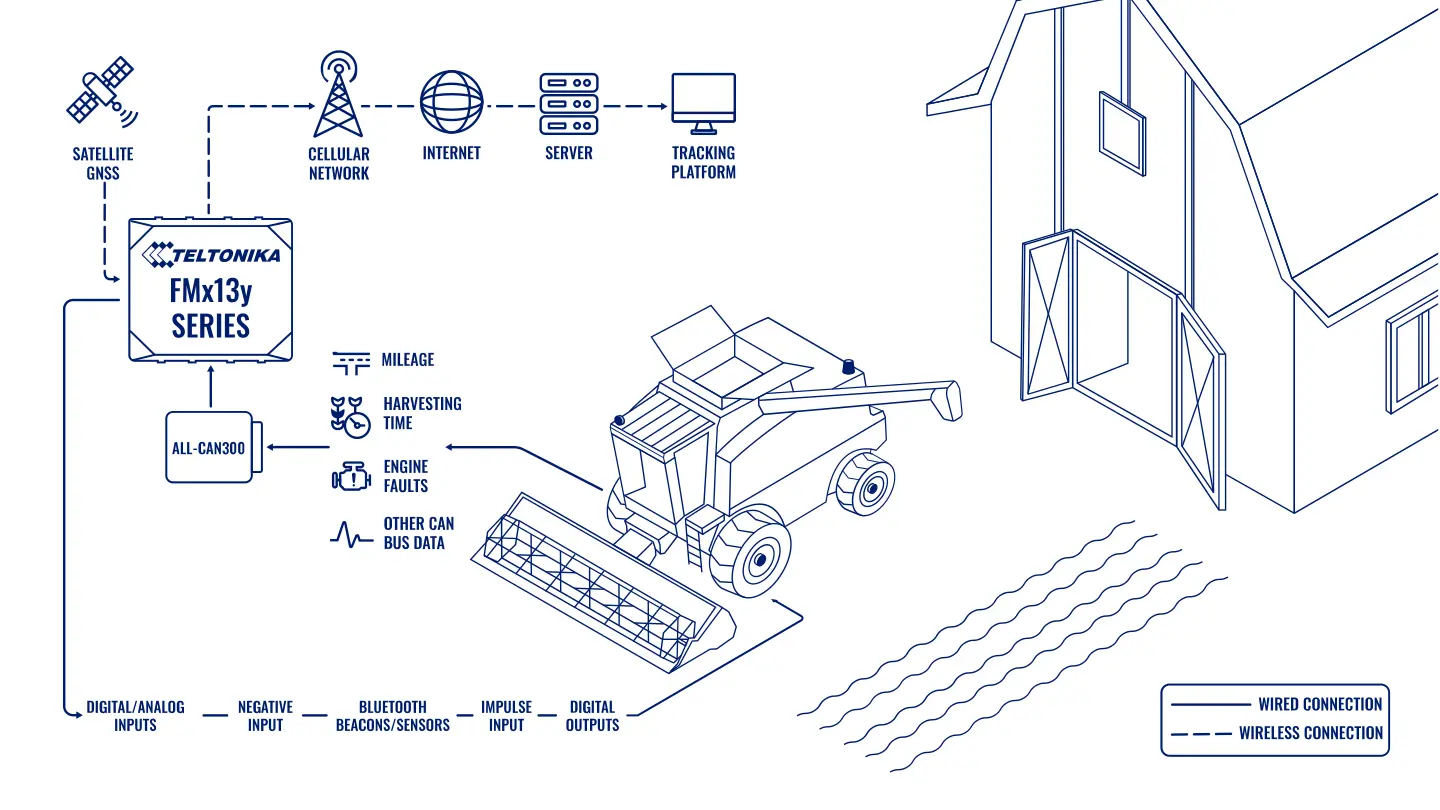
How it is put together. The FMB130 is a tracker from the ADVANCED range with GNSS, a GSM modem, Bluetooth and a set of inputs and outputs. The contactless ALL-CAN300 reader connects to it: it reads the CAN bus without splicing into the wires, so the machinery manufacturer's warranty is not affected. Teltonika keeps a list of supported models, with more than 450 combines, tractors and other agricultural machines on it, and it is better to check your own machine before buying.
What comes off the bus. The set of parameters depends on the make, model and year of build. Usually it is engine hours, engine revs, coolant temperature, fuel level and warning lights. On some combines the harvested area, threshing output, grain moisture and the state of the threshing drum are available as well.
How a reminder comes about. In the platform the intervals are set for each machine: an oil change every 250 engine hours, filters every 500, a general inspection once a season. The counter runs from real CAN data rather than from an entry in a log. Between 20 and 30 engine hours before the due point the mechanic gets a notification, and the machinery list shows who is coming up to a service and who is already overdue.
What the dispatcher or the mechanic sees. A map with the position of every machine, the current engine hours, and the fault log. If an engine, brake or tyre pressure light comes up on the dashboard, the event arrives straight away with coordinates. You can tell where the machine is standing and whether a fitter has to be sent out to it.
What the FMB130 can do on its own. The negative input is handy for a door or hopper lid sensor. Configurable digital and analogue inputs take the ignition signal and count working time where CAN is not available. The pulse input suits a fuel flow meter, and the digital outputs suit remote immobilisation or a signal. Bluetooth beacons on implements show which one is currently hitched to the tractor, while wireless sensors pass on temperature, humidity and movement.
One limitation worth bearing in mind: on older machinery with no CAN bus, engine hours and faults cannot be taken off the bus. There engine hours are counted from the ignition or from an engine running sensor, and the warning lights never reach the system.
Checking the readings. At fitting, the engine hours from CAN are compared with the counter on the tractor's or combine's dashboard. If the figures agree, the starting point of the service schedule is taken from the bus. If the machine does not give out engine hours, or gives them out with a discrepancy, the dashboard reading is entered into the platform by hand and from then on the counter runs from the ignition.
What a service event looks like. In the machine's record: the type of work, the engine hours at the time of the service, the date, and who marked it as done. Once it is marked, the counter to the next service resets, and the history keeps a record that shows whether the schedule was kept to during the season.
What you get
Servicing by actual running time
The intervals are counted from real engine hours off CAN, so a machine neither goes in for servicing early nor works past its allowance.
Faults are visible at once
An engine, brake or tyre pressure light comes through as a notification, not as a call from the tractor driver half a day later.
Less paperwork for the mechanic
The service log is kept in the platform automatically, and the service history of every machine is held in one place.
A predictable season
Machinery that is due for a service is dealt with before the harvest rather than in the thick of the work, when every day of downtime is expensive.
Safety in the field and on the road
Worn brakes and flat tyres are spotted before they cause an accident with a heavy machine.
Data for the agronomist
Harvested area, output and grain moisture off a combine's CAN help assess the work, not only plan repairs.
Why this solution
The FMB130 is one of the most widely used Teltonika trackers for machinery with additional sensors. It has enough inputs and outputs for a farm's typical tasks, Bluetooth for beacons and wireless sensors, and a housing built for dust and vibration.
The ALL-CAN300 solves the main problem of a mixed fleet: different makes of machinery speak different protocols, and the reader translates them into parameters you can understand. The connection is contactless, with no wires cut, so it can be taken off and moved to another machine.
The range is configured remotely through FOTA WEB. If the farm adds a new machine or changes the set of parameters, the configuration is changed without a trip out to the field.
How this works in Azerbaijan. This scenario is in most demand in the Kura-Aras lowland, where cotton and grain are harvested with large fleets of machinery, in the Shamkir and Yevlakh districts, and on farms working under contract in Karabakh. In summer the machinery works in heat of up to +40 °C and in dust, engines overheat, so watching coolant temperature and faults off CAN is particularly useful here. On remote fields Azercell, Bakcell or Nar coverage can be weak; the tracker stores its points in memory and sends them once the signal returns, so engine hours are not lost. Before fitting it is worth checking the machinery models against the ALL-CAN300 support list, and for older tractors with no CAN to plan for counting from the ignition from the outset. GPS.az, a Teltonika GOLD partner in Azerbaijan, fits the trackers and CAN readers, connects the machinery to the Wialon platform and sets up service intervals and notifications to match a particular farm's schedules.
Related case studies
Related rollouts and equipment

Questions about the “Service schedules for farm machinery from CAN data” scenario
Request a call
A specialist will call back and match a solution to your fleet and your task.