
Plant tracking with no jumps or gaps in the track
The Teltonika FTC880 and FTC961 trackers on the FT platform hold a smooth track for tractors, bulldozers and dump trucks at low speed and off road, survive pressure washing to IP69K and do not flatten the machine's battery while it stands idle.
The Teltonika FTC880 and FTC961 trackers on the FT platform hold a smooth track for tractors, bulldozers and dump trucks at low speed and off road, survive pressure washing to IP69K and do not flatten the machine's battery while it stands idle. It sounds simple enough: fit a tracker and you see the machine on the map. With plant and heavy equipment it is different. A tractor crawls across a field at walking pace, an excavator spends all day turning on one patch of ground, a dump truck weaves around a quarry. In those conditions an ordinary tracker draws zigzags and jumps that never actually happened. The heavy equipment market is growing — by some estimates from 778.53 billion dollars in 2024 to 841.46 billion in 2025 — and with it grows the demand for monitoring you can believe. In this use case Teltonika shows which trackers are built for the job.
What this scenario solves
The machine is working properly, but the track on the map is not.
Coordinate jumps distort the picture and get in the way of control.
Reports are built on crooked data, and people stop taking them seriously.
It all comes down to low speed.
The machine is working properly, but the track on the map is not. Coordinate jumps distort the picture and get in the way of control. Reports are built on crooked data, and people stop taking them seriously.
It all comes down to low speed. Many trackers handle slow, continuous movement badly and, instead of a smooth line, record sharp jumps between points. On the road you do not notice it; in a field or on a construction site it turns into a tangle of lines.
Decisions suffer for it. The manager thinks the operator skipped a strip of the field. The bulldozer looks as though it has left the plot. The dump truck in the quarry seems to be darting about with no purpose. In reality everything is fine, but the data says otherwise, and needless investigations begin.
The conditions are hard. Dust, mud, vibration, water. Machines are washed with a high-pressure jet, and a tracker designed for a passenger car does not survive that kind of washing.
Machines stand for long spells. The off season, bad weather, waiting for the next site. If the tracker draws current all that time, the battery goes flat and in the morning the machine will not start.
The fleet changes. Machines are hired for a season, moved between sites, sold. A tracker that takes a long time to fit and has to be wired into the loom is awkward in those circumstances.
What Teltonika offers
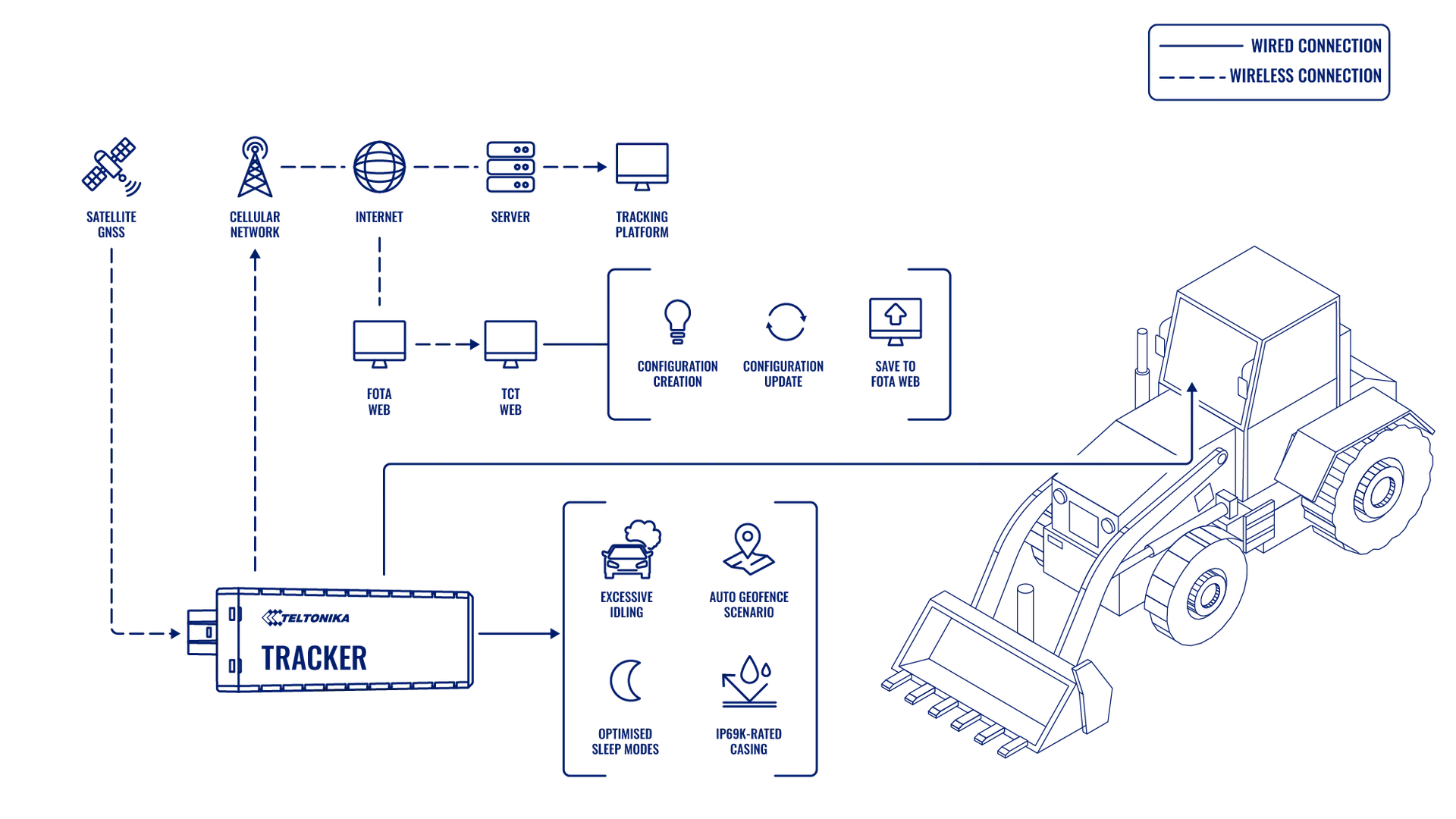
For plant and heavy equipment Teltonika offers the FTx88 series and the FTC961 model on the new FT platform. Their GNSS module works with 41 visible satellites at once and delivers a smooth track even at low speed and off road, with no jumps and no distorted routes.
Installation and setup
Fitting the device and configuring it for the fleet scenario at hand.
Data transfer
The device collects data and sends it to the monitoring platform; how often depends on the model and its settings.
Analysis and control
The person in charge gets reports and alerts and looks into what stands out.
Positioning. The more satellites the receiver sees, the more stable the coordinates. 41 satellites at once give a continuous position update, and the line of a tractor crossing a field or a bulldozer working a site looks the way the machine actually drove. Reports on the ground covered, the mileage and the time on site become trustworthy.
FTx88 for straightforward jobs. The series comes in two versions: the FTC880 with LTE Cat 1 and the FTM880 with LTE Cat M1. The tracker fixes straight onto the machine's battery, so fitting takes minutes and needs no special knowledge, no tools and no trip to a workshop. The same tracker is easy to remove and move to another machine, for example when machines change between seasons or a hired unit goes back to its owner.
FTC961 for demanding jobs. This model has five configurable contacts: digital input, digital output and analogue input. Sensors, signals from attachments and an immobiliser are wired to them. The tracker accepts an input voltage of up to 90 V, which makes it suitable for the widest range of machines, including those with a non-standard electrical system.
Protection. All the devices are built to IP69K: dust, mud, humidity and washing with a high-pressure water jet hold no terrors for them.
Power and idle spells. Every tracker has a built-in 320 mAh battery and the Deep Sleep, Online Sleep and Power Off Sleep modes. When a machine stands for a long time the tracker uses almost no energy and does not discharge its battery. In Power Off Sleep it wakes periodically, sends its coordinates and goes back to sleep — the machine stays in view even through a long idle spell.
Useful features. Excessive idling detection shows where a machine is burning fuel for nothing. Automatic geofences report machines entering and leaving defined areas, which matters for protecting equipment on large and remote sites.
Managing the fleet of trackers. The FOTA WEB platform updates firmware remotely, so every tracker gets new features and fixes without an engineer having to travel out. For configuring FT platform devices there is a separate program, the Telematics Configuration Tool (TCT), in which setting up is quick and clear.
Acceptance on the real machine. Once fitted, the tracker is checked on the machine in its normal working pattern: whether the track is smooth at low speed, whether the start and end of work are marked correctly, whether the tracker drains the battery over a weekend of standing still, and whether it gets a signal out from the far corners of the site. If anything is off, the settings are changed before trackers go on the whole fleet.
An example from a season. A farm hires three extra tractors for the harvest. On the day they arrive an FTC880 goes onto the battery of each one — five minutes per machine. All season the agronomist can see which fields have been worked and how long each tractor ran, and the track neither breaks up nor jumps at low speeds. When the season ends the trackers come off and are put away until next year.
What you get
A track you can believe
The receiver works with 41 satellites at once and draws a smooth line even at low speed and off road.
The machine's battery stays charged
The sleep modes and the built-in 320 mAh battery keep the machine in view while it stands, without loading its battery needlessly.
Washing and dust are no threat
The IP69K housing withstands a high-pressure jet, mud, dust and humidity.
Fitting in minutes
The FTC880 and FTM880 go straight onto the battery and move to another machine easily.
Flexibility for demanding jobs
The FTC961 has five configurable contacts and accepts up to 90 V, for sensors, attachments and non-standard machines.
Configuration and updates remotely
TCT and FOTA WEB save time on rolling out and maintaining the whole fleet of trackers.
Why this solution
Plant and heavy equipment need a tracker built for the way they work, not a car tracker in a protective box. Teltonika's FT platform was created for exactly this: an accurate receiver for low speeds, a sealed housing, frugal sleep modes and fitting that does not touch the wiring.
The range covers different jobs. For simple records of location and working time the FTC880 or FTM880 is enough. If you need to connect sensors or keep track of attachments, the choice is the FTC961. All of them are configured in one program and updated through FOTA WEB.
The limitations are worth knowing. The FTx88 models do not connect to the CAN bus and do not read fuel consumption, so accurate fuel records need a fuel level sensor and a tracker with the right inputs. Mounting on the battery is convenient, but where there is a risk of theft the tracker is better hidden more thoroughly. For Cat M1 connectivity on the FTM880 you need to check that the operator supports the technology in the area of work.
How this works in Azerbaijan. Plant and heavy equipment in this country work in very different conditions: the cotton and grain fields of the Kura-Aras lowland around Sabirabad, Saatly and Beylagan, road and new-settlement construction in Karabakh and East Zangezur, crushed stone and sand quarries in the Garadagh district and in Absheron. Everywhere the machines move slowly, off road and in dust, and in summer they stand in the sun at +40 °C. An IP69K housing and a smooth track at low speed are exactly what is wanted here. In mountain districts and on remote plots the signal can be weak, so we check Azercell, Bakcell and Nar coverage on site in advance and choose the SIM cards accordingly. For farms that hire machines for the season, it helps that the FTC880 can be moved across quickly. GPS.az fits FT platform trackers, sets up geofences for fields and sites and brings the machines onto the Wialon platform: reports on engine hours, ground covered and idling are built there, and for fuel records we add an Escort fuel level sensor.
Related case studies
Related rollouts and equipment

Keeping track of site tools with BLE beacons
Agriculture, construction and mining

Where the tools are on site: EYE tags
Agriculture, construction and mining

Ore haulage control: load weight and satellite
Agriculture, construction and mining
Questions about the “Plant tracking with no jumps or gaps in the track” scenario
Request a call
A specialist will call back and match a solution to your fleet and your task.