
Where the tools are on site: EYE tags
A construction company finds its wacker plates, generators and tool boxes by means of EYE Beacon and EYE Sensor Bluetooth tags, whose signal is picked up by the trackers on the plant and by the workers' smartphones.
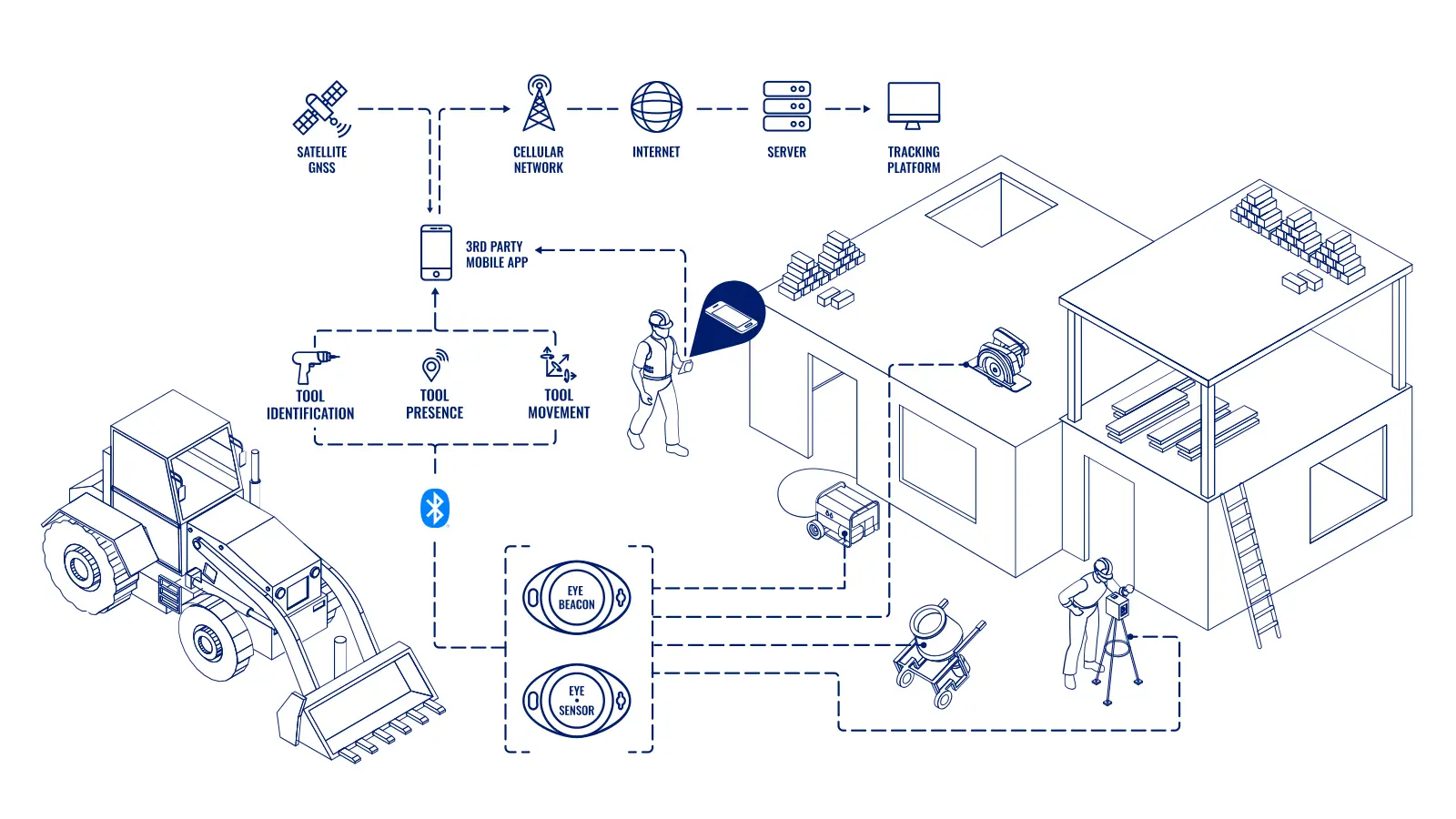
A construction company finds its wacker plates, generators and tool boxes by means of EYE Beacon and EYE Sensor Bluetooth tags, whose signal is picked up by the trackers on the plant and by the workers' smartphones. The central idea of the scenario: there is no need to build a separate network of receivers. Excavators and tippers with Teltonika trackers are already working on the site, and the site managers and workers have phones. Every such tracker or phone becomes a gateway that notices the tags nearby and sends their position into the shared system. A tag is stuck or screwed onto a tool once, and after that it works on its own for years. The manager sees which tool is on which site, which is sitting in the store, and which has not come within reach of any gateway for a long time.
What this scenario solves
Nobody knows for certain which site a particular tool is on now.
Up to 30% of tools and equipment on a construction site goes missing or ends up somewhere other than where it is expected.
Tools stand idle up to 70% of the time, and the company hires in the same items anyway.
Site managers and storekeepers spend hours searching and writing up by hand what is where.
Nobody knows for certain which site a particular tool is on now. Up to 30% of tools and equipment on a construction site goes missing or ends up somewhere other than where it is expected. Tools stand idle up to 70% of the time, and the company hires in the same items anyway. Site managers and storekeepers spend hours searching and writing up by hand what is where.
The losses add up to noticeable sums. In its case study Teltonika quotes an estimate for the United States: searching for tools and inefficient record-keeping costs about 40 billion dollars a year there. No such figures exist for Azerbaijan, so the effect is better measured on your own sites: how many hours a gang waited for a tool, and how many times in a quarter something already on the books was hired in.
When the wacker plate or the saw that is needed is not there, the gang waits. Deadlines slip, the plant schedule falls apart, and the tool that could have done the job is lying on the neighbouring site twenty kilometres away. The project manager learns about this from phone calls rather than from a system.
Manual record-keeping does not save the day. Workers are asked to note where the generator or the tool box was taken, but by the end of the shift they forget. Taking a gang away from its work to fill in tables is expensive, and the data in them is out of date within a day anyway.
The company ends up paying three times over: for the gang standing idle, for hiring or buying what it already owns, and for the time of the people looking for the missing items. What is needed is a way of seeing the tools without heavy investment and without separate infrastructure.
What Teltonika offers
Tools are marked with EYE Beacon or EYE Sensor Bluetooth tags, and their signal is picked up by the Teltonika trackers already fitted to the plant and by workers' smartphones running the company app, so the system itself knows where every item is.
Installation and setup
Fitting the device and configuring it for the fleet scenario at hand.
Data transfer
The device collects data and sends it to the monitoring platform; how often depends on the model and its settings.
Analysis and control
The person in charge gets reports and alerts and looks into what stands out.

How it is put together. At a set interval the tag transmits its identifier over Bluetooth Low Energy. The tracker on an excavator, loader or tipper hears every tag around it and sends the server the list along with its own coordinates. The site manager's smartphone with the mobile app does the same. In the central system the tag takes on the location of the nearest gateway that saw it, and the time of last contact.
This is how wacker plates, floor saws, generators, tool boxes, smaller plant such as articulated dumpers and everything else that regularly travels between sites is tracked. The storekeeper no longer has to ring round the site managers, and the workers do not have to report every movement.
An ordinary morning on site. A gang needs a vibrating screed to pour a slab, there is none in the store, and the site manager is sure it was taken to another section. The manager opens the list of tags and sees it: the screed was last noticed by a tipper's tracker yesterday at 17:40 on the neighbouring site, and it has not moved since. The tipper, which is going there for spoil anyway, brings it back by nine in the morning. A search like that used to take half a day of phone calls, and sometimes the hire of a second screed.
Where to start. There is no need to tag everything at once. Usually the expensive and frequently lost tools come first: generators, welding sets, wacker plates, breakers, laser levels. Then boxes of hand tools and small plant are added, once it is clear that the system works and people have got used to it.
What is not on site shows up too: a tag has not been in contact for a long while, which means the tool is either in a store outside gateway range or has been taken away without asking. Before hiring another generator, the manager checks whether one of their own is sitting unused on the neighbouring site.
EYE Beacon and EYE Sensor tags come in an IP67 housing and withstand dust, rain and washing down. The battery lasts a long time, so once fitted they need practically no attention. Besides its identifier, EYE Sensor transmits temperature, humidity, movement and tilt.
Setting up a large estate. Teltonika trackers can search for tags by name (the name filtering function). If you order tags with a set name through the configuration-at-the-factory service, that name only has to be entered into the tracker once, and it will see all present and future tags with that name. Setting up a thousand tags takes as little time as setting up one.
A single tracker sees up to 100 EYE tags at a time. Plant and tools are moving about constantly, though, and over a shift a tracker gets through any number of tags, so coverage of the site builds up by itself. These functions require firmware version 03.29 or newer in the tracker.
A movement counter. EYE Sensor has a movement timer function: it counts only the time the tool was actually moving, stops counting when it stops and carries on at the next movement. That data suits billing customers when equipment is hired out, and servicing based on actual use. Teltonika warns that the movement timer may require a test version of the firmware.
A survey before the rollout. Before tagging all the tools, we walk the site with a tracker or a phone and check at what distance a tag can be seen through a container wall, a vehicle body or concrete. That makes it clear where the gateways are sufficient and where tools will drop out of sight. The report for each tag carries the time it was last detected and the gateway that saw it. An old timestamp is a reason to check on a tool, not proof that it has gone.
What you get
The gang does not wait for tools
You can see where the equipment you need is, and it arrives on site before the work starts rather than after the site manager's phone call.
Less time spent searching
Workers and storekeepers do not spend hours walking round stores and ringing people, and get on with their own work.
No buying or hiring what you already have
Before hiring plant in, it is easy to check whether one of your own is free on another site.
Built on the equipment you already own
The Teltonika trackers on the plant and the smartphones serve as gateways, so there is no separate receiver network to build.
Tags that last years with no attention
An IP67 housing and a long-life battery suit the dust and dirt of a construction site.
Hundreds of tags set up quickly
The name filter and configuration at the factory allow new tools to be brought in without reconfiguring the trackers.
Why this solution
EYE tags and Teltonika trackers are made by the same manufacturer and are designed to work together from the outset. A tracker needs no modification to see the tags, the Bluetooth scanning function is in the standard firmware, and the name filter removes the main headache of large projects: linking every tag by hand.
The solution scales gradually. You can start with one site and a dozen of the most expensive and most frequently lost tools, and then add tags without replacing trackers.
There are limitations worth knowing about in advance. A tag does not transmit its own coordinates; its position is known only when a tracker or a smartphone happens to be nearby. A tool locked in a container on a site with no plant and nobody carrying the app will not be updated in the system. For valuable equipment that often stands on its own, a self-contained tracker with GPS is a better fit. The accuracy is different too: the system knows which gateway it was seen near, not a point to the metre, so finding a box on a large site still means using your eyes — just within a sensible radius.
How this works in Azerbaijan. The scenario fits the construction sites of Karabakh and East Zangezur well, where a contractor has several sites going at once in Fuzuli, Aghdam, Shusha and Zangilan and tools travel constantly between them and the depot. Road and civil engineering firms in Absheron and Baku, with dozens of sites and a single store, are in a similar position. In the mountains and on remote sections the mobile signal can be weak; a tracker on the plant then keeps the tag data in memory and sends it once an Azercell, Bakcell or Nar network appears. Dust, summer heat and winter mud are within the tolerance of IP67 tags, but it is better to fix them in a protected spot on the tool's body where they will not be torn off in use. GPS.az selects the EYE tags, sets up scanning by name on the Teltonika trackers and presents the tool list with its last location and time in Wialon.
Related case studies
Related rollouts and equipment
IP67 trackers for construction machinery
Agriculture, construction and mining

Ore haulage control: load weight and satellite
Agriculture, construction and mining

Recording farm machinery and implements with the FMB140
Agriculture, construction and mining
Questions about the “Where the tools are on site: EYE tags” scenario
Request a call
A specialist will call back and match a solution to your fleet and your task.