
Finding a stolen vehicle abroad
A Teltonika scenario for stolen vehicle recovery: a tracker with a Teltonika global SIM card keeps reporting its position even after the vehicle has been taken into another country.
A Teltonika scenario for stolen vehicle recovery: a tracker with a Teltonika global SIM card keeps reporting its position even after the vehicle has been taken into another country. An ordinary tracker with a local SIM card works well at home. But a stolen vehicle is rarely kept near the place it was taken from: it is moved quickly to a remote district or across a border. If the SIM card has no roaming in the neighbouring country, or roaming is switched off, the tracker goes on writing points to memory but cannot send them, and the owner loses the trail. Teltonika closes that gap with connectivity: a SIM card on the Global Plan tariff and the IoT platform through which it is managed.
What this scenario solves
A stolen vehicle is often taken out of the country within a matter of hours.
A tracker with a local SIM card may be left without a connection abroad.
With no data coming through, the owner, the insurer and the police cannot see where the vehicle is.
Expensive vehicles disappear into neighbouring countries, where they are harder to find and recover.
A stolen vehicle is often taken out of the country within a matter of hours. A tracker with a local SIM card may be left without a connection abroad. With no data coming through, the owner, the insurer and the police cannot see where the vehicle is. Expensive vehicles disappear into neighbouring countries, where they are harder to find and recover.
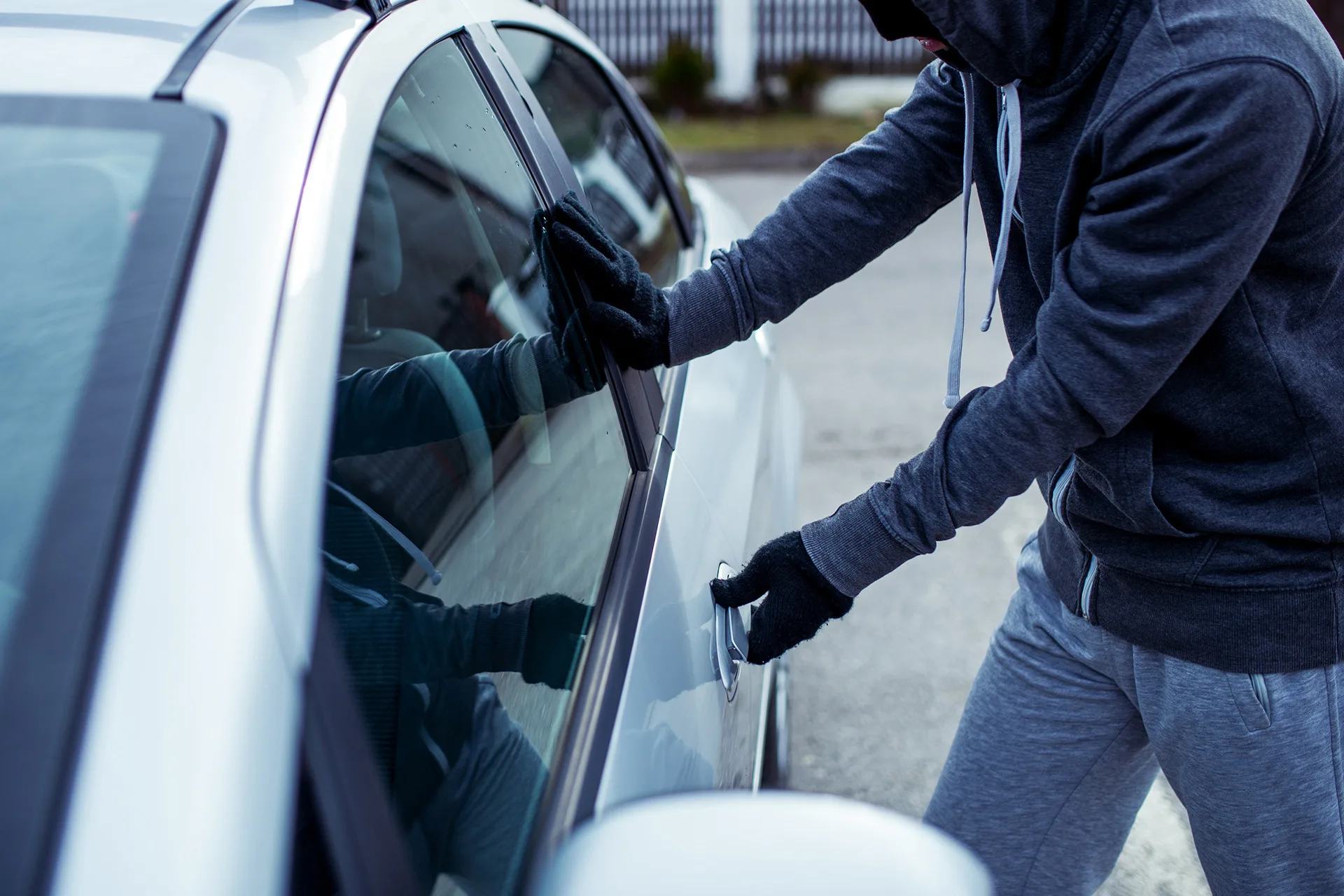
The statistics are unpleasant. According to Statista, an average of about 85.3 vehicles per 100,000 inhabitants are stolen worldwide. In 2020 the countries with the highest theft rates included Uruguay, Italy and the United States.
Thieves usually work to one pattern: take the vehicle quickly and move it far away as soon as possible. Some vehicles are broken up for parts or sold for scrap. Expensive and rare models are more often taken across a border into neighbouring countries, usually less economically developed ones. Known routes run from the United States into Canada, from Brazil into Bolivia, and from Italy into Albania.
It is not only owners who suffer. Insurers pay out, companies lose working vehicles and contracts, and the state spends resources on the search.
Teltonika trackers themselves can do a good deal against theft: engine immobilising, tamper sensors, driver identification. But if the vehicle has been taken anyway and could not be found quickly, everything comes down to one question: will the tracker be able to get a connection where it has been taken?
What Teltonika offers
A Teltonika tracker with a SIM card on the Global Plan tariff connects to mobile networks in dozens of countries, so it keeps sending its position and trip history even if the vehicle has been taken abroad.
Installation and setup
Fitting the device and configuring it for the fleet scenario at hand.
Data transfer
The device collects data and sends it to the monitoring platform; how often depends on the model and its settings.
Analysis and control
The person in charge gets reports and alerts and looks into what stands out.
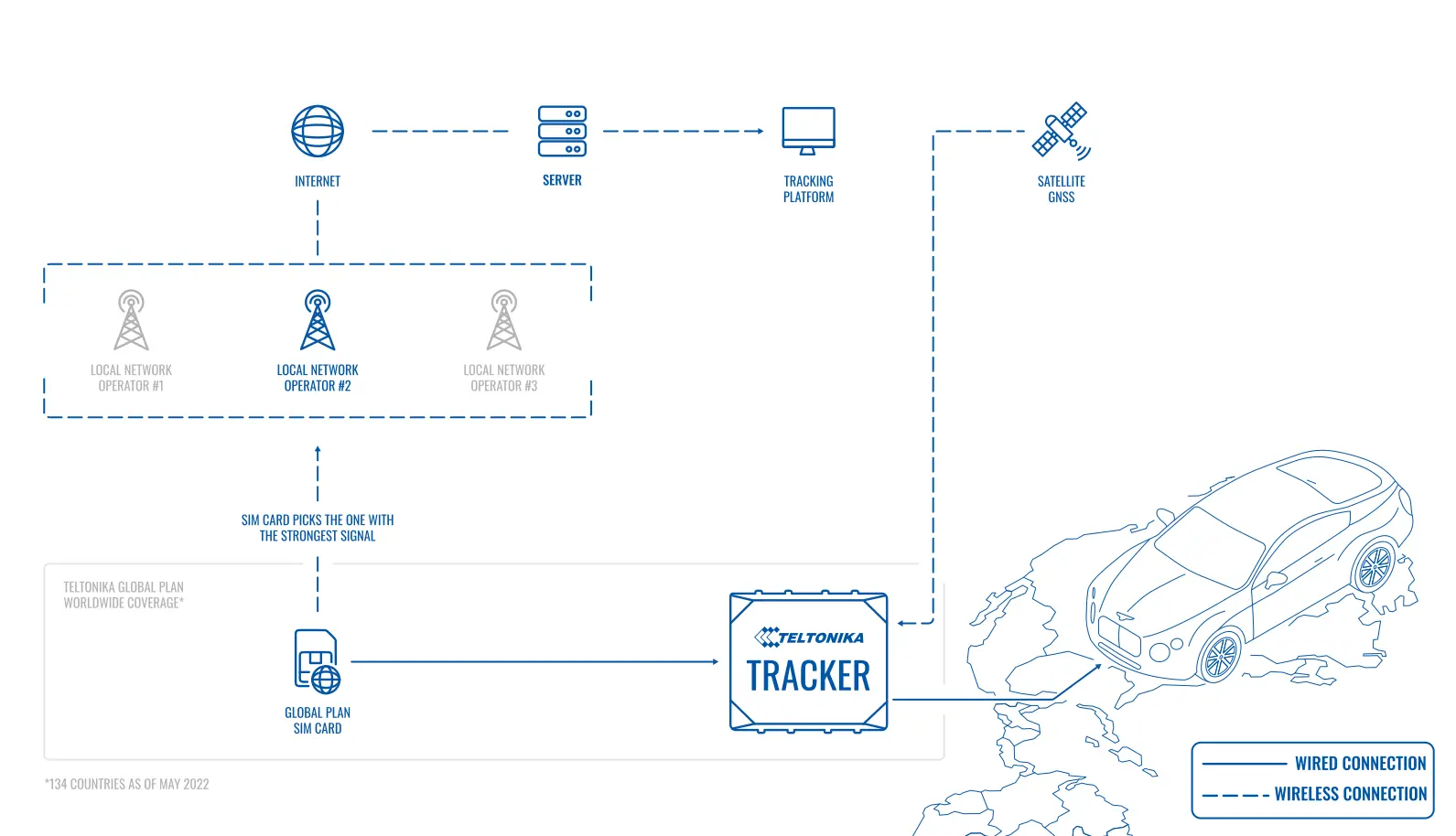
What the solution consists of. The minimum set is a Teltonika SIM card and the IoT platform in which it is managed: activation, traffic monitoring, tariff changes. The SIM card goes into any Teltonika vehicle tracker. As of May 2022 the Global Plan tariff worked in 134 countries and territories, with up to three major operators available in each.
How the network is chosen. The SIM card is not tied to a single operator. In each country it connects to whichever of the available networks has the stronger signal, and switches over if the connection is lost. For a stolen vehicle being driven along unfamiliar roads, that matters: one operator's dead spot does not break the reporting.
An example. A sports car is stolen in Italy and moved to Albania. Both countries are inside the Global Plan coverage, so the tracker keeps reporting its position after the border crossing as well. The owner and the security team see the vehicle's whole journey and where it is parked now.
What the tracker itself contributes. Internal flash memory holds the points while there is no connection — in a tunnel, an underground car park or on a ferry — and sends them as soon as the network returns. Sensitive high-gain GNSS antennas pick up satellites even in poor reception conditions. As a result the movement history is preserved in full rather than in fragments.
Where the vehicle is visible. The position and trip history arrive at the server and open in the vehicle monitoring software on a smartphone, a tablet or a computer. The data can be handed to the police or to a recovery team, including in another country.
How a search usually goes. An alert arrives at night: the vehicle is moving with the ignition off, or it has been started without the key and its tag. The owner or the operator on duty opens the map and sees that the vehicle has already left the city. The tracker is switched to frequent reporting so that the movement can be followed almost live. The coordinates are passed to the police. If the vehicle has already crossed a border, a tracker on a global SIM card keeps getting through, and the route history shows where it was hidden along the way and where it is standing now. That data is passed to the police of the country where the vehicle is, through the insurer or by official request.
Why the whole history matters, not just the last point. Thieves often use a holding spot: they leave the vehicle in a quiet place for a few days to see whether anyone comes for it. The history of stops shows those places. Sometimes other stolen vehicles are found there too.
Saving on traffic in normal times. While all is well with the vehicle, the tracker reports at its usual rate and uses little traffic. The global tariff is above all an insurance policy: it does its work at the moment the vehicle ends up outside its home network.
Who manages the SIM cards. Through the IoT platform the integrator or the security team can see which card is currently registered on which network and how much data it has sent, and can suspend or activate a card quickly.
Other Teltonika anti-theft scenarios. This connectivity complements the anti-theft functions rather than replacing them: engine immobilising at a safe speed, an alert for movement with the ignition off, driver identification by key or card. Together they first make the vehicle hard to steal and then, if it happens anyway, help to find it.
The basic rules still apply. Lock the doors and close the windows, take the keys with you, do not leave the vehicle unattended for long. A tracker with the right connectivity is the last line of defence, the one that helps recover the vehicle and cut the losses for the owner, the insurer and the police.
Honest limitations. Global Plan coverage does not extend to every country in the world, and the list has to be checked against your own routes. Experienced thieves use GSM and GPS jammers, so the tracker is better fitted out of sight and backed up with tamper sensors and an alert for loss of connection. The tracker shows where the vehicle is, but detaining thieves and seizing a vehicle abroad is police work under local law.
Cellular, not satellite. Global Plan is roaming on cellular networks. Where there is no network at all, the tracker accumulates points in memory and sends them once a network appears. A satellite channel is not part of this scenario; for assets that work outside cellular coverage, satellite options are considered as a separate project.
Interval and traffic. In normal mode the tracker reports less often, and during a theft it is switched to frequent reporting. Traffic use depends on that, so the tariff and data bundle are chosen for the normal mode, and the cost of frequent reporting abroad is worth confirming with the operator in advance.
If the connection is lost altogether. An absence of data for longer than a set period becomes an event in its own right: the operator on duty sees the last point, its time and the direction of travel, and starts working to the procedure without waiting for the connection to come back.
What you get
A search in almost any country
The Global Plan tariff kept the connection alive in 134 countries and territories, so the vehicle does not vanish from the map once it crosses a border.
The best signal available
In each country the SIM card picks whichever of several operators has the stronger connection.
The network to suit the job
Teltonika vehicle trackers work on 2G, 3G and 4G LTE, and the model is chosen for the region and the service life expected.
SIM management in one place
The IoT platform shows every card in the fleet with its traffic and status, and it can be adapted to the company's processes.
A reputation for the integrator
Vehicles found and returned do more for a telematics company and its insurance partner than any advertising.
Everything from one supplier
Trackers, accessories, SIM cards, the tariff and the management platform from one manufacturer with one support desk.
Why this solution
Teltonika makes not only the trackers but the connectivity for them. When the device, the SIM card and the management platform come from one manufacturer, there are fewer places where something can fail: the tracker definitely supports that SIM, and support answers for the whole chain.
The benefit goes to any business where a vehicle is expensive or crosses borders often: couriers and international logistics operators, freight forwarders, taxi firms, owners of expensive construction and municipal plant, of collectors' and luxury cars, even of yachts and fast launches.
The solution needs no special tracker: a SIM card on the global tariff can go into a Teltonika device that is already fitted. For an insurer or an integrator that means protection can be strengthened across an existing fleet without a second installation — it is enough to swap the card and update the connection settings remotely.
A connection that holds across borders lets the police and recovery teams act quickly: what they see is the vehicle's current position, not the last known point from a week ago.
How this works in Azerbaijan. The country sits on transit routes: the M-1 leads to the Russian border, the M-2 to Georgia, the M-3 to Iran, and ferries run from the port of Alat to Aktau and Turkmenbashi. In theory a stolen vehicle could be taken out quickly in any of those directions, and the lorries of international hauliers work abroad regularly in any case. For vehicles that only travel inside the country, local Azercell, Bakcell or Nar SIM cards are enough. For those that go abroad, connectivity is worth thinking through in advance: roaming from a local operator or a multi-operator SIM card, and in both cases checking coverage in the countries on the route. In mountain districts and on remote stretches of road the connection can be weak, so the point buffer in the tracker's memory and a concealed installation both matter. GPS.az fits Teltonika trackers out of sight, selects connectivity to suit your fleet's routes and sets up alerts in the Wialon platform for movement without a key, loss of connection and departures from geofences.
Related case studies
Related rollouts and equipment
Questions about the “Finding a stolen vehicle abroad” scenario
Request a call
A specialist will call back and match a solution to your fleet and your task.