
Finding stolen vehicles with dead reckoning
For finding stolen vehicles Teltonika proposes the FTC927 tracker with dead reckoning: when GPS is jammed or lost in a tunnel, it carries on plotting the track from a gyroscope and an accelerometer.
For finding stolen vehicles Teltonika proposes the FTC927 tracker with dead reckoning: when GPS is jammed or lost in a tunnel, it carries on plotting the track from a gyroscope and an accelerometer. An ordinary tracker is fine while it can see satellites. Thieves know that. They jam the signal, drive the vehicle into an underground car park or slip away through a tunnel — and the track breaks off at the last point, from which the vehicle could have gone anywhere. Dead reckoning closes that gap. The tracker knows at what speed and in which direction the vehicle was moving after the signal was lost, and continues its path from there. For a recovery service that is the difference between somewhere in the district and into that particular garage.
What this scenario solves
Thieves jam the GPS signal more and more often, and an ordinary tracker loses the vehicle.
In tunnels and underground car parks there are no satellites, and the track breaks off at the entrance.
A winding tunnel gives no clue which way the vehicle went.
The police are not allowed by law to search every underground garage in a district.
Thieves jam the GPS signal more and more often, and an ordinary tracker loses the vehicle. In tunnels and underground car parks there are no satellites, and the track breaks off at the entrance. A winding tunnel gives no clue which way the vehicle went. The police are not allowed by law to search every underground garage in a district.
Jammers are the commonest tool. Using them is illegal, but in many countries they can still be bought or kept. Where regulation is loose, sellers describe them as shields that protect the GPS signal, and banning such devices is difficult. Even strict laws do not always help: in Mexico using a jammer carries 12 to 15 years in prison, and yet, according to figures quoted by Teltonika, 64% of vehicle thefts there in 2024 were committed with the signal suppressed.
Tunnels are the second weak point. In Australia, according to the major financial portals, a vehicle is stolen every 11 minutes. The most thefts are in Queensland and New South Wales, and those are exactly the places with the most tunnels. If tunnels were straight, the direction of the exit could be guessed. But Australian tunnels often curve, and once a stolen vehicle has gone in, working out which way it turned is all but impossible.
The third scenario is underground garages. In the United Kingdom 354 vehicles a day are stolen, and no more than 30% are recovered. Many of them are fitted with telematics, but the thieves hide them below ground, where the tracker cannot see satellites. The police have no right to inspect every garage and can check only a limited number. Even an approximate place where a vehicle disappeared narrows the search sharply.
What Teltonika offers
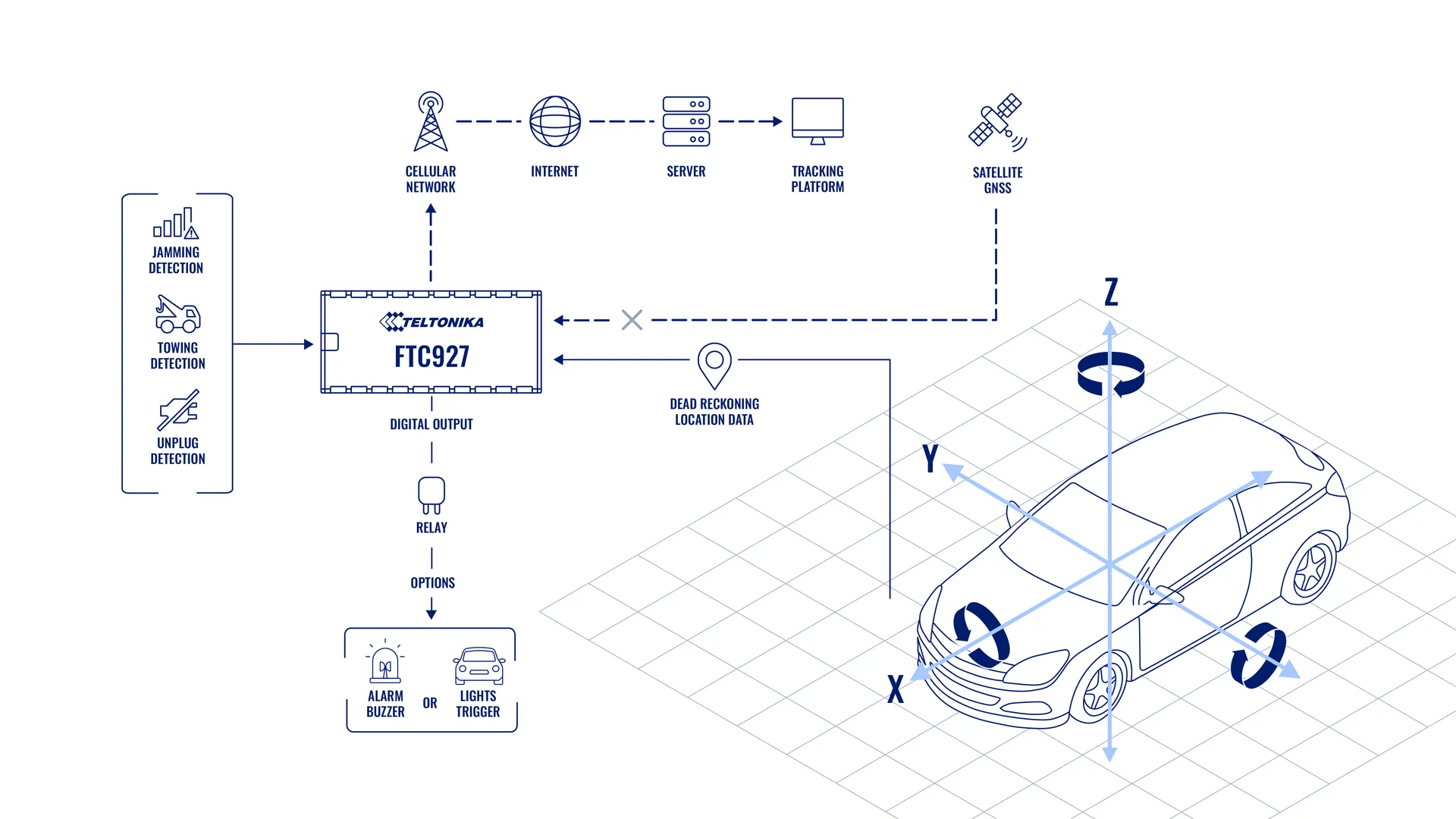
The FTC927 combines satellite navigation with a gyroscope and an accelerometer and keeps working out the vehicle's position where there are no satellites or the signal is jammed.
Installation and setup
Fitting the device and configuring it for the fleet scenario at hand.
Data transfer
The device collects data and sends it to the monitoring platform; how often depends on the model and its settings.
Analysis and control
The person in charge gets reports and alerts and looks into what stands out.
Teltonika builds basic protection into all its devices: detection of jamming, of a power cut and of towing. But in a tunnel or under a jammer those notifications are not enough — the owner knows something has happened but not where the vehicle went. That is why the manufacturer produces trackers with dead reckoning on the FT platform. There are several models; for typical tasks Teltonika recommends one of the most popular, the FTC927.
How it works. The tracker gets position data from two sources. The first is satellites: the FTC927 tracks up to 41 visible satellites at once. The second is the built-in accelerometer and gyroscope. The accelerometer shows how hard the vehicle is accelerating or braking, the gyroscope how the direction changes as it turns or tilts.
While the signal is normal, the coordinates come from the satellites. As soon as the signal is lost — entering a tunnel or an underground car park, dense built-up streets, or a jammer switched on — the tracker moves over to calculating from the motion sensors and carries on plotting the track. When satellites are available again, the position is refined from them, and the cycle repeats. Switching back and forth like this means the vehicle is not lost even on a difficult stretch.
What the operator sees. The calculated points go to the server continuously as long as there is a connection. The recovery service or the telematics provider sees which way the vehicle went after the signal was lost and where it stopped, and can act at once, even if the vehicle is already in a tunnel or an underground garage.
There is active protection as well. Thanks to the flexible pinout, the FTC927 can be wired to actuators and, on a signal, set off a hidden buzzer or an unusual light pattern on the vehicle. It will not stop a professional, but it may slow a theft down and draw attention.
Honestly about the limitations. Dead reckoning is a calculation rather than a measurement, and the error grows with every minute without satellites. For a tunnel or an entry into a car park the accuracy is enough to establish direction and place. If the vehicle is carried a long way on a recovery truck in a fully screened body, the calculation gradually loses accuracy. And one more thing: sending the data needs a mobile network — a powerful jammer that suppresses GSM as well will stop the tracker sending its points while the vehicle is within its reach, and they will come through later from memory.
Command security. The buzzer, the light signal or the immobiliser are triggered only by users given a separate right to send commands in the platform, not by everyone who can see the vehicle on the map. Engine immobilisation is wired so that it takes effect after the vehicle has stopped rather than on the move: a vehicle that cuts out on a main road is dangerous to everyone around it. Every command stays in the log with a time and a user name — which matters when an action is disputed afterwards.
What the tracker will not do. It shows where the vehicle went, but it does not bring it back. Recovery is carried out by the police on the owner's report, and the track data is passed to them on an official request or through the insurer.
What you get
The track does not break off under a jammer
Dead reckoning rebuilds the approximate route from the gyroscope and accelerometer and gives a direction of travel and a search radius.
You can see where the vehicle was hidden
If a stolen vehicle has been driven into a closed garage or warehouse, the track reaches the point of entry and the search has a specific place to start from.
A better chance of getting the vehicle back
Continuous position data speeds up the search and cuts the owner's losses, whether that owner is a company or a private individual.
A hidden buzzer and light signals
The flexible pinout allows alarms to be wired in that help startle a thief and drag the theft out.
The basic functions are there too
Detection of jamming, of a power cut and of towing all fire immediately and give the owner time to react.
Why this solution
Thieves change their methods faster than standard protection systems are updated. A tracker that can only send coordinates from satellites is defeated today by a jammer in a few minutes. Teltonika answers that with the FT platform, where dead reckoning works alongside proven anti-theft functions.
The FTC927 needs no separate modules: the gyroscope and accelerometer are built in and the modes switch automatically. For telematics providers, leasing companies and insurers it is a way to raise the recovery rate without changing monitoring platform.
How this works in Azerbaijan. In Baku this scenario is mostly about the underground car parks of shopping centres and residential complexes, multi-storey car parks and the dense streets of the centre, where the satellite signal is unsteady in any case. Protection of this kind is asked for most often by leasing companies, hire firms and owners of expensive off-roaders, which are popular with thieves. In the fitting it matters where the device goes: the tracker has to be hidden so that it is not found in five minutes, and fixed rigidly, otherwise the gyroscope will read vibration of the housing as movement of the vehicle. After fitting, the sensors are calibrated on a drive. A SIM from any local operator will do for sending the data — Azercell, Bakcell or Nar — but for vehicles that often travel to Georgia or Russia along the M-2 and M-1 a multi-operator card is better. GPS.az fits the FTC927, sets up notifications for jamming, power cuts and towing, and brings the calculated track onto the Wialon platform so that after a theft it is clear where the vehicle went once the signal was lost.
Related case studies
Related rollouts and equipment

Questions about the “Finding stolen vehicles with dead reckoning” scenario
Request a call
A specialist will call back and match a solution to your fleet and your task.