
Monitoring fishing boats with the FMC230
For monitoring small fishing vessels and motorboats Teltonika proposes the waterproof FMC230 tracker with an IP67 housing, LTE Cat 1 connectivity and memory for 422,400 records.
For monitoring small fishing vessels and motorboats Teltonika proposes the waterproof FMC230 tracker with an IP67 housing, LTE Cat 1 connectivity and memory for 422,400 records. Over the past half century world consumption of seafood has more than doubled. Along with it have grown overfishing, bottom trawling, fishing with explosives and other illegal catching. Rules and restrictions for fishermen keep multiplying, but a rule only works when compliance with it can be checked. Large vessels have long been fitted with monitoring systems. The weak point is the small-scale fleet: the small boats and launches that number in the thousands and that still carry almost no trackers. The Teltonika solution is aimed precisely at them: an inexpensive, water-protected tracker that runs off the boat's battery and sends its track over the mobile network.
What this scenario solves
Illegal, unreported and unregulated fishing costs the world economy between 10 and 23 billion dollars a year.
83% of small fishing vessels in the Mediterranean and the Black Sea carry no tracking equipment of any kind.
Three quarters of the fish stocks of those seas are caught beyond a sustainable level.
A smartphone with a chart on board is easily lost or run flat, and monitoring a boat by it is unreliable.
Illegal, unreported and unregulated fishing costs the world economy between 10 and 23 billion dollars a year. 83% of small fishing vessels in the Mediterranean and the Black Sea carry no tracking equipment of any kind. Three quarters of the fish stocks of those seas are caught beyond a sustainable level. A smartphone with a chart on board is easily lost or run flat, and monitoring a boat by it is unreliable.
According to the Food and Agriculture Organization of the United Nations (FAO), trade in and consumption of seafood reached a record in 2018. Illegal, unreported and unregulated fishing — IUU fishing — grew along with it. That is a problem for capture fisheries and for aquaculture alike.
Countries answer it in different ways. The Philippines, under its Fisheries Code, has required vessels to use a vessel monitoring system (VMS) since 2022. In Europe fishing activity is overseen by the European Fisheries Control Agency (EFCA), while individual states adopt sustainable fishing strategies and other measures.
The rules are gradually spreading from large vessels to small ones. A study by the General Fisheries Commission for the Mediterranean for 2020 found that 83% of small fishing vessels in the Mediterranean and the Black Sea had no equipment for fixing their position. Yet there are more than 87,600 such vessels, and their income exceeds 3 billion dollars a year. Three quarters of the stocks of these seas are caught beyond sustainable limits, so bringing the small-scale fleet under control is an urgent task.
In 2018 the European Commission proposed a reform of the EU fisheries control regulation under which a tracking system would be required on all fishing vessels, boats included. At present satellite monitoring is compulsory only for large vessels, while small ones are allowed to carry a mobile device with an electronic chart. That approach has obvious weaknesses: a phone can be lost, it runs flat, and if several people use a boat then all their devices have to be connected. In its study the EU Fisheries Control Coalition calls a fixed tracker the more convenient and straightforward option and expects it to become compulsory for small vessels in time as well.
Finally, control by area. The General Fisheries Commission for the Mediterranean has divided the waters into geographical sub-areas (GSA), which are used for vessel monitoring. In the commission's estimate that system has cut overfishing by more than 10%. The sub-area boundaries have become the key instrument against IUU fishing, which means that the main thing is to know exactly where each boat is.
What Teltonika offers
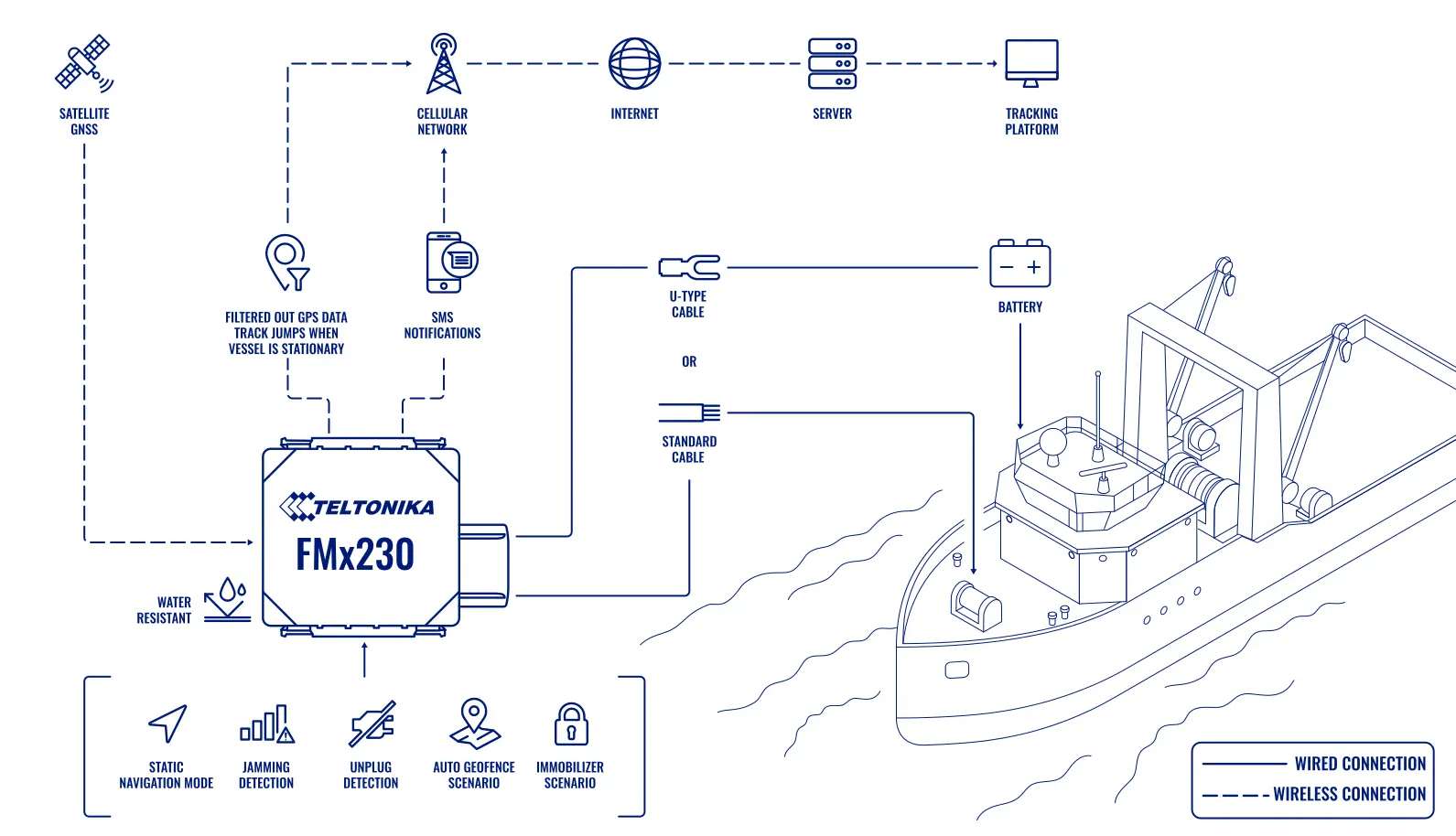
The FMC230 tracker is fitted to the boat, runs off its battery and sends the track to the server over LTE, and where there is no coverage it holds the points in memory and sends them later.
Installation and setup
Fitting the device and configuring it for the fleet scenario at hand.
Data transfer
The device collects data and sends it to the monitoring platform; how often depends on the model and its settings.
Analysis and control
The person in charge gets reports and alerts and looks into what stands out.
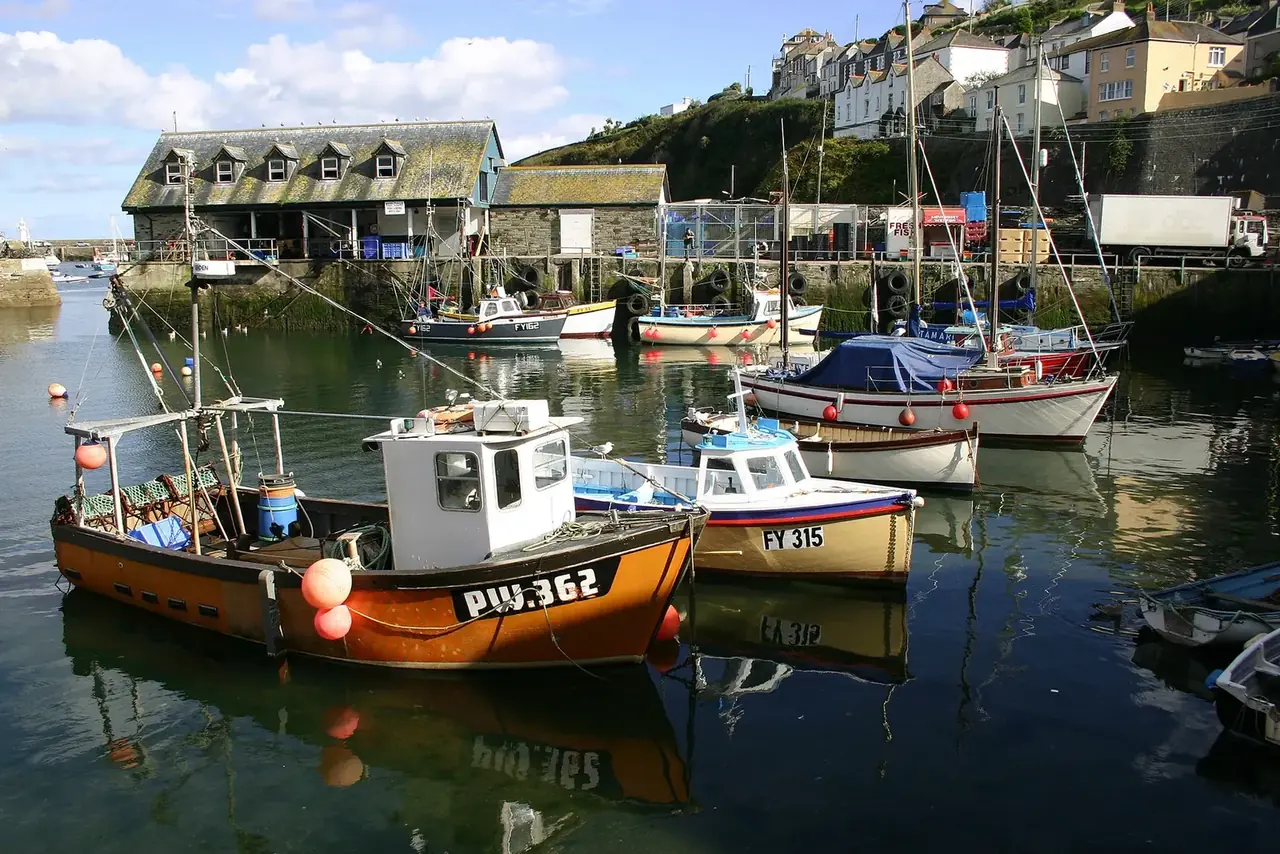
Why LTE. The 2G and 3G networks will be switched off gradually over the coming years, so Teltonika chose the FMC230 — a waterproof tracker with LTE Cat 1 and a 2G fallback. It is a model with an IP67 housing from the FMx2 range, and the manufacturer calls it the preferred option for water transport.
Coverage at sea is the first question fishermen ask. Data from the Mediterranean Posidonia network shows that fishing vessel traces are densest near the coast. A Vodafone study of mobile coverage at sea found that most vessels spend about 60% of their working time inside 4G LTE coverage. LTE Cat 1 gives good coverage and signal penetration with low latency, which matters for a moving object. In ideal conditions LTE Cat 1 is available up to 53 nautical miles from shore, but in practice the range depends on the type, power and height of the shore antennas, on the weather, the terrain and other conditions.
When there is no coverage. The FMC230 holds data in 128 MB of flash memory — up to 422,400 records. When the boat comes back into coverage, the accumulated track goes to the server. For an inspector that means a fishing ground far from shore does not drop out of the history.
Accuracy at rest. The FMC230 has a Static Navigation mode that filters out coordinate jumps when the object is standing still. Without the filter the track of a stationary boat looks like a tangle of lines, and it could wrongly suggest that the vessel entered a prohibited area. With the filter such false IUU fishing alarms become rarer. If the filter is switched off, the tracker sends the coordinates as they are.
The housing. The certified IP67 housing protects the tracker from moisture, from a jet of water from a hose and from brief immersion at a depth of between 15 and 100 cm for up to 30 minutes. The TPE gasket withstands salt water. That matters in the marine industry: corrosion is one of the expensive problems of vessels. Teltonika cites a study by the US Federal Highway Administration (FHWA) putting the cost to the industry at 2.7 billion dollars a year.
Fitting. The housing closes with a two-stage catch and opens without tools, so fitting and servicing take less time. The tracker can be ordered already configured for the project, so that no time is spent on configuration on site and no settings are got wrong.
Power comes from the launch's or the motorboat's battery through a cable. There are two types of cable, standard and U-shaped, both with IP67 protection and both made to order. With them the FMC230 can be fitted anywhere in the cabin or outside it. For a simple installation and basic tracking the manufacturer recommends the U-shaped cable.
Protection against theft. Scenarios for detecting GSM jamming, a power cut, an automatic geofence and an immobiliser make it possible to respond to a threat: sound an alarm, send notifications, block the engine from starting. Outboard motors are a frequent target for thieves, and this function is useful to an owner even with no regulatory requirement at all.
The firmware and configuration of the FMC230 can be updated remotely through FOTA WEB, without taking the tracker off the boat.
What the inspector or the owner sees. On the map, the boat's position, its track for a trip out to sea, the time spent in each fishing ground, and entries into and exits from prohibited zones. Notifications arrive when a defined zone boundary is crossed, when power is cut or when the signal is jammed. From the history of trips it is easy to work out how many hours the boat spent in each area over a season.
An honest limitation. The FMC230 is a cellular tracker. It works well near the coast, where the small-scale fleet spends its time, but it does not replace a satellite monitoring system for vessels that go far out into open water. And if a regulator requires equipment with particular certification for VMS, that has to be established before purchase.
Monitoring is neither navigation nor rescue. The FMC230 sends the track to shore, but it does not replace the navigation instruments on board and it is not an emergency beacon. Life-saving and emergency communication equipment for the boat is needed separately, under the rules for small vessels.
Damp and condensation. IP67 protects against spray and brief immersion, but moisture builds up inside a cabin because of temperature swings. The tracker is fitted so that water does not stand around the housing and so that the cable connector faces downwards.
What you get
It works in the damp and in a swell
The IP67 housing and LTE Cat 1 connectivity allow the FMC230 to be used in fishing, in monsoon regions and in humid subtropical and oceanic climates, and it survives brief immersion.
A housing on catches
The certified housing opens and closes without tools, and the TPE gasket withstands salt water.
No tangled track at rest
The Static Navigation mode filters out coordinate jumps, so drift at anchor does not turn into a false suspicion of illegal fishing.
Nothing is lost without coverage
Up to 422,400 records are held in flash memory and go to the server as soon as the boat is back inside coverage.
The boat and the motor are harder to steal
Jamming and power cut detection, geofences and the immobiliser give the owner time to react.
Ready to fit
Trackers can be ordered already configured, with the cable required, which saves time on large and long-running projects.
Why this solution
A small-scale fleet needs a device that stands up to water and salt, runs off the boat's own electrical system and still costs a sensible amount, so that thousands of vessels can be equipped with it. The FMC230 from the FMx2 series meets those requirements: an IP67 housing on catches with a TPE gasket, LTE Cat 1 with a 2G fallback, plenty of memory for time without coverage, and a static navigation filter for a clean track.
Teltonika has a broad range of certified trackers and accessories, its own research and development and support worldwide. For an integrator running a government or industry-wide project, factory configuration of the devices and remote servicing through FOTA WEB matter: there is no need to visit hundreds of boats with a laptop.
How this works in Azerbaijan. Here this scenario is about the Caspian. Small fishing boats work along the coast from Sumgait and Absheron down to Neftchala and Lankaran, while launches and motorboats are owned by fish farms, pleasure trip operators and private owners. For most such trips out to sea the Azercell, Bakcell and Nar coverage along the shore is enough, and for the time without a network the FMC230 stores the track in memory. For vessels that go far from shore a cellular tracker is not enough — those need satellite communication, and we select that option separately. Points to allow for: the tracker is fitted where constant waves do not reach it and the sun does not heat the housing all day long — in summer on deck near Lankaran it gets extremely hot. The power cable is better run with some slack and protected against chafing. We do not invent the requirements for monitoring fishing vessels in Azerbaijan: if a project involves reporting to government bodies, we agree the data format with the customer in advance. As a Teltonika GOLD partner in Azerbaijan, GPS.az supplies the FMC230, fits it to boats and sets up geofences for fishing grounds, boundary-crossing notifications and reports on trips out to sea on the Wialon platform.
Related case studies
Related rollouts and equipment



Questions about the “Monitoring fishing boats with the FMC230” scenario
Request a call
A specialist will call back and match a solution to your fleet and your task.