
Keeping track of equipment in explosive atmospheres
For oil and gas, chemical and pharmaceutical sites Teltonika proposes EYE Beacon ATEX tags and EYE Sensor ATEX devices: they show where tools and equipment are and are safe to use in zone 1.
For oil and gas, chemical and pharmaceutical sites Teltonika proposes EYE Beacon ATEX tags and EYE Sensor ATEX devices: they show where tools and equipment are and are safe to use in zone 1. At such plants equipment is forever being carried from one area to another: pumps, centrifuges, containers, portable machines, measuring instruments. Losing something on a large site is easy, and the search takes a long time. Meanwhile an ordinary tracker cannot be brought into an explosive atmosphere at all — every device there has to carry a certificate confirming that it will not become a source of sparks. The Teltonika solution is built on Bluetooth tags certified to ATEX Zone 1. They are attached to equipment and show which room it is in, how long it has been there and when it is due for servicing.
What this scenario solves
In an explosive atmosphere electronics cannot be used without explosion protection certification.
On a large site portable equipment goes missing and is hunted for hours.
Deadlines in these processes are tight, and every hour of searching brings work to a halt.
Servicing by the calendar takes no account of how much the equipment has actually worked.
In an explosive atmosphere electronics cannot be used without explosion protection certification. On a large site portable equipment goes missing and is hunted for hours. Deadlines in these processes are tight, and every hour of searching brings work to a halt. Servicing by the calendar takes no account of how much the equipment has actually worked.
Oil and gas and chemicals are vast industries, and they share one feature: the risk of explosion and ignition. Any device used near flammable gases, vapours or dust has to meet strict safety requirements and must not endanger the environment it works in. Consumer tags and ordinary trackers are therefore out of the question here.
The second problem is time. Many process operations run to a schedule, and if the pump or the instrument that is needed is not found in time, the whole operation falls apart. On large chemical, oil and gas sites equipment moves from area to area constantly, it is left where it should not be, and specialists' working hours go into the search.
Industrial safety rules require strict records of equipment, especially equipment whose failure is itself dangerous. And expensive equipment on remote or poorly guarded areas also disappears — it gets stolen or taken to the wrong place.
Finally, servicing. If tools are serviced by the calendar, some units are repaired far too early and others far too late. What is needed is a record of how much the equipment was actually used and where it was, so that servicing can be planned around the real load.
What Teltonika offers
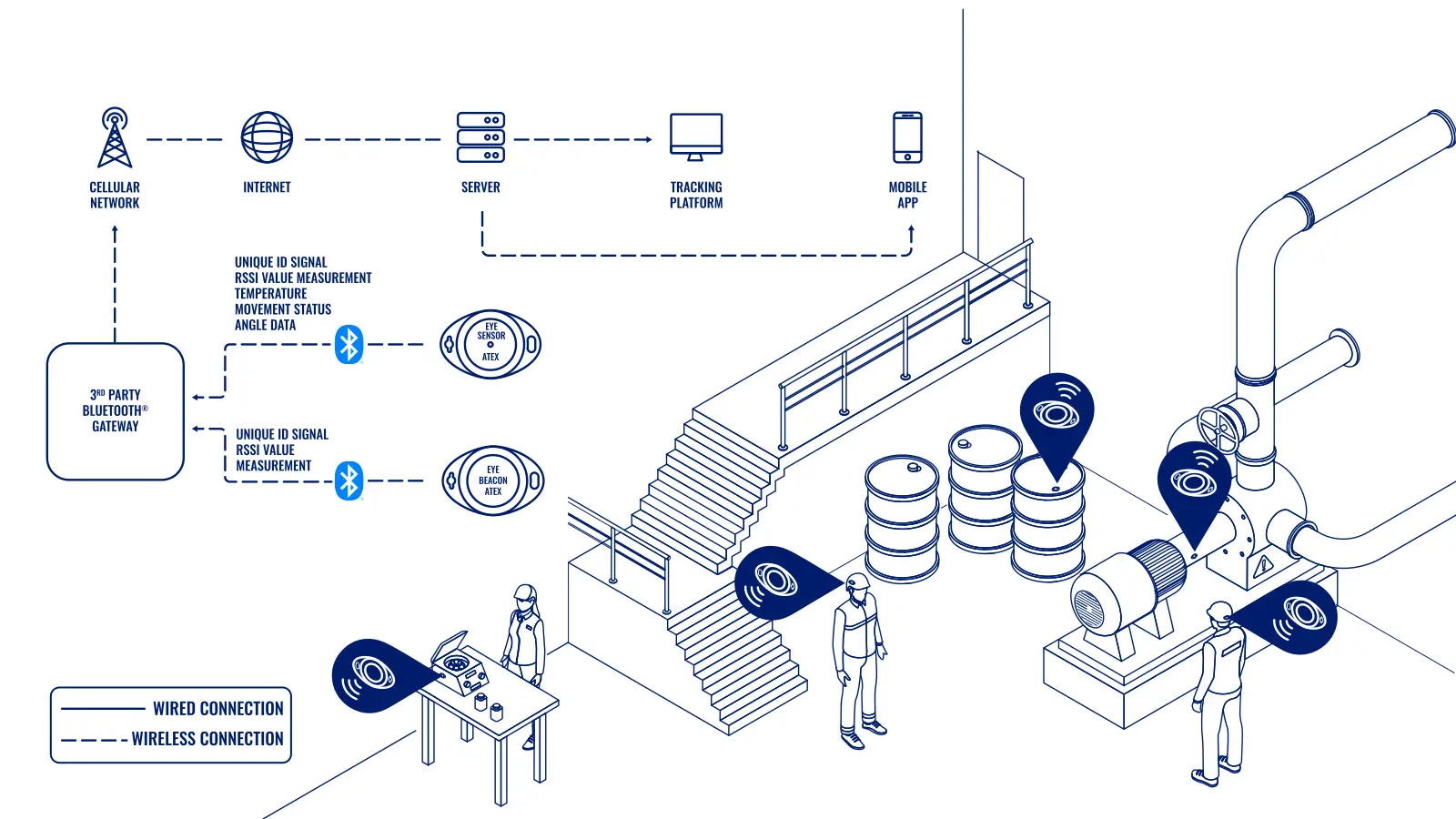
EYE Beacon ATEX tags and EYE Sensor ATEX devices are attached to equipment, gateways around the site pick up their signal and work out which room each item is in.
Installation and setup
Fitting the device and configuring it for the fleet scenario at hand.
Data transfer
The device collects data and sends it to the monitoring platform; how often depends on the model and its settings.
Analysis and control
The person in charge gets reports and alerts and looks into what stands out.

Both devices are ATEX certified for zone 1, that is for places where an explosive atmosphere may occur in normal operation. That makes it possible to keep track of equipment and staff where ordinary electronics are forbidden, without any risk of becoming a source of ignition.
How it works. An EYE tag is attached to the item in question: a tool, a machine, a container, a pump, a centrifuge. Gateways are placed around the site and scan the air continuously. Smartphones with third-party software can be used instead of gateways. From the received signal strength (RSSI) the gateway or the smartphone works out which tag is nearby, and so shows the location of the item to within a room.
Finding the pump you need becomes a matter of a minute: the platform shows which room it was last in. The platform can also send notifications of its own — if somebody has entered a hazardous area, for instance, or moved equipment to where it should not be. That helps against theft and against misuse alike.
The service plan is built from data. With an EYE Beacon, use is judged from the item's presence in a particular place: if the pump is standing in a working area, it is taken to be working. An EYE Sensor gives more — it records movement. If a tool has not moved for a long time it can be counted as idle, and the time it really worked can be added up. When the running total reaches a threshold, the platform sends a notification that servicing is due.
In an explosive atmosphere that matters especially: equipment failure there can turn into an accident. The data gathered can be analysed to look for patterns that point to risk — equipment that ends up too often in an area where it has no business being, for example.
What has to be allowed for. The solution gives accuracy to within a room, not to within a metre. The tags are certified for zone 1, but the gateways and smartphones that read them also have to meet the requirements of the zone they stand in — or else they are placed outside it, at the boundaries between areas and in passageways. That is worth thinking through before purchase, together with the plant's industrial safety department.
Marking and the scope of the certificate. An ATEX certificate applies to a specific model and states which zones, gas groups and temperature classes it is approved for. Before purchase the industrial safety department compares the marking on the device and the certificate data with the zone classification of its own site. If a zone on the site is stricter than the certificate states, the tag does not go there.
Fitting and acceptance. Tags are attached without breaking into the equipment housing, and gateways are placed either in a version rated for the zone or outside its boundary. Acceptance is conveniently run through a simple list: every tag is bound to its own item in the platform, when an item is moved between rooms the system shows the change of zone, and notifications about forbidden zones reach the person responsible.
What you get
Safe for an explosive atmosphere
ATEX Zone 1 certification allows EYE Beacon ATEX and EYE Sensor ATEX to be used where ordinary tags are forbidden.
Equipment is found in minutes
A location accurate to the room saves walking the whole site and helps stop tools being left anywhere at all.
Fewer losses
Notifications about a move to the wrong place or a removal from the area help spot a theft or a mistake in time.
Servicing by real running time
Records of presence and movement show how much the equipment worked, and the platform gives a reminder at the right moment.
Decisions on data
The history of use helps you see which equipment is in short supply, which stands idle, and what is worth buying.
Why this solution
EYE tags are among the most compact Bluetooth devices Teltonika makes, and the ATEX version keeps their main strengths: small size, simple fitting and a battery that lasts up to 10 years. The housing is protected to IP67, and the omnidirectional antenna works steadily whichever way the tag sits on the equipment.
For the customer that means a tag is fitted once and needs no attention for years. No wiring, no battery changes every quarter, and no repeated approvals for work in an explosive atmosphere.
Teltonika works with partners in more than 160 countries and has been awarded an EcoVadis silver medal for sustainability — for large oil, gas and chemical companies that vet their suppliers on ESG, that is an argument too.
How this works in Azerbaijan. The main market for this solution here is the oil and gas sector on Absheron: onshore terminals, the bases of service contractors in the Garadagh district and around Baku, and repair workshops where equipment is prepared for offshore platforms. The second direction is the chemical and petrochemical plants in Sumgait. At such sites portable pumps, gas analysers, welding stations and tool containers move between areas constantly, and there may be several contractors at once. Points to allow for: explosion protection requirements are set by the industrial safety department of the particular plant, and many operators on Absheron work to international standards, so we begin with which zones the tags will be in and where the gateways can go. The second common mistake is trying to get accuracy to the metre when the task is solved by identifying the room. GPS.az selects the tags and gateways, helps with the layout plan and sets up the Wialon platform to show equipment by zone, with notifications about movement and running-time reports for planning servicing.
Related case studies
Related rollouts and equipment
Questions about the “Keeping track of equipment in explosive atmospheres” scenario
Request a call
A specialist will call back and match a solution to your fleet and your task.